
Who
Dr. Shan Jiang's research group in the Department of Materials Science and Engineering at Iowa State University, Ames, Iowa, USA. The group works on surface, interface and coating materials, including waterborne antimicrobial coatings.



Gurdeep Singh Saini
COO at Droplet Lab
Holds a BASc in Mechanical Engineering from Ryerson University (now Toronto Metropolitan University) and an MASc from York University. He develops the automatic edge and baseline detection behind the Dropometer's analysis.
Who
Dr. Shan Jiang's research group in the Department of Materials Science and Engineering at Iowa State University, Ames, Iowa, USA. The group works on surface, interface and coating materials, including waterborne antimicrobial coatings.
Problem
The group needed wetting measurements on its own coated samples, many of them small pieces of coated fabric, tested with water and with oils. The only contact angle instrument available was an older shared instrument in the department.
Lösung
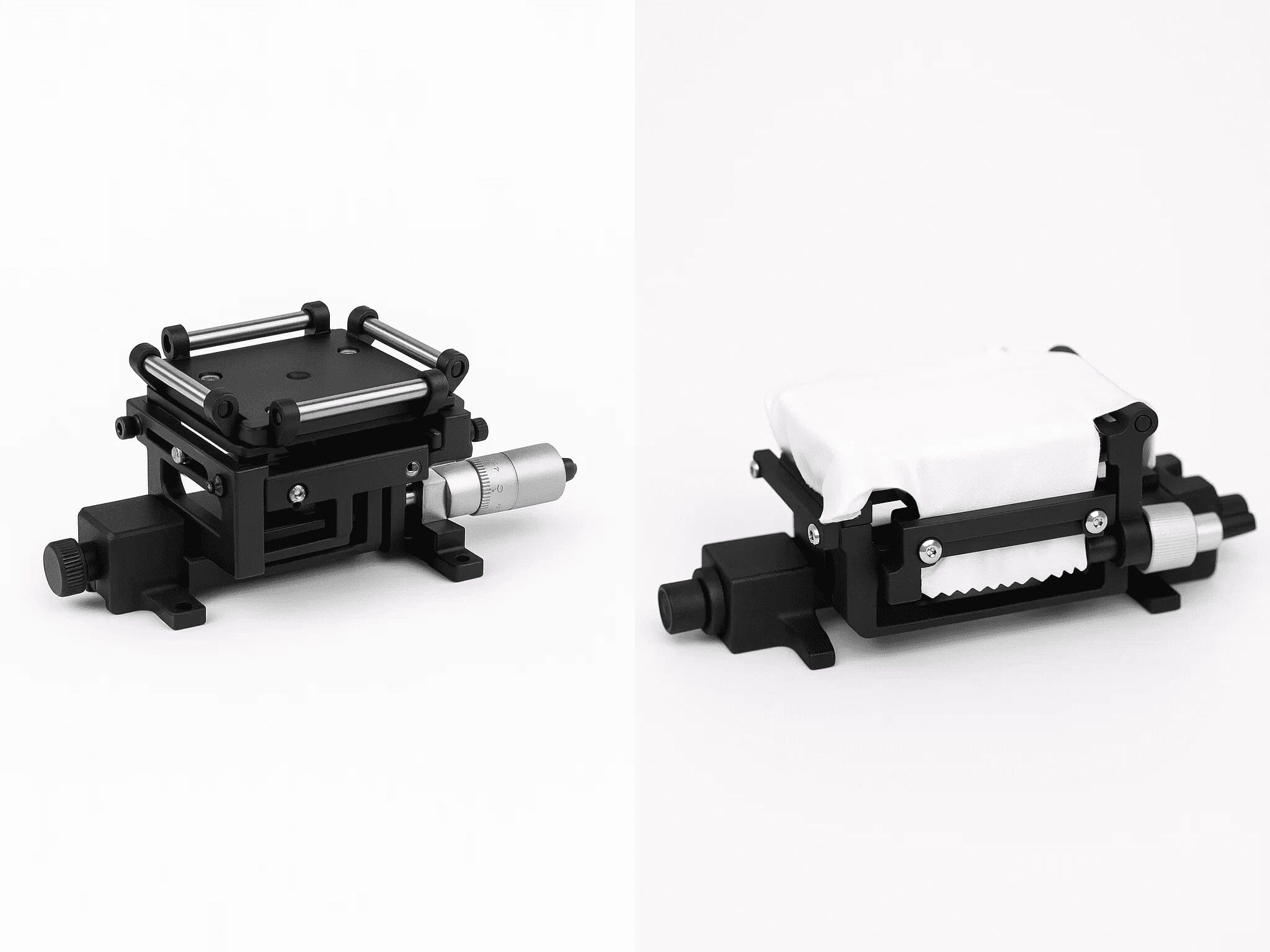
A Dropometer with the automatic dropper, a motorised tilting stage for roll off measurements and a fabric holder, bought directly from Droplet Lab after the group met the team at the ASEE annual conference in June 2025, with remote training for the group's researchers.
Time to Value
23 June 2025: met at the ASEE annual conference. August 2025: university IT review of the software. 8 September 2025: purchase orders issued. 9 October 2025: instrument delivered, with remote training on 10 and 15 October. 11 November 2025: group confirmed the full setup works. 17 June 2026: paper published online.
Results
The instrument has been in the group's lab since October 2025. Researchers measure contact angle on small coated fabric samples, using the supplied fabric holder and holders they 3D printed for their own sample sizes, and roll off on the tilting stage. The group's 2026 paper on rechargeable antimicrobial coatings in ACS Applied Materials & Interfaces used the Dropometer.
Research focus
Surface, interface and coating materials, including waterborne antimicrobial coatings.
Products / applications
Functional coatings on fabrics and other surfaces.
Measurement stage
Laboratory research on coated samples.
Users
A PhD candidate runs the instrument day to day, with other researchers in the group.
Materials and surfaces tested
Small coated fabric samples, tested with water and with oils.
Key constraints
Soft, porous samples that must be held flat; several test liquids; a research budget.
A coating that repels or kills microbes is only as good as its surface, and fabric is a hard surface to measure.
Why coatings need wetting data
Why fabric is hard to measure
Why the group wanted its own instrument
What success would require
What Was Deployed
Dr. Shan Jiang met the Droplet Lab team at the ASEE annual conference on 23 June 2025. The request was a quote for the research group in Materials Science and Engineering, with the automatic dropper, the tilting stage and a fabric holder.
The software went through the university's IT review in August. The purchase orders followed on 8 September, and the instrument reached the lab in Ames on 9 October 2025. Droplet Lab trained the group's researchers in remote sessions on 10 and 15 October and 7 November.
In the first weeks Droplet Lab took back and adjusted the automatic dropper and tilting stage, and returned them in early November. When the tilting stage needed attention again in May 2026, it was fixed on a video call with Droplet Lab's engineers.
Timeline (high level)
June 2025: First contact
Met the Droplet Lab team at the ASEE annual conference (23 June)
August to September 2025: Purchase
October 2025: Delivered and trained
November 2025: Adjusted
May 2026: Support call
Tilting stage fixed on a video call with Droplet Lab engineers (8 May)
June 2026: Published
Antimicrobial coatings paper published online in ACS Applied Materials & Interfaces (17 June 2026, July 2026 issue)
Test method
Contact angle on coated samples with the Dropometer (Droplet Lab, Canada), in the group's own lab, plus roll off on the motorised tilting stage. The measurement conditions used in the 2026 paper are not yet reported on this page.
Sample size and operators
Measurements by researchers in the group, trained remotely by Droplet Lab in October and November 2025.
Repeatability / reproducibility
Not yet reported.
Notes / assumptions
Source: R. Ortega, Z. Yang, S. Demirci, T. A. Twedt, U. K. Dey, F. Liu, T. S. M. Rawah, N. Resende De Macedo, J. C. Mora Diaz, L. G. Gimenez Lirola, S. Jiang, 'Core Shell Nanoparticle Additive Enables High Efficacy Antimicrobial Coatings', ACS Applied Materials & Interfaces 18 (2026) 35959 to 35969, doi:10.1021/acsami.6c05097. The abstract reports a core shell particle that cuts the amount of costly hydantoin acrylamide monomer by about 65% while keeping antimicrobial performance, in waterborne coatings that can be recharged with dilute bleach.
Measured Outcomes
2026
Published
Rechargeable antimicrobial coatings paper that used the Dropometer (Ortega et al., ACS Applied Materials & Interfaces 18 (2026) 35959 to 35969).
3D printed
Custom sample holders
The group 3D printed its own holders to fit its fabric sample sizes, alongside the supplied fabric holder.
Water and oils
Test liquids
With the liquid density set in the app for each oil.
Operational Outcomes
In house
Wetting measured in the group's own lab instead of on a shared departmental instrument.
One instrument
Contact angle and roll off on the same portable instrument.
Supported
Remote training and fixes from Droplet Lab's engineers by video call.
I spoke with my group about their experience using the setup. They appreciate the software and the compact design.Dr. Shan Jiang - Assistant Professor, Materials Science and Engineering, Iowa State University
October 2025
Delivered