
Inhalt
Case Study

Its catheters are under 2 mm across. Before buying, this medical device maker watched a live water contact angle demo on a mandrel from its own lab.

Last Updated
October 18, 2026
Industrie
Medical device manufacturing
Location
United States
Anwendung
Catheter surface check before coating
Customer since
2025
Units
2
Second unit ordered within seven months Drop shape method validated against a KRÜSS DSA100E in peer review Published contact angle accuracy of 0.35°

A US medical device manufacturer wanted to measure surface energy on its catheters, to make sure the surface was clean before coating. The parts are small and curved, so the engineers first asked whether a drop could be measured on them at all. They sent a drop image from a catheter and a mandrel about 1 mm across from their own lab. After a live demo in March 2025 they ordered a Dropometer, and a second unit followed in October 2025.

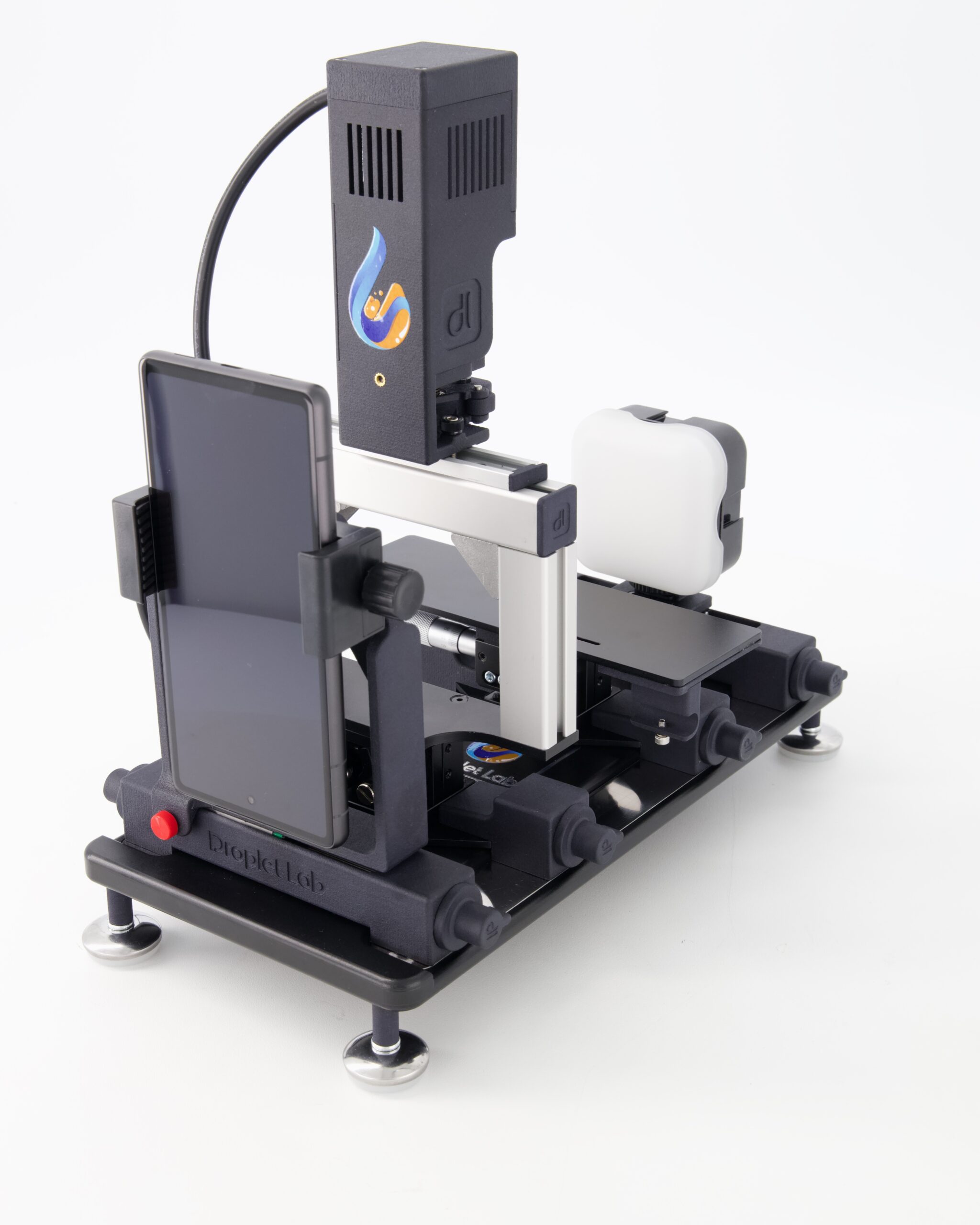
Standard Dropometer with automatic dropper (product photo; not the client's catheter setup)
Abhimanyu Foto
Geschrieben von
Abhimanyu Bhandankar
Holds an MBA from Schulich School of Business and a BE in IT. He joined Droplet Lab in July 2019 and now leads sales and marketing.
CEO at Droplet Lab
Weiterlesen
Gurdeep-Saini-Photo
Technical Review by
Gurdeep Singh Saini
Holds a BASc in Mechanical Engineering from Ryerson University (now Toronto Metropolitan University) and an MASc from York University. He develops the automatic edge and baseline detection behind the Dropometer's analysis.
COO at Droplet Lab
Weiterlesen
Abhimanyu Foto
Written By

Abhimanyu Bhandankar

CEO at Droplet Lab

Holds an MBA from Schulich School of Business and a BE in IT. He joined Droplet Lab in July 2019 and now leads sales and marketing.

Gurdeep-Saini-Photo
Bewertet von

Gurdeep Singh Saini

COO at Droplet Lab

Holds a BASc in Mechanical Engineering from Ryerson University (now Toronto Metropolitan University) and an MASc from York University. He develops the automatic edge and baseline detection behind the Dropometer's analysis.

Executive Summary

Who

A US medical device manufacturer that makes catheters. The evaluation was led by its manufacturing engineers, starting in February 2025. The company bought its first Dropometer in March 2025 and a second one in October 2025.

Problem

The engineers wanted to measure surface energy on their catheters, to make sure the surface was clean before coating. The catheters are small diameter, curved parts, under 2 mm across. Before buying, the team asked whether Droplet Lab had done this before and how a drop could be tested on such a part.

Lösung

A Dropometer for water contact angle, bought through a US distribution partner after a live demo on a mandrel about 1 mm across that the team sent from its own lab. Droplet Lab shared the sample stage design file for a fixture the team planned to make, and added the surface tension and surface energy apps to the first unit.

Time to Value

8 Feb 2025: first enquiry. 12 Feb 2025: discovery call. 13 Feb 2025: the team sent a drop image from one of its catheters. 7 Mar 2025: live demo on the team's mandrel. 14 Mar 2025: decision to buy, starting with water contact angle. 30 Apr 2025: first unit with the team. 23 Oct 2025: second unit ordered. November 2025: second unit delivered.

Results

The demo answered the team's first question: a water drop could be measured on a cylinder about 1 mm across. The company ordered its first Dropometer in March 2025 and a second one in October 2025, seven months later. The company has not shared measurement results, so none are reported on this page.

Highlights

2

Dropometers bought

7 months

First order to second order

About 1 mm

Demo mandrel diameter

Under 2 mm

Catheter diameters discussed

The manufacturer, at a glance

Firma

US medical device manufacturer.

Products / applications

Catheters, with a coating applied during manufacture.

Measurement stage

Surface check before coating, to confirm a clean surface.

Users

Manufacturing engineers.

Materials and surfaces tested

Catheters under 2 mm in diameter. A stainless steel mandrel about 1 mm across for the demo. Test liquid: water.

Key constraints

Small diameter, curved parts that must sit above the stage under the needle; purchase through a US distribution partner.

The challenge: a clean surface check on a small, curved part

The coating needs a clean surface underneath, and a catheter is a hard place to put a drop.

Why the surface must be clean before coating

The engineers described their goal as measuring surface energy on their catheters, to make sure the surface is clean before the coating goes on. Residue left on a surface changes how a water drop sits on it, which is why sample preparation and contamination control matter for any wetting check. Our medical device guide covers where these checks fit in device manufacturing.

Why water contact angle

A clean, high energy surface lets a water drop spread, while a contaminated one makes it bead up. That is the idea behind wettability, and it is why a treated versus untreated contact angle comparison is a common first experiment. The team asked for water contact angle and surface energy.

Why catheters are hard to measure

The catheters the engineers described were under 2 mm in diameter, and they called them a small diameter, curved surface. The part has to be held above the stage, in line with the camera and under the needle. Academic groups have published water contact angles on coated catheter sections, for example in this study of GO PEI coatings on silicone catheter sections, but the team wanted to see it work at its own size.

The insight: show the measurement on a part of the same size before the purchase order

What Was Deployed

Delivered configuration: a Dropometer portable contact angle and surface tension kit for water contact angle. The surface tension and surface energy apps were added to the first unit. The second unit, ordered in October 2025, was set up for contact angle. For surface energy, the team asked whether the polar and non polar parts need two drops, one of water and one of diiodomethane. Droplet Lab pointed it to the Fowkes method, the two liquid approach described in SEMI/ASTM D7490-13, which the Dropometer supports. The team planned to make its own fixture to hold the catheter under the needle. Droplet Lab sent the sample stage design file and answered its questions on stage height, mounting holes and where to place the catheter.
The Origin

From a website example to a demo on a mandrel from the team's own lab

In February 2025 a manufacturing engineer at the company asked Droplet Lab for a quote. The engineer wrote that the team wanted to measure surface energy on its catheters, to make sure the surface was clean before coating. The engineer had found a medical device example on Droplet Lab's website and wrote that it sounded very similar to what the team was doing. On a discovery call on 12 February, the engineers agreed to send a photo of a water drop on one of their catheters for analysis. Droplet Lab agreed to set up a demonstration on a needle or another cylinder of similar size. The wider use case is covered on our page about catheter and medical device coating checks. The needles ordered for the demo were delayed by the supplier, so the team overnighted a stainless steel mandrel about 1 mm across from its own lab. Droplet Lab ran the live demo on 7 March 2025. One week later the team decided to buy, starting with water contact angle, and the order came through a US distribution partner on 20 March.

Before vs After

Metric Before After
Feasibility on a small part Open question whether a drop could be measured on a small diameter, curved catheter Water drop measured live on a stainless steel mandrel about 1 mm across, sent from the team's own lab
Evidence before buying A drop image from one of the team's catheters, sent for analysis Live demo on 7 March 2025, then a decision to buy one week later
Holding the part Catheter to sit above the stage, under the needle Sample stage design file plus answers on stage height and mounting holes, for a fixture the team planned to make
Messungen Water contact angle and surface energy of interest Water contact angle bought; surface tension and surface energy apps added to the first unit
Dropometers in the company None Two, ordered seven months apart

Rollout timeline

Timeline (high level)

8 to 13 Feb 2025: Enquiry and discovery call

  • Quote request from a manufacturing engineer
  • Discovery call with two engineers on 12 February
  • Team sends a photo of a water drop on one of its catheters

27 Feb to 8 Mar 2025: Demo on the team's mandrel

  • Demo needles delayed by the supplier
  • Team overnights a stainless steel mandrel about 1 mm across
  • Live demo on 7 March; videos of the measurement process sent the next day

13 to 20 Mar 2025: Questions and order

  • Surface tension and surface energy questions answered, including the Fowkes method
  • Decision to buy with water contact angle on 14 March
  • Sample stage design file and fixture answers sent on 17 and 19 March
  • Order placed through a US distribution partner on 20 March

April to June 2025: First unit

  • First unit with the team at the end of April, with the surface tension and surface energy apps added
  • A stage bracket and a light switch nut needed replacing after delivery
  • Replacement parts shipped in late May

October to November 2025: Second unit

  • Second Dropometer ordered on 23 October, for contact angle
  • Delivered in November 2025

Proof and validation: what this case shows, and what it does not

Test method

Water contact angle on catheters before coating, as the engineers described their goal. Before purchase, Droplet Lab measured a water drop live on a stainless steel mandrel about 1 mm across, supplied by the team.

Sample size and operators

Number of parts and operators: not disclosed. Feasibility was shown before purchase in a live demo on a mandrel from the team's own lab.

Repeatability / reproducibility

Not disclosed. The company has not shared measurement data. The Dropometer's drop shape method is validated against a KRÜSS DSA100E in peer review, with a published contact angle accuracy of 0.35°.

Notes / assumptions

This page describes how the company evaluated, bought and deployed the Dropometer. It does not report the company's measurement results, acceptance limits or which cleaning method it chose.

Outcomes to date

Measured Outcomes

2

Dropometers

A second unit ordered seven months after the first.

About 1 mm

Demo mandrel

A water drop was measured live on a stainless steel mandrel from the team's own lab before purchase.

Under 2 mm

Catheter diameters

The catheter sizes the engineers described when they asked whether a drop could be measured on their parts.

Operational Outcomes

Decision before purchase

Feasibility shown on a cylinder of the same size, sent by the team, before the order.

Own fixture

Sample stage design file and fixture answers for a holder the team planned to make.

Room to grow

Surface tension and surface energy available as apps on the same instrument.

Financial Context

Bought through a US partner, one function first

Prices, savings and payback are not disclosed. The company bought both units through a US distribution partner and started with water contact angle, with surface tension and surface energy available as apps on the same instrument.

Purchase · 2 units

First in March 2025, second in October 2025.

Channel · US partner

Bought through a US distribution partner.

Scope · one function first

Water contact angle, with more apps available.

Cost savings and payback: not disclosed. Instrument pricing is available on request.

In the client's words

[We want] to measure surface energy on our catheters to ensure that we have a good clean surface prior to coating application.
Manufacturing engineer - US medical device manufacturer

Describing the need, February 2025

What's next

Delivered

First Dropometer with contact angle, surface tension and surface energy apps (April 2025)
Second Dropometer for water contact angle (November 2025)
Sample stage design file shared for the team's own catheter fixture (March 2025)

Frequently asked questions

Can you measure contact angle on a catheter under 2 mm across?

The team tested it before buying. In a live demo on 7 March 2025, a water drop was measured on a stainless steel mandrel about 1 mm across, sent from the team's own lab. The team then planned its own fixture to hold catheters under the needle, using the sample stage design file Droplet Lab shared.

Why check water contact angle before coating?

A clean, high energy surface lets a water drop spread, while a contaminated one makes it bead up. The engineers wanted to confirm a clean surface before the coating goes on.

How is surface energy measured with two liquids?

Surface energy uses contact angles of two or more liquids, such as water and diiodomethane. Droplet Lab pointed the team to the Fowkes method, the two liquid approach described in SEMI/ASTM D7490-13, which the Dropometer supports.

Next Step

Need to measure wetting on a part that is thin, curved or small?

Send us a drop image from your part, or a sample of the same size, and we will show you the measurement on a live call before you buy. The Dropometer is a 1 kg portable kit with an open sample stage, and its drop shape method is validated against a KRÜSS DSA100E in peer review.