



Inhalt
Case Study

Our first instrument for this team had faults we took years to fix. The team called the redesigned unit's build quality and ease of assembly quite impressive.

Last Updated
October 18, 2026
Industrie
Adhesives and materials R&D
Firma
Fortune 500 materials science company
Location
United States
Customer since
2020
Drop shape method validated against a KRÜSS DSA100E in peer review Two peer reviewed validation papers on the method Instrument replaced with a redesigned unit when repairs did not hold

An adhesives and materials research team at a Fortune 500 materials science company bought a Dropometer in 2020 for contact angle and surface free energy. The automatic dispenser on that unit gave years of trouble, and the team worked around it by hand. In December 2024 Droplet Lab replaced it with a redesigned instrument. In February 2025 the team called its build quality and ease of assembly quite impressive.

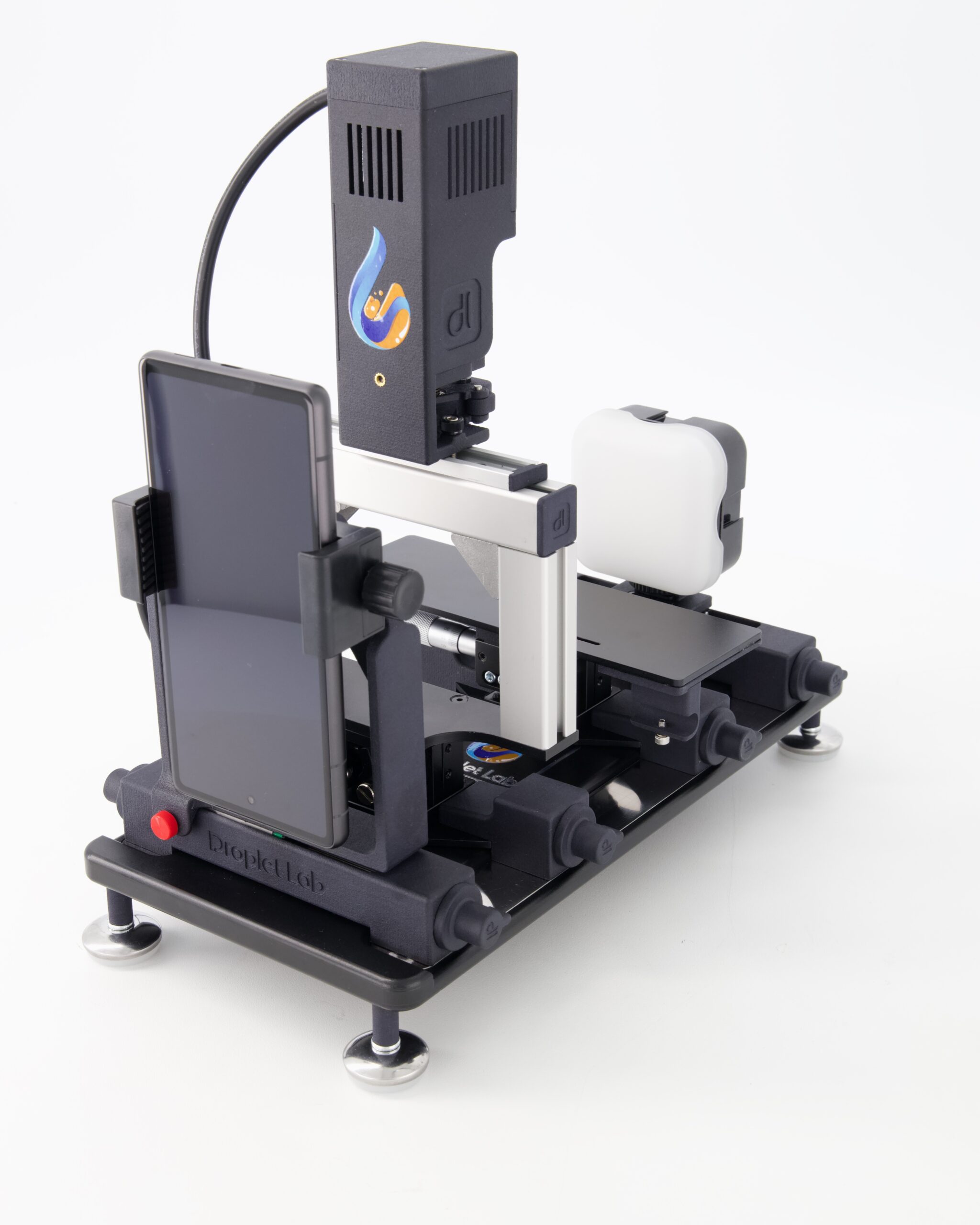
Product photo: a Droplet Lab Dropometer with the automatic dropper. Not a photo of the client's lab.
Abhimanyu Foto
Geschrieben von
Abhimanyu Bhandankar
Holds an MBA from Schulich School of Business and a BE in IT. He joined Droplet Lab in July 2019 and now leads sales and marketing.
CEO at Droplet Lab
Weiterlesen
Gurdeep-Saini-Photo
Technical Review by
Gurdeep Singh Saini
Holds a BASc in Mechanical Engineering from Ryerson University (now Toronto Metropolitan University) and an MASc from York University. He develops the automatic edge and baseline detection behind the Dropometer's analysis.
COO at Droplet Lab
Weiterlesen
Abhimanyu Foto
Written By

Abhimanyu Bhandankar

CEO at Droplet Lab

Holds an MBA from Schulich School of Business and a BE in IT. He joined Droplet Lab in July 2019 and now leads sales and marketing.

Gurdeep-Saini-Photo
Bewertet von

Gurdeep Singh Saini

COO at Droplet Lab

Holds a BASc in Mechanical Engineering from Ryerson University (now Toronto Metropolitan University) and an MASc from York University. He develops the automatic edge and baseline detection behind the Dropometer's analysis.

Primary outcome: a redesigned instrument the team trusts, and a second user working on their own

Automatic dispenser, first unit against redesigned unit

From the team's support emails of March 2023 and February 2025

First unit, March 2023 Not working; drops placed by hand
Redesigned unit, February 2025 Working after one support call

On the first instrument the automatic dispenser failed often enough that by March 2023 the team placed every drop by hand. The redesigned instrument arrived in December 2024 with new electronics. One support call on 18 February 2025 fixed the Bluetooth link between the phone and the dispenser. By May 2025 a second user was trained and working alone, using manual dispensing for sessile drop contact angle at zero tilt.

2 users

A second user trained by May 2025 and working alone.

4 measurements

Contact angle, surface energy, surface tension and sliding angle.

1 call

One support call fixed the dispenser connection step and covered every module.

Dec 2024

Redesigned instrument delivered, replacing the 2020 unit.

Executive Summary

Who

An adhesives and materials research team at a Fortune 500 materials science company, working at a US research site. The team develops adhesives and studies how they interact with substrates.

Problem

The team wanted static and dynamic contact angle and surface free energy on solids, alongside the balance it already used for liquids. Its first Dropometer, delivered in 2020, had repeated faults with the automatic dispenser and with finding drop edges, and repairs and promised fixes did not hold.

Lösung

Droplet Lab redesigned the instrument's electronics and dispenser and replaced the team's unit in December 2024. One support call in February 2025 resolved the setup step that had stopped the dispenser connecting, and walked the team through every module.

Time to Value

August 2019: first contact. January 2020: purchase order. June 2020: first instrument in use. 2020 to 2023: dispenser and edge detection problems. December 2024: redesigned instrument delivered. February 2025: support call and routine use. May 2025: second user trained.

Results

In February 2025 the team called the redesigned unit's build quality and ease of assembly quite impressive. One support call fixed the dispenser link. By May 2025 a second user had been trained and was comfortable using the instrument alone.

Highlights

Dec 2024

Redesigned instrument delivered

Feb 2025

Support call, routine use

2

Trained users

4

Messungen

“The overall build quality, modularity of the setup, and ease of putting it all together is quite impressive.”

The client, at a glance

Research focus

Adhesives and materials, including how adhesives interact with substrates.

Products / applications

Adhesive development, with contact angle and surface free energy on solids.

Measurement stage

Research and development.

Users

Research associates at the site; two trained users on the current instrument.

Materials and surfaces tested

Not shared by the client.

Key constraints

A busy research team with little time for instrument troubleshooting, and an existing Wilhelmy balance for liquids.

The challenge: a first instrument that did not hold up

We are telling this part plainly, because it is why the team's later verdict matters.

What the team needed

Static and dynamic contact angle and surface free energy on solids, with sliding angle as a third priority. The team already measured liquid surface tension on a Wilhelmy balance, so the Dropometer was bought mainly for solids. Surface free energy is the number behind the work of adhesion between an adhesive and its substrate. Our guide to surface energy measurement explains the method, and the surface free energy calculator turns contact angles into a value.

A hard start

The first instrument was damaged in transit in 2020 and returned. Its replacement was delayed by the pandemic and arrived with a loose screw, exposed wires and a bent needle, and without the assembly instructions the team needed.

Faults that repairs did not fix

From mid 2020 the automatic dispenser often failed to draw or place drops, and the software often could not find the drop edges. Droplet Lab sent parts, a new syringe and a manual syringe holder, and missed two promised dates for a new dispenser. The team kept working by filling and placing drops by hand. Hand dispensing works, but it adds a step where operators can differ. That step matters for reproducible contact angle measurement, which depends on placing each drop the same way.

What success would require

An instrument the team could rely on without support, with automatic dispensing that works, and analysis it could trust for contact angle and surface energy. For adhesives work, that means checking a surface before it is bonded, as in our use case on how to prevent adhesive failure before bonding. Bond strength itself is still confirmed with tests such as the ASTM D3359 tape adhesion test. A simple way to see the effect is Experiment 4, contact angle on treated and untreated surfaces.

The insight: when repairs do not hold, replace the design, not the part

What Was Deployed

A redesigned automatic Dropometer contact angle and surface tension kit with new electronics and dispenser, delivered in December 2024 to replace the team's 2020 unit. It carries the four measurements the team bought: contact angle, surface energy, surface tension and sliding angle. It has manual and automatic dispensing and a tilting stage. The team assembled it from Droplet Lab's written guide. On 18 February 2025, one support call with Droplet Lab's engineer fixed the Bluetooth link to the dispenser. The same call walked the team through the other features. Results can be checked against our reference values for the surface free energy of common polymers and substrates.
The Origin

“I want the instrument as much as you want to sell it to us!”

In August 2019 Droplet Lab wrote to the team about its instrument for surface tension and contact angle. The site's adhesives technical lead replied in September that he had already recommended buying it: “I want the instrument as much as you want to sell it to us!” The team's priorities were clear from the start: static and dynamic contact angle and surface free energy on solids first, sliding angle third. It already had a balance for liquid surface tension. After an online demo in September 2019, the purchase order followed in January 2020 for an automatic Dropometer with all four measurements. Teams with the same question can read why contact angle matters for coatings and adhesives QC. They can compare options in our guide to the best surface energy analyzer for production QC. More adhesive and label applications are in our packaging and containers guide.

Before vs After

Metric Before After
Drop dispensing First unit (2020 to 2023): automatic dispenser faults; by March 2023 every drop placed by hand Redesigned unit (2025): automatic dispenser working after one support call; manual dispensing in routine use
Arrival and assembly 2020: first unit damaged in transit; its replacement arrived with a loose screw, exposed wires and a bent needle 2025: assembled by the team from a written guide, with build quality the team called quite impressive
Drop edge detection 2020: the software often could not find the drop edges 2025: automatic edge and baseline detection, with a manual override
Electronics Original controller and dispenser electronics Redesigned electronics, introduced with the replacement unit
Users Two specialists, with frequent support A second user trained and working alone by May 2025

Rollout timeline

Timeline (high level)

August 2019 to January 2020: Contact and order

  • First email in August 2019
  • Technical lead recommends the purchase in September
  • Online demo in September 2019, then purchase order in January 2020

March to June 2020: Delivery

  • First unit damaged in transit and returned
  • Replacement delayed by the pandemic
  • Delivered in June 2020

July 2020 to March 2023: Faults and repairs

  • Automatic dispenser and edge detection problems
  • Parts, a new syringe and a manual syringe holder sent
  • Team works around the dispenser by hand

December 2023 to December 2024: Redesign and replacement

  • Electronics and dispenser redesigned
  • New instrument shipped and delivered in December 2024 after a customs hold

February to May 2025: In use

  • Assembled from the guide
  • Support call on 18 February 2025
  • Second user trained by May 2025

Proof and validation: what we can show so far

Test method

Sessile drop contact angle with manual dispensing at zero tilt, on the redesigned instrument. The automatic dispenser, tilting stage and pendant drop were demonstrated on the February 2025 call but are not yet in routine use.

Sample size and operators

Two trained users at the team's site. Sample numbers not shared.

Repeatability / reproducibility

No customer data shared yet. We will add repeatability values only after the team shares them and approves their use.

Notes / assumptions

The first instrument's dispenser and edge detection faults are described from the team's support emails. The full client quote will be added only after the team approves it in writing.

Outcomes to date

Measured Outcomes

Dec 2024

Redesigned unit delivered

The redesigned instrument, with new electronics and dispenser, replaced the team's 2020 unit in December 2024.

2

Trained users

A second user was trained by May 2025 and was comfortable using the instrument alone.

1

Support call

One call fixed the setup step behind the dispenser connection and covered every module.

Operational Outcomes

Trust in the instrument

After years of workarounds on the first unit, the team called the redesigned unit's build quality and ease of assembly quite impressive.

Self assembly

The team assembled the redesigned instrument itself and found it quite impressive.

Routine use

Sessile drop contact angle in regular use, with more modules to explore.

What the team said

“So first of all, let me get started by saying the manual mode works great. I in fact did measurements yesterday just using manual drop dispenser. And I like the new setup. It's. It's well made. It's robust enough. Even the new software, I think the model and the image drop analyzer, I think it looks improved. Like my angle on the right and angle on the left were pretty much on point. There were not much deviation at all. It's like to the decimal point they were identical. So the image quality, the processing is. I'm pretty pleased with the upgrades compared to the last equipment.”
Research Associate - Sustainable Technology and Process Development

Research Associate, Sustainable Technology and Process Development, a Fortune 500 materials science company

What's next

Delivered

Redesigned Dropometer with new electronics and dispenser (December 2024)
Support call and second user trained (2025)

In Pilot

Automatic dispensing, tilting stage and pendant drop, demonstrated but not yet in routine use

Planned

Firmware update so the on instrument display can control the dispenser

Frequently asked questions

What went wrong with the first instrument?

The first unit, delivered in 2020, had repeated faults with the automatic dispenser and with finding drop edges. Parts and repairs did not hold, so the team placed drops by hand. Droplet Lab redesigned the electronics and dispenser and replaced the unit in December 2024.

How did the team rate the redesigned unit?

In February 2025 the team wrote that the build quality, modularity and ease of putting it all together were quite impressive. One support call on 18 February 2025 fixed the Bluetooth link to the dispenser, and a second user was working alone by May 2025.

Which measurements does the team run?

The instrument carries contact angle, surface energy, surface tension and sliding angle, with manual and automatic dispensing and a tilting stage. The team bought it mainly for static and dynamic contact angle and surface free energy on solids, because it already used a Wilhelmy balance for liquids.

Next Step

Need contact angle and surface energy on adhesives and substrates, from an instrument that holds up?

The Dropometer measures static and dynamic contact angle, surface energy, surface tension and sliding angle, with manual or automatic dispensing. The drop shape method is validated against a KRÜSS DSA100E in peer review. Book a 15-minute consult about an adhesive and a substrate, or request a quote.