



Inhalt
Case Study

Deionised water read 60 mN/m instead of about 72. A needle size chart and an in house check brought it to 71.

Last Updated
October 18, 2026
Industrie
Agrochemical co-formulants
Firma
European startup
Location
Europe
Customer since
2025
Drop shape method validated against a KRUSS DSA100E in peer review Two peer reviewed validation papers Root cause found on a live call with the client

A European startup developing greener ingredients for pesticides and fertilisers bought a Dropometer to study how its adjuvants wet leaves and lower surface tension. Its deionised water kept reading about 60 mN/m, whatever the needle or drop volume. A diagnosis call with our engineer pointed to the needle diameter that sets the image scale. With our needle size chart and its own measurements, the team now reads 71 mN/m.

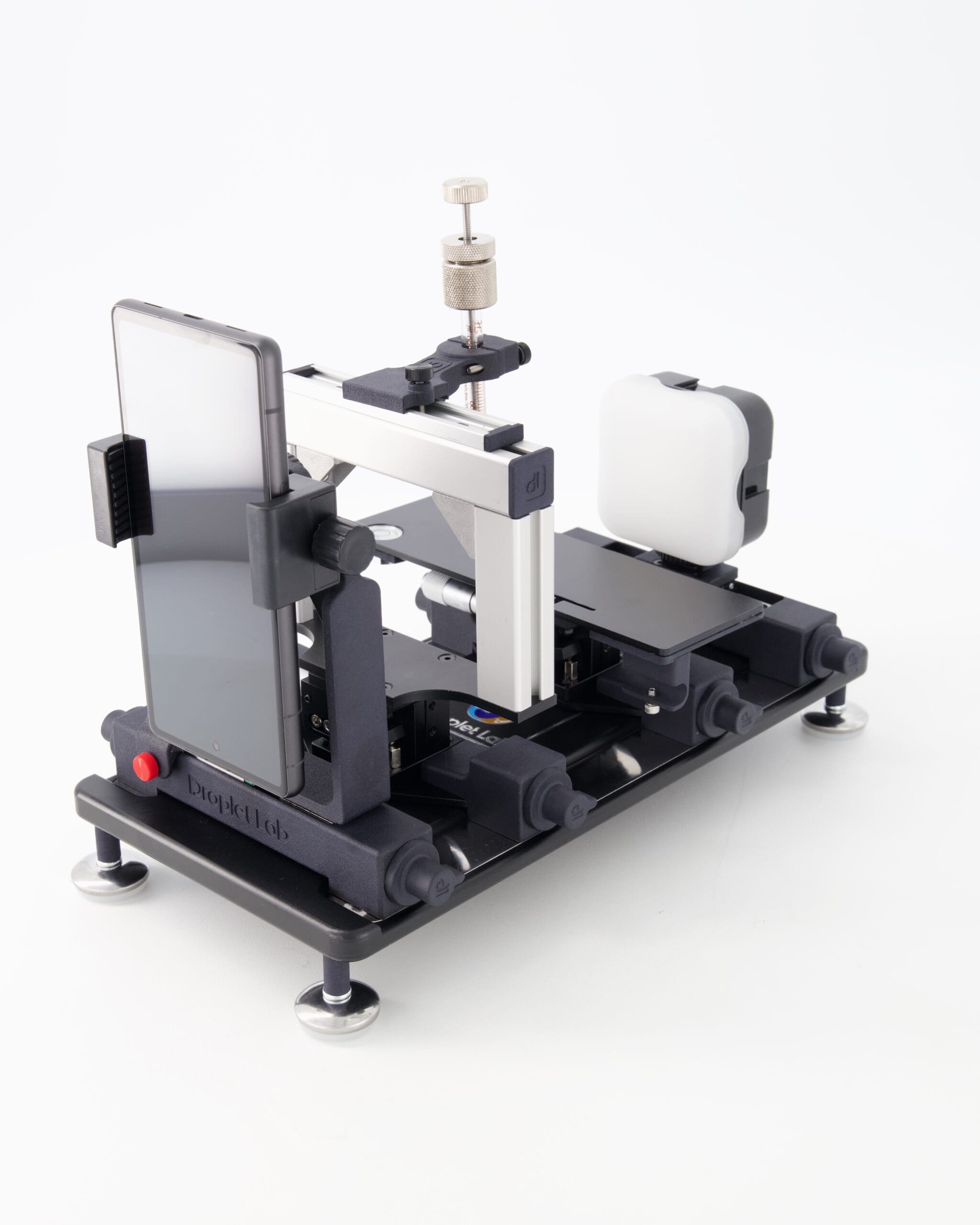
Product photo: a Droplet Lab Dropometer. Not a photo of the client's lab.
Abhimanyu Foto
Geschrieben von
Abhimanyu Bhandankar
Holds an MBA from Schulich School of Business and a BE in IT. He joined Droplet Lab in July 2019 and now leads sales and marketing.
CEO at Droplet Lab
Weiterlesen
Gurdeep-Saini-Photo
Technical Review by
Gurdeep Singh Saini
Holds a BASc in Mechanical Engineering from Ryerson University (now Toronto Metropolitan University) and an MASc from York University. He develops the automatic edge and baseline detection behind the Dropometer's analysis.
COO at Droplet Lab
Weiterlesen
Abhimanyu Foto
Written By

Abhimanyu Bhandankar

CEO at Droplet Lab

Holds an MBA from Schulich School of Business and a BE in IT. He joined Droplet Lab in July 2019 and now leads sales and marketing.

Gurdeep-Saini-Photo
Bewertet von

Gurdeep Singh Saini

COO at Droplet Lab

Holds a BASc in Mechanical Engineering from Ryerson University (now Toronto Metropolitan University) and an MASc from York University. He develops the automatic edge and baseline detection behind the Dropometer's analysis.

Primary outcome: deionised water from about 60 to 71 mN/m

Surface tension of deionised water, pendant drop

Values reported by the client; water is about 72 mN/m at room temperature

Before the fix (May to August 2026) 60 mN/m
After the fix (October 2026) 71 mN/m

From May 2026 the team's deionised water read about 60 mN/m against about 72 mN/m expected at room temperature, with any needle, drop volume or stabilisation time. A diagnosis call on 26 August 2026 pointed to the needle diameter that sets the image scale. With Droplet Lab's needle size chart and its own in house measurement, the team reported 71 mN/m on 8 October 2026 and closed the issue. Only water has been checked so far.

71 mN/m

Deionised water after the calibration fix, against about 72 expected.

60 mN/m

Typical reading before, the same across needles and drop volumes.

72 mN/m

The value the team expected for deionised water at room temperature.

1 call

One live diagnosis call found the cause.

Executive Summary

Who

A European startup developing greener ingredients for crop protection products and fertilisers, such as adjuvants, solvents and preservatives. Its R&D team studies how formulations wet plant leaves and how fast surface tension falls between the spray tank and the leaf.

Problem

The team needed contact angle on leaves and dynamic surface tension of its formulations. From May 2026, deionised water read about 60 mN/m instead of about 72, whatever the needle, drop volume or stabilisation time. Until that was explained, no surface tension result on a formulation could be trusted.

Lösung

A Dropometer with contact angle, surface tension, surface energy and a sliding angle tool. On a live call, Droplet Lab's chief technology officer traced the low readings to the needle diameter used to calibrate each image, then sent a needle size chart.

Time to Value

January 2025: first enquiry. July 2025: order. 6 October 2025: delivered. 8 October 2025: onboarding. May 2026: low water readings reported. 26 August 2026: diagnosis call. 8 October 2026: 71 mN/m, issue closed.

Results

Using Droplet Lab's needle size chart and a parallel in house measurement, the team reported 71 mN/m for deionised water, against about 60 mN/m before and about 72 expected. It then wrote that the problem could be considered solved. Only water has been checked so far.

Highlights

60 → 71 mN/m

Deionised water

72 mN/m

Expected for deionised water

1 call

To find the cause

Oct 2026

Issue closed by the client

“Thank you for the equipment. It's. It's really friendly.”

The client, at a glance

Research focus

Co-formulants for crop protection and fertiliser products, such as adjuvants, solvents and preservatives.

Products / applications

Adjuvants that help sprays wet and spread on plant leaves.

Measurement stage

Research and development.

Users

An R&D chemist and colleagues in the team.

Materials and surfaces tested

Leaves of different water repellency, Parafilm, deionised water and the team's formulations.

Key constraints

A small startup team, a single instrument, and support from another continent.

The challenge: a surface tension reading that could not be trusted

For an adjuvant developer, surface tension is the first number on every formulation.

Why water comes first

Before measuring any formulation, the team checked deionised water, which should read about 72 mN/m at room temperature. The density difference was already set to 0.9982 g/cm³ and the edge detection looked right, so a low value pointed to something systematic. Our guide to reproducible surface tension measurement covers the same checks.

Readings that could not be right

From May 2026 the team's deionised water read about 60 mN/m, whatever needle, drop volume or stabilisation time it used. Cleaning the syringe and needle with isopropanol and flushing more than 20 times with deionised water did not change it. Updating the software to version 1.4.4.0 did not change it either.

The insight: the needle sets the scale, so measure the needle

What Was Deployed

A Dropometer contact angle and surface tension kit with contact angle, pendant drop surface tension, surface energy and a manual sliding angle tool, delivered in October 2025 and set up with a remote onboarding call. In pendant drop, the software converts pixels to millimetres from the outside diameter of the needle in the image, so the needle value sets the scale for every result. On the August 2026 call, the team and our engineer checked that value against the real needle. Droplet Lab then sent a needle size chart, and the team measured its needles in house. Our surface tension measurement guide explains the method, and our guide to choosing a tensiometer for dynamic surface tension compares the options.
The Origin

Greener co-formulants, and a lab that needed to see them wet a leaf

In January 2025 the startup asked Droplet Lab about contact angle and sliding angle, to study how its adjuvants wet and spread on plant leaves. It had found Droplet Lab through a friend and the published literature. The team wanted to measure on leaves of different water repellency and on Parafilm, and also the dynamic surface tension of its products: how quickly surface tension falls in the seconds between the spray tank and the leaf. The fast bubble method in ASTM D3825 is the usual standard for dynamic surface tension. The Dropometer is partially compliant: it measures static and slower dynamic surface tension by pendant drop, not by fast bubble. The startup ordered in July 2025, with surface tension and surface energy included alongside contact angle and sliding angle. Our Farming and Agriscience guide covers the wider measurement picture for spray and leaf work.

Before vs After

Metric Before After
Surface tension of deionised water About 60 mN/m 71 mN/m, against about 72 expected
Needle diameter that sets the image scale Not checked against the real needle Taken from the needle size chart and checked in house
Effect of needle, drop volume and stabilisation time Reading stayed near 60 mN/m with every change Cause traced to the image scale, not the sample
Fehlerbehebung By email: cleaning, density setting and software version A live diagnosis call, then the needle size chart by email
Next step for the team Checking the instrument Ready to measure its own formulations

Rollout timeline

Timeline (high level)

January to July 2025: Enquiry and order

  • Enquiry about leaf wetting and sliding angle
  • Order with contact angle, surface tension and surface energy

August to October 2025: Delivery

  • Shipping delayed three times on our side
  • Customs hold and import charge
  • Delivered 6 October; onboarding call 8 October

December 2025: First feedback

  • Contact angle repeatability, calibration lines and phone holder raised
  • Advice and 3D print files for a new holder sent

May to August 2026: Low water readings

  • Water at about 60 mN/m reported in May
  • Troubleshooting by email: cleaning, density setting and software version
  • Diagnosis call on 26 August

August to October 2026: Fixed

  • Needle size chart sent 27 August
  • Client reports 71 mN/m and closes the issue on 8 October

Proof and validation: what we can show so far

Test method

Pendant drop surface tension of deionised water, with the image scale set from the needle's outside diameter. Values are those reported by the client.

Sample size and operators

The client's R&D chemist. Repeat counts not shared.

Repeatability / reproducibility

Not yet reported. Only water has been checked so far; no second reference liquid and no formulation results yet.

Notes / assumptions

Deionised water is about 72 mN/m at room temperature, the value the team expected. All values on this page are the client's own. Contact angle repeatability on leaves, the original purchase use case, has not yet been confirmed with the team.

Outcomes to date

Measured Outcomes

71 mN/m

Deionised water

Reported by the client on 8 October 2026, against 60 mN/m before and about 72 expected.

11 mN/m

Change in the water reading

From about 60 to 71 mN/m, both reported by the client, once the needle diameter was taken from the chart and checked in house.

1

Diagnosis call

One live video call with our engineer pointed to the needle diameter as the cause.

Operational Outcomes

Issue closed

The client wrote that the problem could be considered solved.

Calibration understood

The team now checks needle diameters in house.

Remote tools

Our engineer shared a free tool to control the phone from a laptop, for a larger view of each drop.

What the team said

“Thanks to the needle size chart and parallel in-house measurement, we manage to get values closer to the one expected than previously obtained (71 vs 60 mN/m, respectively). You can consider the problem solved. Thanks for your help – and your team - on this one!”
R&D Chemist - European agrochemical formulation startup

R&D Chemist, a European agrochemical formulation startup

What's next

Delivered

Dropometer with contact angle, surface tension, surface energy and sliding angle tool (October 2025)
Calibration fix and needle size chart (August to October 2026)

In Pilot

Dynamic surface tension and leaf contact angle on the team's own formulations

Planned

A software update with polar coordinate fitting to widen calibration tolerance, now in benchmarking

Frequently asked questions

Why does deionised water read low in pendant drop surface tension?

In this case the cause was the image scale. In pendant drop, the software converts pixels to millimetres from the needle's outside diameter, so a wrong needle value shifts every result. The team's water read about 60 mN/m instead of about 72, whatever needle, drop volume or stabilisation time it used.

How was the issue fixed?

On a live call on 26 August 2026, Droplet Lab's engineer traced the low readings to the needle diameter. Droplet Lab then sent a needle size chart, the team measured its needles in house, and deionised water read 71 mN/m.

Does the Dropometer measure dynamic surface tension to ASTM D3825?

Partially. ASTM D3825 uses the fast bubble method. The Dropometer measures static and slower dynamic surface tension by pendant drop, not by fast bubble, so it is partially compliant.

Next Step

Developing adjuvants or spray formulations, and need surface tension you can trust?

The Dropometer measures pendant drop surface tension, dynamic surface tension and contact angle on real leaves and films. The drop shape method is validated against a KRUSS DSA100E in peer review. Book a 15-minute consult about a formulation and a leaf, or request a quote.