



Inhalt
Case Study

A personal care lab wanted to compare how water beads on fats. It swapped a pipette and microscope for automated dosing and timed capture.

Last Updated
October 18, 2026
Industrie
Plant based oils and fats for personal care
Firma
Global ingredients company
Location
United States
Customer since
2025
Drop shape method validated against a KRÜSS DSA100E in peer review Published accuracy of 0.35° in peer review Automatic dosing and timed image capture

The personal care innovation lab of a global oils and fats company compares the hydrophobicity of fats and other surfaces by the contact angle of a water drop. Its first proof of concept used a pipette and a video microscope with no backlight. It bought a Dropometer with an automatic dropper so every drop gets the same dose and images are captured on a timer, then set it up over two remote calls.

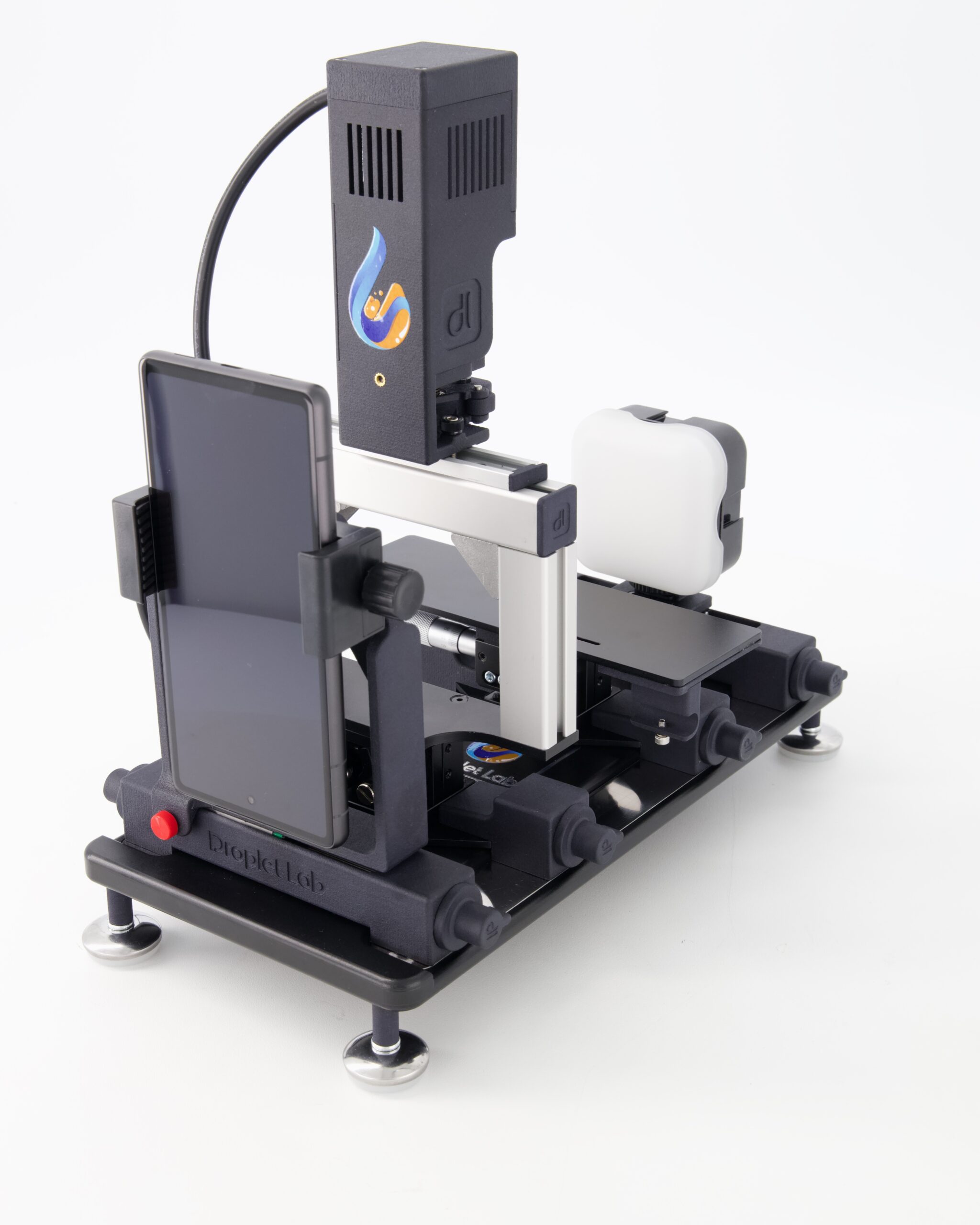
Product photo: a Droplet Lab Dropometer with automatic dropper. Not a photo of the client's lab.
Abhimanyu Foto
Geschrieben von
Abhimanyu Bhandankar
Holds an MBA from Schulich School of Business and a BE in IT. He joined Droplet Lab in July 2019 and now leads sales and marketing.
CEO at Droplet Lab
Weiterlesen
Gurdeep-Saini-Photo
Technical Review by
Gurdeep Singh Saini
Holds a BASc in Mechanical Engineering from Ryerson University (now Toronto Metropolitan University) and an MASc from York University. He develops the automatic edge and baseline detection behind the Dropometer's analysis.
COO at Droplet Lab
Weiterlesen
Abhimanyu Foto
Written By

Abhimanyu Bhandankar

CEO at Droplet Lab

Holds an MBA from Schulich School of Business and a BE in IT. He joined Droplet Lab in July 2019 and now leads sales and marketing.

Gurdeep-Saini-Photo
Bewertet von

Gurdeep Singh Saini

COO at Droplet Lab

Holds a BASc in Mechanical Engineering from Ryerson University (now Toronto Metropolitan University) and an MASc from York University. He develops the automatic edge and baseline detection behind the Dropometer's analysis.

Primary outcome: dosing, timing and capture taken out of the operator's hands

Steps of a water contact angle test done by hand

Drop dosing, image timing and image capture

Proof of concept (2024) 3 of 3 steps by hand
With the Dropometer (April 2025) 0 of 3 steps by hand

In its proof of concept the lab placed each water drop with a pipette and imaged it under a video microscope with no backlight. With the Dropometer, an automatic dropper with a 250 µL syringe sets the dose, and the app captures images at a set interval. The instrument arrived on 27 March 2025 and was set up over two remote calls on 1 and 2 April 2025. The client has not yet shared measurement results.

250 µL syringe

Automatic dropper sets the same dose for every water drop.

3 measurements

Contact angle, with surface tension and surface energy added at no cost.

2 remote calls

From unboxing to first water drops on the client's bench.

1 hour demo

Live demo before purchase, answering the lab's method questions.

Executive Summary

Who

The personal care innovation lab of a global company that makes plant based oils and fats. Its customer innovation manager develops fat and oil ingredients for personal care customers and needs to show how water repellent their surfaces are.

Problem

The lab compared hydrophobicity with water drops placed by pipette and imaged under a video microscope. Drop size and timing varied by hand, and fat surfaces can change under a drop over time, so the data was hard to defend to customers who send their own contact angle images.

Lösung

A Dropometer with an automatic dropper and a 250 µL syringe for consistent dosing, a levelled sessile stage, and the contact angle app with timed image capture. Surface tension and surface energy apps were added at no cost after delivery was delayed.

Time to Value

18 October 2024: quote request. 30 October 2024: one hour live demo. 13 November 2024: decision to buy. 13 January 2025: purchase order. 25 March 2025: shipped after several delays. 27 March 2025: delivered. 1 and 2 April 2025: remote onboarding and first water drops.

Results

The instrument was delivered on 27 March 2025 and running after two remote onboarding calls. Dosing and image timing are now automated. The lab returned to it in August 2025 after time away. Measurement results have not yet been shared with us.

Highlights

250 µL

Automated syringe

3

Measurements on one unit

2 calls

Remote onboarding

0 of 3

Test steps left to hand

“…this was infinitely more valuable than just watching the YouTube videos because being able to answer my questions was really helpful.”

The client, at a glance

Research focus

Fat and oil ingredients for personal care customers.

Products / applications

High melt point fats and other triglyceride based materials.

Measurement stage

Customer innovation and application development.

Users

One customer innovation manager, working in a small lab annex.

Materials and surfaces tested

Water drops on fat surfaces; customers' reference surfaces include fluorinated coatings.

Key constraints

Results must be consistent enough to show customers, from one operator.

The challenge: hydrophobicity data that a customer would believe

Comparing surfaces by contact angle only works if every drop is dosed and imaged the same way.

A proof of concept under a microscope

The lab first imaged water drops on fats with a video microscope bought for fat crystal texture work. Drops came from a pipette, images were in colour with no backlight, and the angle was read from the picture. It showed the idea worked, but not that the numbers would repeat. Our guide to reproducible contact angle measurement explains why drop dose and image timing decide whether a number repeats.

Fats change under the drop

Triglycerides are not completely nonpolar. On some fats the lab saw the water drop flatten over time, through spreading, soaking in or evaporation. One image at an unknown moment could not separate a water repellent fat from one that was slowly wetting. Surface texture can also shift the reading, because a rough surface may trap air under the drop, as in the Cassie Baxter model. Our Wenzel vs Cassie Baxter roughness experiment shows the effect on simple samples.

Customers send their own contact angle images

Customers shared images of similar tests, some on fluorinated reference surfaces. To compare fairly, the lab needed the same drop size and the same timing every time, and a method it could explain. Fluorinated finishes are the usual benchmark for water repellency, which is why PFAS free reformulation of repellent finishes leans on contact angle data. For textiles, contact angle adds numbers alongside the AATCC TM193 aqueous repellency grade; it does not replace that test.

What success would require

A consistent dose for every drop, images captured on a timer, and data the lab could defend as reliable because each variable was controlled. Our buying guide to contact angle goniometers for industrial QA covers how to weigh these needs when choosing an instrument.

The insight: control the drop and the clock, not just the camera

What Was Deployed

The lab runs a Dropometer contact angle kit with an automatic dropper and a 250 µL syringe. It adds a sessile stage with a bubble level and the contact angle app with timed image capture. Surface tension and surface energy apps were added at no cost. The dropper doses the same volume for every drop, and the app takes images at a set interval. The lab can watch whether a drop spreads, soaks in or evaporates on a fat surface over several minutes. Our contact angle measurement guide covers the sessile drop method behind these readings. Tracking a water drop over time is also how researchers followed leaf wetting in our analysis of superhydrophobic refoliated aspen leaves, a published Dropometer study.
The Origin

From a microscope proof of concept to a dedicated instrument

The lab's customer innovation manager first imaged water drops on fats as a proof of concept. He used a video microscope the lab had bought for fat crystal texture work. A colleague on the commercial side found the Dropometer and asked him to judge it as the technical lead. On 18 October 2024 he asked for a quote for all four measurements and the automatic dropper. After a one hour live demo on 30 October, where he asked about dosing, backlighting and timed capture, he recommended the purchase. After the call Droplet Lab sent him the two peer reviewed validation papers and our guide to surface science in cosmetics. On 13 November 2024 the team decided to buy the basic unit with the automatic syringe.
Decision Rationale

Why the automatic dropper

The lab's question was not whether it could see a drop, but whether every drop was the same.

Option A

Keep the microscope setup

Pipette drops imaged under the existing video microscope.

Not chosen: no control of dose or timing, and no backlight.
Option B

Basic Dropometer, manual dosing

Contact angle with drops dispensed by hand.

Not chosen: the lab wanted every drop dosed the same way.
Option C

Basic Dropometer with automatic dropper

Contact angle with automatic dosing and timed capture; other measurements later if needed.

Chosen
The lab chose to pay for automatic dosing on day one and to start with contact angle only, adding other measurements later if fabric work came in. The cost of the choice was a longer wait: delivery slipped several times between mid February and late March 2025. Droplet Lab added surface tension and surface energy at no cost to make up for the delay. When the lab shares results, they can be added here and, with its approval, to our open dataset of wetting measurements from customer labs.

Next Step

Comparing how water beads on fats, waxes or coated surfaces?

The Dropometer doses each drop with an automatic dropper and captures images on a timer, so you can compare surfaces and watch drops change over minutes. Contact angle, surface tension and surface energy run on one instrument, validated against a KRÜSS DSA100E in peer review. Book a 15-minute consult about your own sample, or request a quote.

Before vs After

Metric Before After
Drop dosing Water drop placed by pipette Automatic dropper with a 250 µL syringe
Imaging Video microscope, colour image, no backlight Backlit drop image on a levelled stage
Timing of images Taken by hand when the operator was ready Captured automatically at a set interval
Contact angle Read from microscope images Calculated in the contact angle app
Measurements available Water contact angle only, as a proof of concept Contact angle, surface tension and surface energy

Rollout timeline

Timeline (high level)

October to November 2024: Discovery and demo

  • Quote request on 18 October
  • One hour live demo on 30 October
  • Decision to buy on 13 November

January to March 2025: Order and build

  • Purchase order on 13 January
  • Delivery slipped several times from mid February
  • Surface tension and surface energy added at no cost on 10 February

March 2025: Delivery

  • Shipped 25 March
  • Delivered 27 March

1 and 2 April 2025: Remote onboarding

  • Apps activated over the internet
  • Stage rail tightened and levelled
  • First water drops dosed by the automatic dropper

August to September 2025: Back in use

  • Lab returns to the instrument after time away
  • Guidance on resetting the syringe actuator

Proof and validation: what we can show so far

Test method

Sessile water drops dosed by the automatic dropper through the supplied needle, on a levelled stage, with images captured in the contact angle app.

Sample size and operators

One customer innovation manager. Sample counts not shared.

Repeatability / reproducibility

Not yet reported.

Notes / assumptions

This page covers the purchase, setup and method only. The client has not shared measurement results with Droplet Lab, and none are shown here. Results will be added only with the client's approval.

Outcomes to date

Measured Outcomes

250 µL

Automated dosing

An automatic dropper with a 250 µL syringe replaced pipette drops, so every drop gets the same dose.

3

Measurements on one unit

Contact angle, with surface tension and surface energy added at no cost after the delivery delays.

2

Remote onboarding calls

From a delivered box on 27 March 2025 to first automated water drops on 2 April 2025.

Operational Outcomes

Variables controlled

Dose and image timing are set by the instrument, not the operator.

Drops followed over time

Timed capture lets the lab see whether a drop spreads or soaks into a fat surface.

Back in use

The lab returned to the instrument in August 2025 after time away.

What the team said

“To be able to kind of dose a consistent amount of water and then to be able to automatically capture the image at an allotted amount of time, you know, that's great. Takes out a lot of the human error variables for me.”
Customer Innovation Manager - Global oils and fats company, during the live demo

Customer Innovation Manager, a global oils and fats company

What's next

Delivered

Dropometer with automatic dropper and contact angle app (March 2025)
Surface tension and surface energy apps, added at no cost

In Pilot

Comparing the hydrophobicity of fat and triglyceride surfaces with water drops

Planned

Possible fabric applications, where surface tension and sliding angle may help
Measurement results, added to this page with the client's approval

Frequently asked questions

Why use an automatic dropper to compare hydrophobicity?

Contact angle comparisons only hold when every drop gets the same dose and is imaged at the same moment. The lab's first proof of concept used a pipette and a video microscope, so drop size and timing varied by hand. The automatic dropper with a 250 µL syringe doses each drop the same way, and the app captures images on a timer.

Can the Dropometer follow a water drop that changes on a fat surface?

Yes. Timed image capture lets the lab watch whether a drop spreads, soaks in or evaporates over several minutes, instead of relying on one image taken at an unknown moment. This matters on fats, because triglycerides are not completely nonpolar and some drops flatten over time.

How was the instrument set up?

The instrument was delivered on 27 March 2025. The lab was taking its first water drops after two remote onboarding calls on 1 and 2 April 2025. Surface tension and surface energy apps were added at no cost after delivery was delayed.

Next Step

Comparing how water beads on fats, waxes or coated surfaces?

The Dropometer doses each drop with an automatic dropper and captures images on a timer, so you can compare surfaces and watch drops change over minutes. Contact angle, surface tension and surface energy run on one instrument, validated against a KRÜSS DSA100E in peer review. Book a 15-minute consult about your own sample, or request a quote.