






Inhalt

Kunststoff Industrie
The Practical Guide to Surface Science (2026)

?s=100&d=m
Geschrieben von
No biography added yet.
Weiterlesen
?s=100&d=m
Reviewed by
N/A
No biography added yet.
Weiterlesen
?s=100&d=m
Written By

No biography added yet.

?s=100&d=m
Bewertet von

N/A N/A

No biography added yet.

Dies ist ein praktischer Leitfaden zur Oberflächenforschung für Forscher, die in der Kunststoffindustrie arbeiten.

In diesem brandneuen Leitfaden erfährst du alles über:

  • Entscheidende Prinzipien der Oberflächenforschung
  • Die Bedeutung von oberflächenwissenschaftlichen Messungen für die Kunststoffindustrie
  • Anwendbare ASTM-Normen und -Richtlinien

Lassen Sie uns gleich eintauchen.

Kunststoff

Executive Summary

What it covers: A practical, plastics-focused walkthrough of four core surface measurements—contact angle (static + advancing/receding), surface tension (static + dynamic), surface energy, and sliding angle; and how to use them to predict wetting, adhesion, coating/printing behavior, and product performance. It also includes benchmark reference data and real-world case studies to connect lab metrics to manufacturing outcomes.
Key insights: Static contact angle alone can be misleading on real polymer surfaces; advancing/receding angles (hysteresis) give a more complete read on cleanliness, roughness, heterogeneity, and adhesion risk. Method choice matters (Young–Laplace is more consistent but assumes axisymmetry; polynomial fits handle non-axisymmetric drops but are more sensitive to local defects), and dynamic surface tension is the right tool when interfaces evolve quickly (droplet/bubble formation, foams, coalescence, drying paints).
Business value: Turn surface science into faster, more reliable decisions for printing, coating, bonding, and cleaning by catching contamination, treatment drift (e.g., corona/plasma), and non-uniformity before defects hit the line. Improve yield and performance by tuning surfaces to hit target wetting/adhesion (e.g., raising surface energy for ink adhesion, tailoring hydrophobicity/hydrophilicity for self-cleaning or biocompatibility) and validating changes with repeatable measurements and benchmarks.
Standards to follow: Use ASTM D2578 as the official QA/QC gate for wetting tension (“dyne level”) on PE/PP films, with clear dwell-time criteria, replicate spots, and disciplined reporting. Treat contact angle and surface free energy as supplemental trending tools—keep them documented separately (fixed timestamp, defined liquids/model) and correlated to D2578 and downstream adhesion tests rather than labeling them as “ASTM D2578 results.”
Bottom line: This guide is a hands-on playbook for plastics teams to measure the right surface property at the right time, then translate those numbers into actionable controls for adhesion, printability, coating quality, and functional surfaces. It helps you move from “we think the surface changed” to “we can quantify it, standardize it, and prevent failures.”

Kapitel 1: Einführung

Die Kunststoffindustrie steht vor einer großen Herausforderung: Sie muss die richtige Haftung zwischen den verschiedenen Arten von Polymeren gewährleisten. Dies kann entweder eine unerwünschte oder unzureichende Haftung sein. Um diese Hürden zu überwinden, ist das Verständnis der Oberflächen- und Grenzflächeneigenschaften entscheidend. Kunststoffhersteller analysieren aktiv Oberflächeneigenschaften wie Kontaktwinkel, Gleitwinkel, Oberflächenenergie und Oberflächenspannung. Durch die sorgfältige Untersuchung dieser Parameter können sie genau vorhersagen, wie Kunststoffe mit ihrer Umgebung und anderen Materialien interagieren. Dieses Wissen ermöglicht es ihnen, die Haftung, das Benetzungsverhalten, die Beschichtung, den Druck und letztendlich die Gesamtleistung ihrer Produkte einfach zu bewerten.


Kunststoff

We use the following surface properties to understand the behavior of Plastics products and improve their quality.

Kapitel 2: Kontaktwinkelmessung

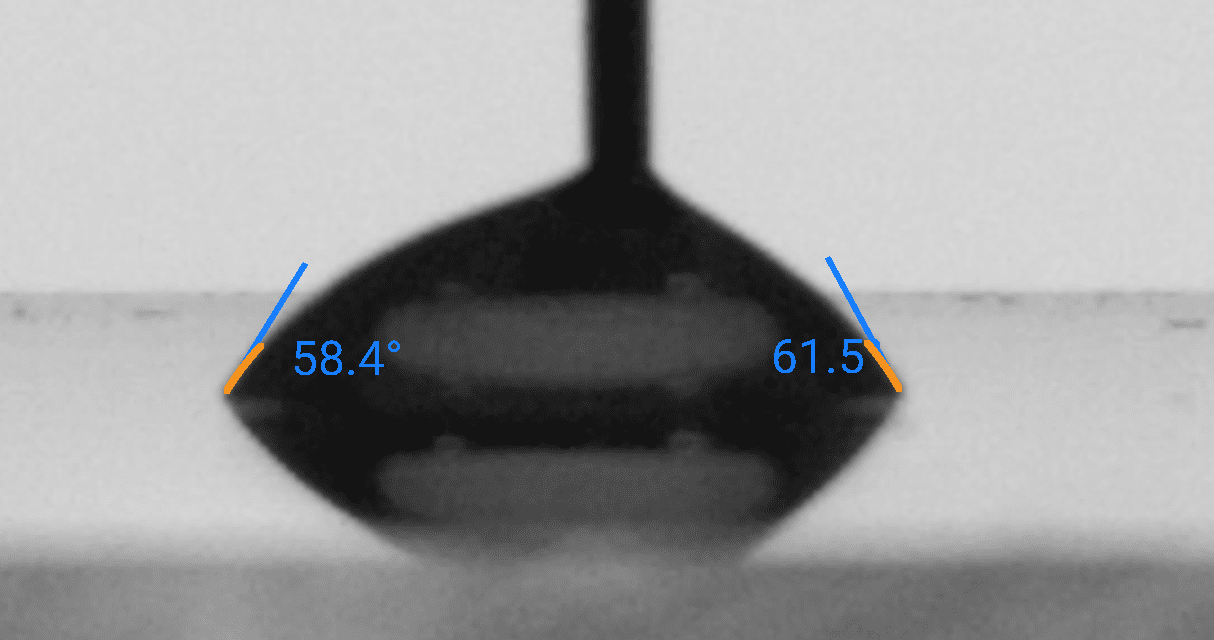
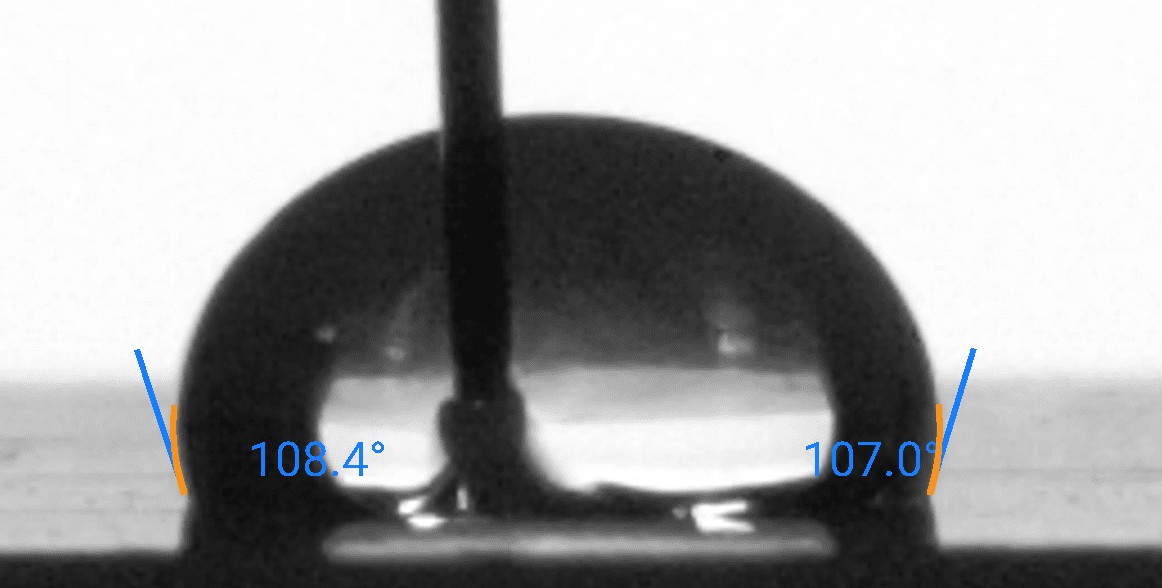
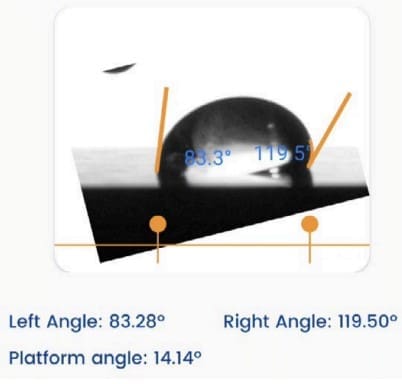
Der Kontaktwinkel quantifiziert die Benetzbarkeit einer Oberfläche, indem er den Winkel zwischen der Oberfläche einer Flüssigkeit und einer festen Oberfläche darstellt.
Dropletlab-Forschung

Sample Image taken from Droplet Lab Tensiometer.

Young – Laplace-Methode

Polynomiale Methode

Dynamischer Kontaktwinkel

Ideally, when we place a drop on a solid surface, a unique angle exists between the liquid and the solid surface. We can calculate the value of this ideal contact angle (the so-called Young’s contact angle) using Young’s equation. In practice, due to surface geometry, roughness, heterogeneity, contamination, and deformation, the contact angle value on a surface is not necessarily a single consistent value but rather falls within a range. The upper and lower limits of this range are known as the advancing and receding contact angles, respectively. The values of advancing and receding contact angles for a solid surface are highly sensitive to many parameters, such as temperature, humidity, homogeneity, and minor contamination of the surface and liquid. For example, the advancing and receding contact angles of a surface can differ at different locations.

Dynamischer Kontaktwinkel versus statischer Kontaktwinkel

Praktische Oberflächen und Beschichtungen weisen von Natur aus eine Kontaktwinkelhysterese auf, die auf eine Reihe von Gleichgewichtswerten hinweist. Wenn wir statische Kontaktwinkel messen, erhalten wir einen einzigen Wert innerhalb dieses Bereichs. Sich ausschließlich auf statische Messungen zu verlassen, wirft Probleme auf, wie z. B. schlechte Wiederholgenauigkeit und unvollständige Oberflächenbewertung in Bezug auf Haftung, Sauberkeit, Rauheit und Homogenität.

In practical applications, we need to understand how easily a liquid spreads (advancing angle) and how easily it is removed (receding angle), such as in painting and cleaning. Measuring advancing and receding angles offers a holistic view of liquid-solid interaction, unlike static measurements, which yield an arbitrary value within the range.

Diese Erkenntnisse sind entscheidend für reale Oberflächen mit Variationen, Rauheit und Dynamik und helfen Branchen wie Kosmetik, Materialwissenschaft und Biotechnologie bei der Gestaltung effektiver Oberflächen und der Optimierung von Prozessen.

Erfahren Sie, wie die Kontaktwinkelmessung mit unserem Tensiometer durchgeführt wird

Für ein vollständigeres Verständnis der Kontaktwinkelmessung lesen Sie unsere Kontaktwinkelmessung: Der endgültige Leitfaden

Open Benchmark Data: Contact Angle & Surface Energy

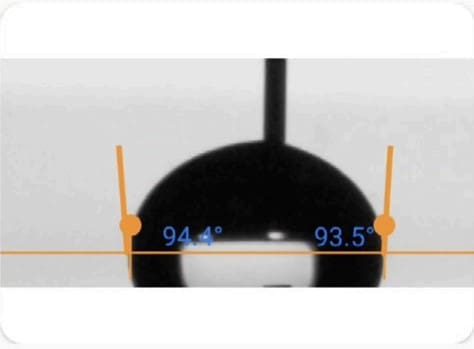
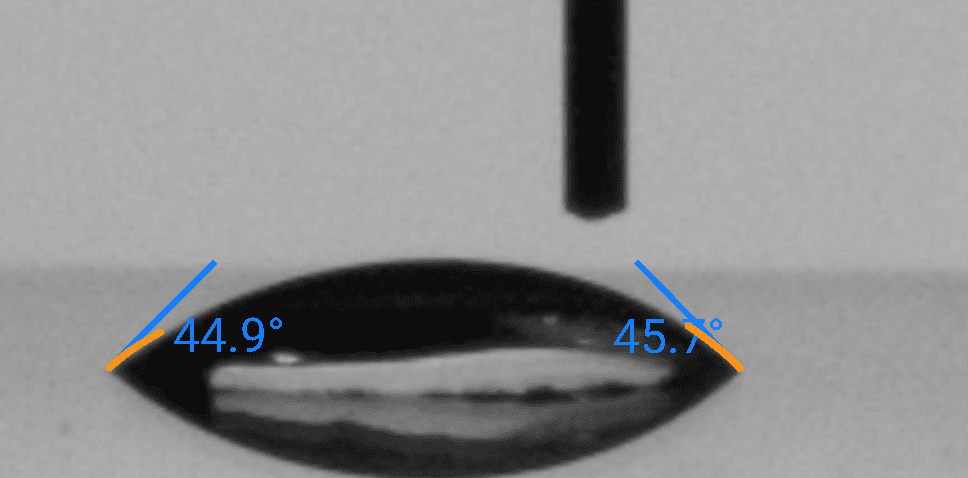
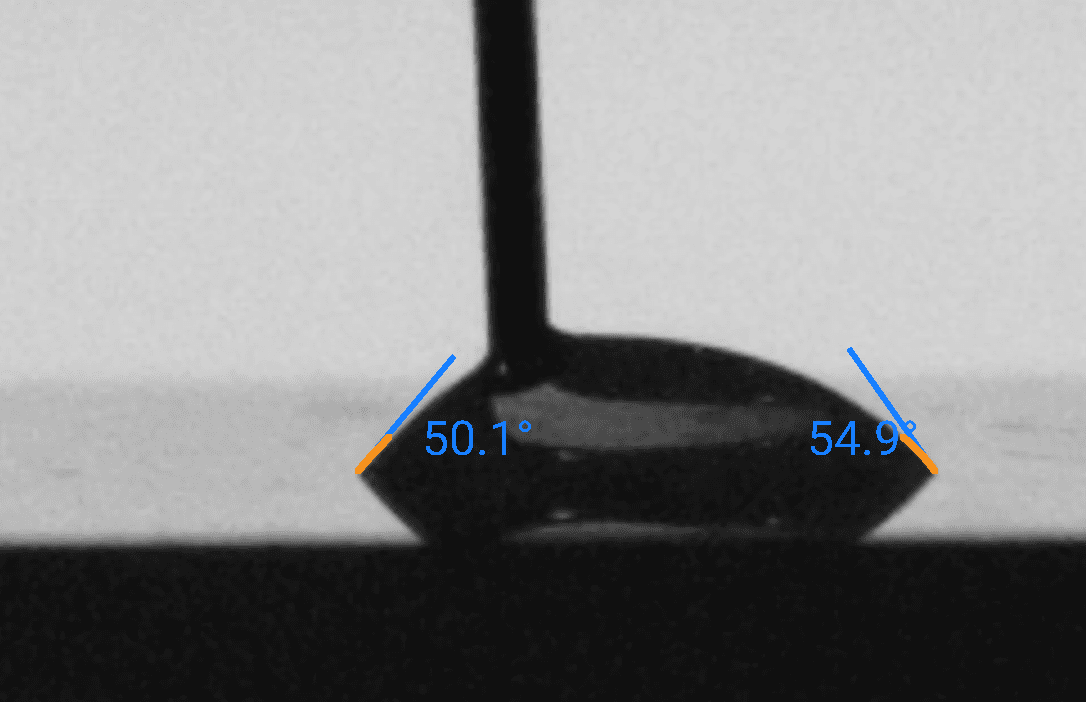
These reference measurements show how deionized water wets four standard substrates measured with the Droplet Lab Dropometer. Use them as visual and numerical benchmarks when you're checking your own sample preparation, treatments, and chemistry.

Full contact angle and surface energy datasets (including additional liquids and statistics) are available on our dataset hub.

Glass - DI Water
Glass - DI Water
Nylon - DI Water
Nylon - DI Water
PMMA - DI Water
PMMA - DI Water
Teflon - DI Water
Teflon - DI Water

The droplet images above are taken from the same benchmark series as our open dataset. For each substrate and probe liquid we report:

● Advancing and receding contact angles (and hysteresis)
● Derived surface energy (SFE) values based on multi-liquid measurements
● Measurement conditions, uncertainties, and sample preparation details

Comparing your own droplet shapes and angles against these references is a fast way to spot contamination, treatment drift, or unexpected changes in wettability.

Kapitel 3: Messung der Oberflächenspannung

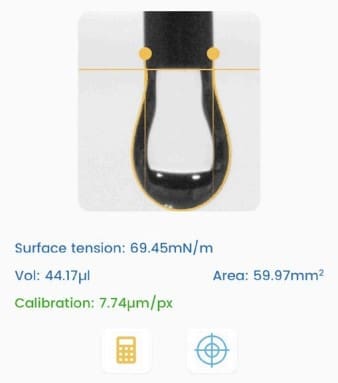
Diese Eigenschaft misst die Kraft, die auf die Oberfläche einer Flüssigkeit wirkt, mit dem Ziel, ihre Oberfläche zu minimieren.

Messung der Oberflächenspannung

Sample Image taken from Droplet Lab Tensiometer

Dynamische Oberflächenspannung

Die dynamische Oberflächenspannung unterscheidet sich von der statischen Oberflächenspannung, die sich auf die Oberflächenenergie pro Flächeneinheit (oder die Kraft, die pro Längeneinheit entlang des Randes einer flüssigen Oberfläche wirkt) bezieht.

Die statische Oberflächenspannung charakterisiert den Gleichgewichtszustand der Grenzfläche von Flüssigkeiten, während die dynamische Oberflächenspannung die Kinetik von Änderungen an der Grenzfläche berücksichtigt. Diese Veränderungen können das Vorhandensein von Tensiden, Additiven oder Schwankungen in Temperatur, Druck und Zusammensetzung an der Grenzfläche beinhalten.

Wann sollte die dynamische Oberflächenspannungsmessung verwendet werden?

Dynamic surface tension is essential for processes that involve rapid changes at the liquid-gas or liquid-liquid interface, such as droplet and bubble formation, coalescence (change in surface area), the behavior of foams, and the drying of paints (change in composition, e.g., evaporation of solvent). It is measured by analyzing the shape of a hanging droplet over time.

Die dynamische Oberflächenspannung gilt für verschiedene Branchen, darunter Kosmetika, Beschichtungen, Pharmazeutika, Farben, Lebensmittel und Getränke sowie industrielle Prozesse, in denen das Verständnis und die Kontrolle des Verhaltens von Flüssigkeitsgrenzflächen für die Produktqualität und Prozesseffizienz unerlässlich ist.

Erfahren Sie, wie die Messung der Oberflächenspannung mit unserem Tensiometer durchgeführt wird

Für ein vollständigeres Verständnis der Oberflächenenergiemessung lesen Sie unsere Oberflächenspannungsmessung: Der endgültige Leitfaden

Kapitel 4: Messung der Oberflächenenergie

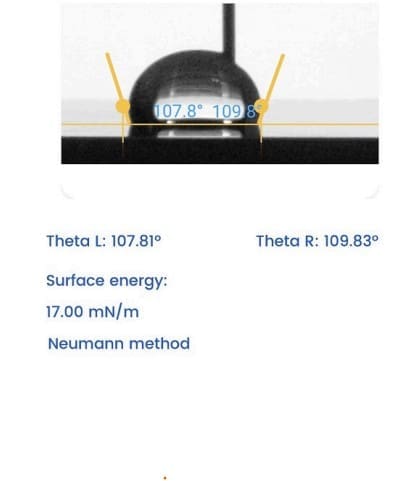
Die Oberflächenenergie bezieht sich auf die Energie, die erforderlich ist, um eine Flächeneinheit einer neuen Oberfläche zu erzeugen.
231

Sample Image taken from Droplet Lab Tensiometer

Erfahren Sie, wie die Messung der Oberflächenenergie mit unserem Tensiometer durchgeführt wird

Für ein umfassenderes Verständnis der Oberflächenenergiemessung lesen Sie unsere Oberflächenenergiemessung: Der ultimative Leitfaden

For benchmark contact angle and surface energy values on glass, nylon, PMMA, and Teflon, see the Open Benchmark Data panel above or visit our Dataset Hub for full CSV downloads.

Kapitel 5: Gleitwinkelmessung

Der Gleitwinkel misst den Winkel, in dem ein flüssiger Film über eine feste Oberfläche gleitet. Es wird häufig verwendet, um die Rutschhemmung einer Oberfläche zu beurteilen.

Gleitwinkel 1

Sample Image taken from Droplet Lab Tensiometer

Erfahren Sie, wie die Gleitwinkelmessung mit unserem Tensiometer durchgeführt wird

Für ein umfassenderes Verständnis der Gleitwinkelmessung lesen Sie unsere Gleitwinkelmessung: Der endgültige Leitfaden

Kapitel 6: Anwendungen in der Praxis

In der Kunststoffindustrie gibt es mehrere Fallstudien, die die Vorteile der Messung von Oberflächeneigenschaften veranschaulichen.

Contact-Angle–Driven Surface Tuning in UV-Responsive Silicone “Bottlebrush” Elastomers for Printable, Self-Healing Plastic Components

This study reports a family of bottlebrush-structured silicone elastomers produced via a solvent-free synthesis combining hydrosilylation and thiol–ene chemistry. Using thiol-functional PDMS helps suppress unwanted side reactions involving Si–H during hydrosilylation. The materials incorporate dynamic covalent C–S bonds that reversibly cleave under UV light, enabling rapid forming and self-healing when illuminated. Despite being ultrasoft, the elastomers can heal in seconds and recover toughness to as high as 86% of the original value. The synthesis also enables efficient grafting of small silane molecules as “spacers” on the polymer backbone; spacer steric effects tune stiffness, while functional spacers (e.g., fluorinated groups) tune surface properties. The authors illustrate potential uses including DLP 3D printing, UV-triggered healing, and recycling.

Role of the Droplet Lab Goniometer

The Droplet Lab Dropometer was used to quantify how small-molecule spacer chemistry changes the silicone elastomer’s surface wetting behavior via water sessile contact angle measurements. Specifically:

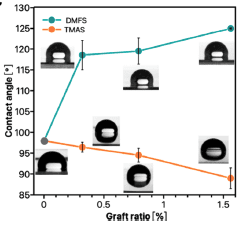
  • Films of fluorinated-spacer elastomers (DMFS series) and amine-containing spacer elastomers (TMAS series) were tested to compare hydrophobicity vs. hydrophilicity.
  • The instrument captured droplet profiles and computed contact angles using Droplet Lab Sessile software “smart mode” (Young–Laplace + polynomial fitting), providing an objective metric for surface modification effects (Section 2.2.7, page 2).

This is the paper’s primary quantitative surface-property measurement, supporting claims about self-cleaning and repellency (Figure 4b–c, pages 5–7).
Key Findings

  • Spacer chemistry can tune silicone elastomer surface wetting measurably, even at very low functional group incorporation.
  • Adding a fluorinated spacer (DMFS) increases water contact angle substantially:
    • baseline (no fluorine) reported at ~98.4°,
    • ~118° with 0.32% fluorine graft ratio,
    • up to ~125° at 1.56% fluorine graft ratio (discussion around Figure 4c).
  • Adding an amine-containing spacer (TMAS) shifts the surface toward greater hydrophilicity, with the highest TMAS content decreasing contact angle by ~10° compared with the non-functional reference (discussion around Figure 4c).
  • A qualitative self-cleaning demonstration supports the wetting results: milk droplets left visible traces on a fluorine-free surface (TES-1) but not on the fluorinated sample (DMFS-1) (Figure 4b).
  • Beyond surface tuning, the material platform also combines UV-triggered softening, rapid self-healing, and printability, enabling manufacturing-friendly routes for soft polymer parts.

Why It Matters

For plastics and elastomer manufacturers, this work shows a practical route to engineer silicone-based polymer surfaces without changing the base polymer family, using modular spacer grafting and then verifying performance with contact angle as a fast, QC-friendly metric. Being able to dial wetting behavior upward (more hydrophobic) or downward (more hydrophilic) supports real decisions such as surface specification setting, self-cleaning/anti-fouling design, compatibility with adhesives/coatings/inks, and process optimization for UV-curable, additive-manufactured elastomer components.

Method Snapshot

  • Sample: Blade-cast elastomer films on glass, ~100 µm thick (fluorinated DMFS and amine TMAS spacer variants).
  • Droplet & angle type: ~5 µL DI water, static sessile contact angle measured from captured droplet shape using Droplet Lab Sessile software (“smart mode”).
  • Temperature / surface tension: Not explicitly stated (ambient assumed); water surface tension not reported/measured in the paper.

Data Note

Figure 4c (page 5) reports the water contact angle trends for TES-1 vs. DMFS- and TMAS-modified elastomers (data generated using the Droplet Lab Dropometer, per Section 2.2.7 on page 2).

Figure

Citation (APA Format)

Huo, M., & Clarke, D. R. (2025). UV responsive, bottlebrush structured silicone elastomers: Synthesis, healing, and application. Macromolecules. Advance online publication.

View Publication →

Verbesserung der Verpackungsleistung

Ein Verpackungsunternehmen kämpft mit einer schlechten Farbhaftung auf seinen Kunststoffbehältern, was zu Etikettenverschmierungen und einer geringeren Attraktivität im Regal führt. Um dies zu beheben, messen sie die Oberflächenenergie des Kunststoffs. Dies zeigt, dass der Kunststoff eine geringe Oberflächenenergie aufweist, was die Benetzung erschwert und zu einer schlechten Farbhaftung führt. Das Unternehmen modifiziert dann die Oberflächenchemie durch Plasmabehandlung, um die Oberflächenenergie zu erhöhen. Dies erhöht die Oberflächenenergie, verbessert die Haftung der Tinte und verbessert das Erscheinungsbild der Verpackung.

Verbesserung der Verpackungsleistung

Verbesserung der Biokompatibilität von Medizinprodukten

A medical device manufacturer is driven to create a plastic catheter with superior biocompatibility, minimizing the risk of blood clot formation. Recognizing the crucial role of surface properties, they leverage surface energy and contact angle measurements to strategically optimize the catheter material's surface energy. Through the precise application of a hydrophilic coating, they successfully increase surface energy, leading to reduced clot formation risk and enhanced overall biocompatibility of the device.

Verbesserung der Biokompatibilität von Medizinprodukten

Herstellung von hydrophoben Mikroplastikteilen mit Micro-UPM

Hydrophobe Oberflächen mit Mikrostrukturen sind für selbstreinigende und widerstandsreduzierende Anwendungen sehr gefragt. Um solche Oberflächen auf Mikroplastikteilen herzustellen, verwendet ein Hersteller die Mikro-Ultraschall-Pulverformtechnik (Micro-UPM). Sie analysieren und optimieren akribisch Schlüsselparameter wie Ultraschallenergie, Schweißdruck, Druckhaltezeit und Replikationsrate, um den gewünschten Oberflächenkontaktwinkel und damit die gewünschten hydrophoben Eigenschaften zu erreichen.

Die Ergebnisse zeigen, dass das Micro-UPM-Verfahren eine effiziente und schnelle Lösung für die Herstellung von hydrophoben Mikroplastikkomponenten bietet.

Herstellung von hydrophoben Mikroplastikteilen mit Micro-UPM

Wir sind Ihre Partner bei der Lösung Ihrer geschäftlichen und technologischen Probleme herausforderungen

Wenn Sie an der Implementierung dieser oder anderer Anwendungen interessiert sind, kontaktieren Sie uns bitte.

Kapitel 7: Normen und Richtlinien

In an industry where precision reigns supreme, how can Plastics manufacturers ensure their products withstand scrutiny? The answer lies in standards and guidelines: the compass that guides them through the complex maze of quality and performance.

ASTM D2578 — Wetting Tension of Polyolefin Films (Dyne Pen / Dyne Solution Method)

What it is

Standard test method for determining wetting tension (dynes/cm ≈ mN/m) of polyethylene (PE) and polypropylene (PP) film surfaces in air by applying liquids of known surface tension and identifying the highest value that “just wets” the surface within a defined time. Use it as the official discrete “dyne level” gate, and (if desired) pair it with separately reported fixed-time contact angle / surface free energy trending for a continuous numeric early-warning signal

When to use it

Production dyne spec verification

Use as the QA/QC decision method when PE/PP film “dyne level” is the line spec tied to print, coating wet-out, or lamination reliability.

Calibration anchor for supplemental trending

Use periodic D2578 checks to calibrate and validate any continuous contact-angle/SFE measurements you run between dyne checks (so you don’t replace the standard with a different method).

In-scope / Out-of-scope

In scope
  • PE and PP films evaluated in air
  • Wetting tension determination using dyne solutions (often implemented via dyne pen/swab practices)
  • “Just wets” judgment based on whether the applied solution remains a continuous film vs retracts/beads within a defined dwell time
  • Discrete reporting as a dyne level (e.g., highest passing dyne, or pass/fail versus a specified dyne requirement)
Out of scope
  • Contact angle measurements (sessile-drop, advancing/receding) and surface free energy (SFE) modeling; report these as supplemental methods, not as D2578 results
  • Predicting end-use performance (ink adhesion, coating defects, lamination bond strength) without product-specific correlation testing
  • Non-polyolefin substrates (or test conditions outside the method intent, such as testing in liquids or non-ambient environments)
  • Web mapping/uniformity metrics as formal D2578 requirements (you can add mapping internally, but it’s not the D2578 determination)

Minimum you must report (checklist)

  • Film identification: PE/PP type/grade (if known), construction, thickness, and any relevant additive/treatment history
  • Treatment details: corona/plasma/flame type and key process conditions (if available) + time since treatment at test
  • Dyne solutions: nominal dyne values used, manufacturer/lot, and storage/expiration status
  • Application method: pen/swab/drop technique and any controlled technique notes (stroke length, pressure guidance, etc.)
  • Dwell-time criterion: the hold time used for the “just wets” decision (e.g., ~2 s)
  • Pass/fail definition: what “just wets” means in your SOP (continuous film vs beads/breaks) and how the final result is chosen (highest passing dyne)
  • Replication & locations: number of test spots and where on the web/roll they were taken (edges/center/splice zones; mapped vs single-point)
  • Results & context: highest passing dyne (or pass/fail versus spec), plus date/time, operator, and any anomalies/retests

ASTM D2578 results come only from the dyne-solution “just wets” determination; do not label contact angle or SFE numbers as “ASTM D2578.” If you use contact angle/SFE tools as a companion, document them as a supplemental method (fixed timestamp + defined liquids/model) and keep them correlated to D2578 and downstream outcomes

How to interpret results (guardrails)

  • Higher passing dyne generally = higher wettability/more process margin, but it remains a proxy; downstream adhesion/bond strength still needs confirmation for your materials and inks/adhesives.
  • Borderline results are sensitive to operator technique and timing; standardize dwell time, training, lighting/handling controls, and use replicate spots to reduce subjectivity.
  • Keep D2578 as the official spec gate; use fixed-time contact angle (e.g., [E-Mail geschützt] s median + IQR) and optional SFE trends as an early drift alarm, reported separately and only used as a gate after internal calibration.
  • If dyne stays “passing” but numeric trends drift (WCA rising and/or IQR widening), treat it as an early warning for dose drift, non-uniformity, or contamination; then confirm with a D2578 check and application-relevant testing.

Jetzt sind Sie an der Reihe

We hope this guide showed you how to apply surface science in the Plastics industry.

Nun möchten wir das Wort an Sie übergeben:

Feel free to leave a comment below—we’d love to hear from you.

Hinterlasse eine Antwort

Deine E-Mail-Adresse wird nicht veröffentlicht. Pflichtfelder sind markiert *


Experiment herunterladen