
This is a practical guide to Surface Science for researchers working in the Automotive Industry.
In diesem brandneuen Leitfaden erfährst du alles über:
Lassen Sie uns gleich eintauchen.
We analyze and improve the performance of automotive products by leveraging surface properties like surface tension and contact angles. These properties are crucial for understanding how coatings and treatments interact with vehicle surfaces, ultimately affecting the spread and adhesion of liquids on solids. Paints, sealants, and protective coatings rely heavily on these surface properties for their effectiveness and durability in the automotive industry. Automotive surface science merges precision engineering with material science to create products that not only protect and enhance vehicle surfaces but also maintain them. Striking the perfect balance between performance and appearance is paramount, ensuring that coatings can withstand environmental stressors, resist wear, and preserve the vehicle’s aesthetic appeal for years to come.
We use the following surface properties to understand the behavior of Automotive products and improve their quality.
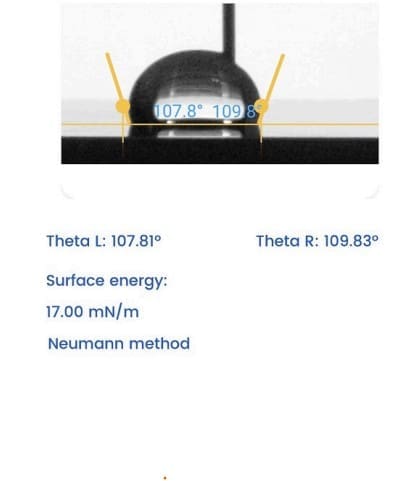
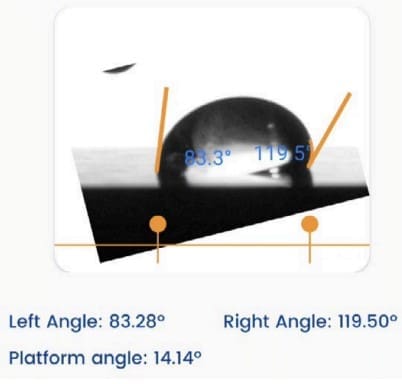
Sample Image taken from Droplet Lab Tensiometer.
Young – Laplace-Methode
Polynomiale Methode
Ideally, when we place a drop on a solid surface, a unique angle exists between the liquid and the solid surface. We can calculate the value of this ideal contact angle (the so-called Young’s contact angle) using Young’s equation. In practice, due to surface geometry, roughness, heterogeneity, contamination, and deformation, the contact angle value on a surface is not necessarily a single consistent value but rather falls within a range. The upper and lower limits of this range are known as the advancing and receding contact angles, respectively. The values of advancing and receding contact angles for a solid surface are highly sensitive to many parameters, such as temperature, humidity, homogeneity, and minor contamination of the surface and liquid. For example, the advancing and receding contact angles of a surface can differ at different locations.
Praktische Oberflächen und Beschichtungen weisen von Natur aus eine Kontaktwinkelhysterese auf, die auf eine Reihe von Gleichgewichtswerten hinweist. Wenn wir statische Kontaktwinkel messen, erhalten wir einen einzigen Wert innerhalb dieses Bereichs. Sich ausschließlich auf statische Messungen zu verlassen, wirft Probleme auf, wie z. B. schlechte Wiederholgenauigkeit und unvollständige Oberflächenbewertung in Bezug auf Haftung, Sauberkeit, Rauheit und Homogenität.
In practical applications, we need to understand how easily a liquid spreads (advancing angle) and how easily it is removed (receding angle), such as in painting and cleaning. Measuring advancing and receding angles offers a holistic view of liquid-solid interaction, unlike static measurements, which yield an arbitrary value within the range.
Diese Erkenntnisse sind entscheidend für reale Oberflächen mit Variationen, Rauheit und Dynamik und helfen Branchen wie Kosmetik, Materialwissenschaft und Biotechnologie bei der Gestaltung effektiver Oberflächen und der Optimierung von Prozessen.
Erfahren Sie, wie die Kontaktwinkelmessung mit unserem Tensiometer durchgeführt wird
Für ein vollständigeres Verständnis der Kontaktwinkelmessung lesen Sie unsere Kontaktwinkelmessung: Der endgültige Leitfaden
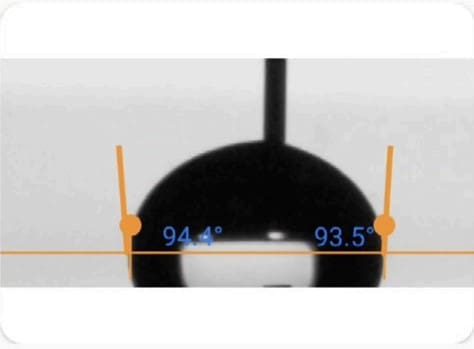
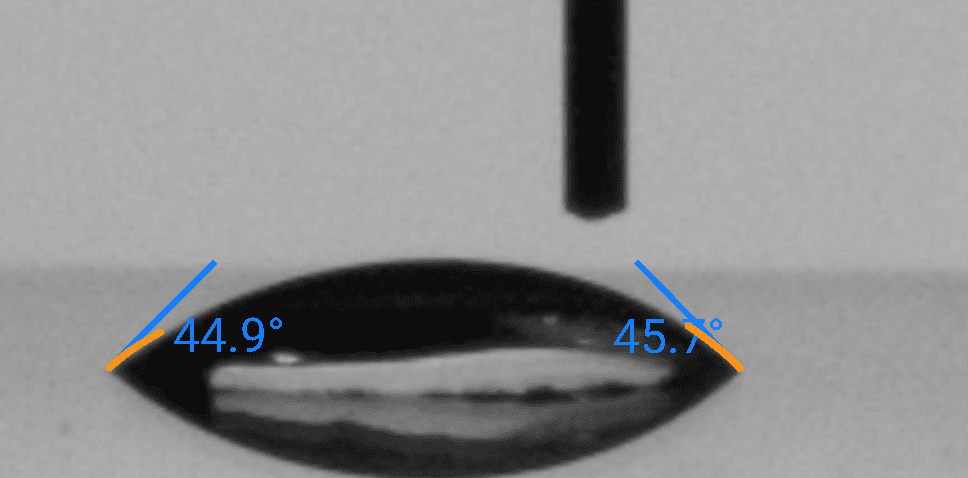
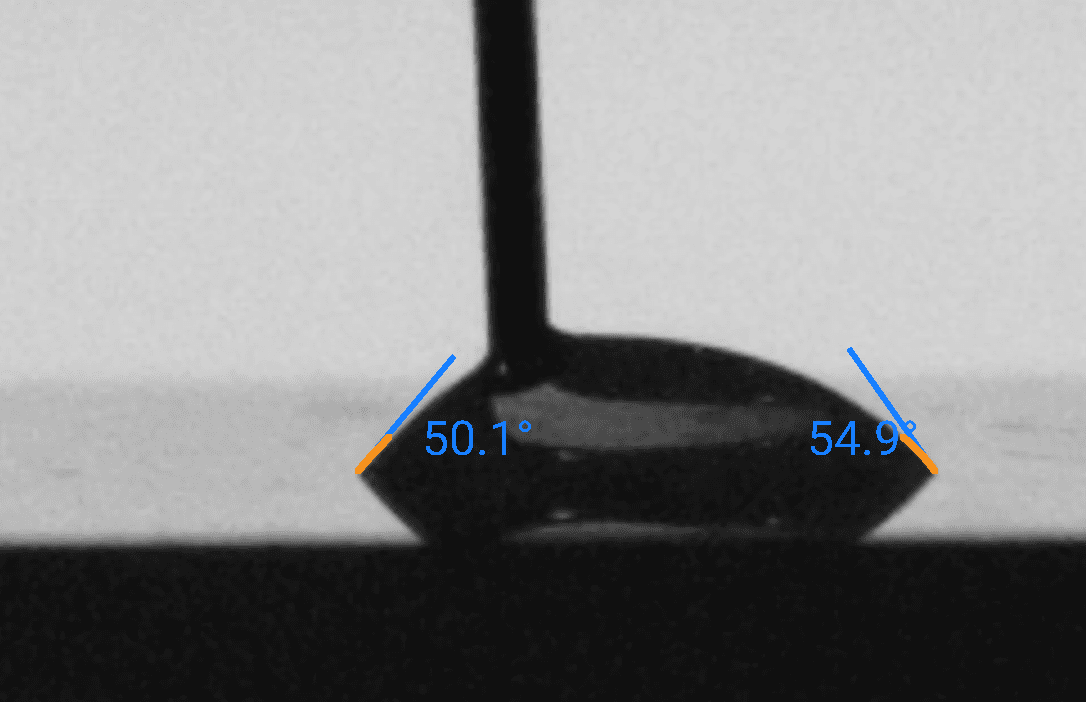
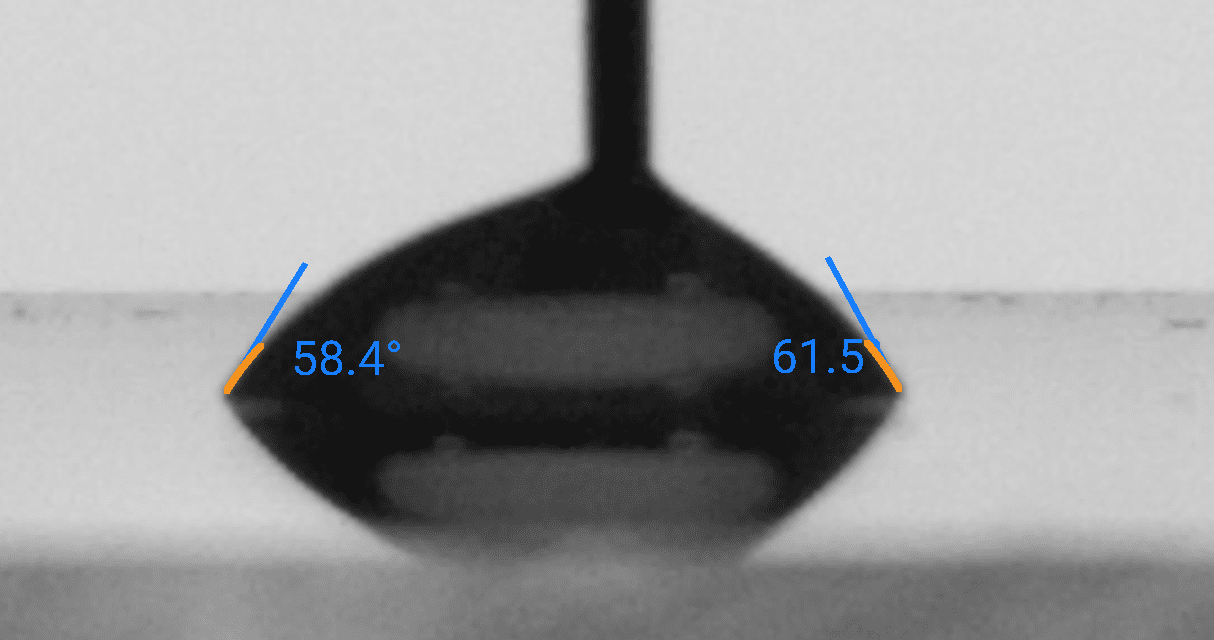
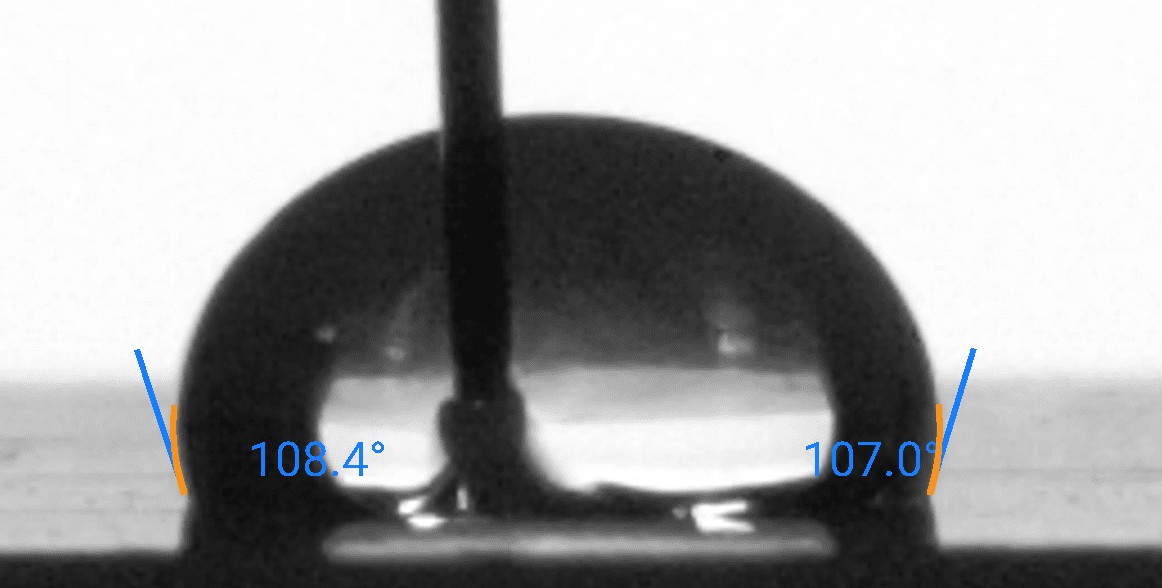
These reference measurements show how deionized water wets four standard substrates measured with the Droplet Lab Dropometer. Use them as visual and numerical benchmarks when you're checking your own sample preparation, treatments, and chemistry.
Full contact angle and surface energy datasets (including additional liquids and statistics) are available on our dataset hub.
The droplet images above are taken from the same benchmark series as our open dataset. For each substrate and probe liquid we report:
● Advancing and receding contact angles (and hysteresis)
● Derived surface energy (SFE) values based on multi-liquid measurements
● Measurement conditions, uncertainties, and sample preparation details
Comparing your own droplet shapes and angles against these references is a fast way to spot contamination, treatment drift, or unexpected changes in wettability.
Measurements were performed with the Droplet Lab Dropometer under controlled laboratory conditions. Treat these values as sanity checks and starting points for your own process targets, not as product specifications.
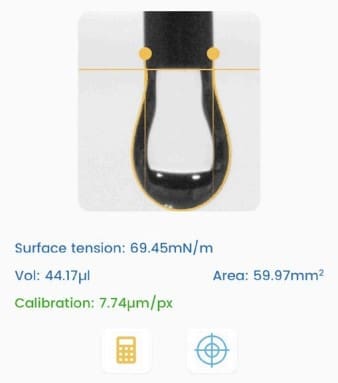
Diese Eigenschaft misst die Kraft, die auf die Oberfläche einer Flüssigkeit wirkt, mit dem Ziel, ihre Oberfläche zu minimieren.
Sample Image taken from Droplet Lab Tensiometer
Dynamische Oberflächenspannung
Die dynamische Oberflächenspannung unterscheidet sich von der statischen Oberflächenspannung, die sich auf die Oberflächenenergie pro Flächeneinheit (oder die Kraft, die pro Längeneinheit entlang des Randes einer flüssigen Oberfläche wirkt) bezieht.
Die statische Oberflächenspannung charakterisiert den Gleichgewichtszustand der Grenzfläche von Flüssigkeiten, während die dynamische Oberflächenspannung die Kinetik von Änderungen an der Grenzfläche berücksichtigt. Diese Veränderungen können das Vorhandensein von Tensiden, Additiven oder Schwankungen in Temperatur, Druck und Zusammensetzung an der Grenzfläche beinhalten.
Wann sollte die dynamische Oberflächenspannungsmessung verwendet werden?
Dynamic surface tension is essential for processes that involve rapid changes at the liquid-gas or liquid-liquid interface, such as droplet and bubble formation, coalescence (change in surface area), the behavior of foams, and the drying of paints (change in composition, e.g., evaporation of solvent). It is measured by analyzing the shape of a hanging droplet over time.
Die dynamische Oberflächenspannung gilt für verschiedene Branchen, darunter Kosmetika, Beschichtungen, Pharmazeutika, Farben, Lebensmittel und Getränke sowie industrielle Prozesse, in denen das Verständnis und die Kontrolle des Verhaltens von Flüssigkeitsgrenzflächen für die Produktqualität und Prozesseffizienz unerlässlich ist.
Erfahren Sie, wie die Messung der Oberflächenspannung mit unserem Tensiometer durchgeführt wird
Für ein vollständigeres Verständnis der Oberflächenenergiemessung lesen Sie unsere Oberflächenspannungsmessung: Der endgültige Leitfaden
Sample Image taken from Droplet Lab Tensiometer
Erfahren Sie, wie die Messung der Oberflächenenergie mit unserem Tensiometer durchgeführt wird
Für ein umfassenderes Verständnis der Oberflächenenergiemessung lesen Sie unsere Oberflächenenergiemessung: Der ultimative Leitfaden
For benchmark contact angle and surface energy values on glass, nylon, PMMA, and Teflon, see the Open Benchmark Data panel above or visit our Dataset Hub for full CSV downloads.
Der Gleitwinkel misst den Winkel, in dem ein flüssiger Film über eine feste Oberfläche gleitet. Es wird häufig verwendet, um die Rutschhemmung einer Oberfläche zu beurteilen.
Sample Image taken from Droplet Lab Tensiometer
Erfahren Sie, wie die Gleitwinkelmessung mit unserem Tensiometer durchgeführt wird
Für ein umfassenderes Verständnis der Gleitwinkelmessung lesen Sie unsere Gleitwinkelmessung: Der endgültige Leitfaden
Within the Automotive industry, several case studies exemplify the advantages of conducting surface property measurements.
We applied four different paints (A, B, C, and D) to curved metal surfaces like car hoods and doors to identify the most water-repellent option. We used contact angle as the key measure, with a larger angle indicating better water repellency. Paint A completely absorbed water droplets, while Paint B formed a 36-degree contact angle. Paints C and D achieved even better results, with contact angles of 42 and 58 degrees, respectively. These measurements represent the average of 8 and 10 readings for paints A and B, and C and D, respectively. Based on these results, Paint D emerges as the most suitable candidate for water resistance, clearly demonstrated by its superior contact angle. Conversely, Paint A proves entirely unsuitable, allowing water to spread and potentially be absorbed due to its minimal contact angle.

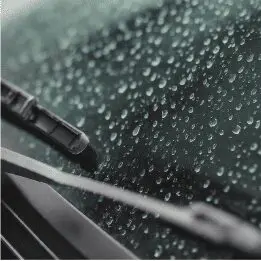
The automotive industry prioritizes maintaining clear visibility for drivers during rain to ensure safety. Traditional windshields often struggle with water build-up, compromising visibility and putting drivers at risk. To address this, the industry has developed a unique solution: applying a hydrophobic coating with a low sliding angle to automotive windshields. This low angle allows rainwater to easily slide off the surface, significantly reducing water build-up and dramatically improving driver visibility and safety in rainy conditions.
Wenn Sie an der Implementierung dieser oder anderer Anwendungen interessiert sind, kontaktieren Sie uns bitte.
In an industry where precision reigns supreme, how can Automotive manufacturers ensure their products withstand scrutiny? The answer lies in standards and guidelines: the compass that guides them through the complex maze of quality and performance.
A combined characterization workflow that pairs ISO 25178 areal (3D) surface texture parameters with quantitative wettability and droplet-mobility metrics to explain whether functional performance is driven mainly by surface chemistry/contamination or by texture/roughness state. Dropometer provides the wettability/mobility measurements; ISO 25178 texture metrology must be performed separately using a profilometer/interferometer.
Use when a part fails or drifts and you need to separate “chemistry/contamination” causes from “texture recipe/process” causes with measurable evidence.
Use when establishing PPAP/APQP-ready limits by correlating texture parameters + wetting/mobility outputs to real performance outcomes.
Note: Correlation thresholds must be calibrated per part family + process by tying texture + wettability outputs to actual functional outcomes (adhesion test, clearing/fogging performance, defect/return rates). Treat Wenzel/Cassie interpretations as diagnostic models with assumptions, not as universal truth.
We hope this guide showed you how to apply surface science in the Automotive industry.
Nun möchten wir das Wort an Sie übergeben:
Feel free to leave a comment below—we’d love to hear from you.