






Inhalt

Biotechnologie Industrie
The Practical Guide to Surface Science (2026)

?s=100&d=m
Geschrieben von
No biography added yet.
Weiterlesen
?s=100&d=m
Reviewed by
N/A
No biography added yet.
Weiterlesen
?s=100&d=m
Written By

No biography added yet.

?s=100&d=m
Bewertet von

N/A N/A

No biography added yet.

Dies ist ein praktischer Leitfaden zur Oberflächenforschung für Forscher, die in der Biotechnologieindustrie arbeiten.

In diesem brandneuen Leitfaden erfährst du alles über:

  • Entscheidende Prinzipien der Oberflächenforschung
  • Die Bedeutung von oberflächenwissenschaftlichen Messungen für die Biotechnologie-Industrie
  • Anwendbare ASTM-Normen und -Richtlinien

Lassen Sie uns gleich eintauchen.

Biotechnologie

Executive Summary

What it covers: A practical biotechnology-focused guide to measuring and interpreting contact angle (static + advancing/receding), surface tension (static + dynamic), surface energy, and sliding angle to quantify wettability and interfacial behavior in materials, coatings, and liquid formulations. It connects each measurement to real biotech use cases (biomaterials, drug delivery, tissue engineering, diagnostics, fermentation sensors, and bioprocess purification).
Key insights: Real biotech surfaces rarely have a single “true” contact angle, hysteresis and advancing/receding angles are often more diagnostic than a lone static value for adhesion, cleanliness, roughness, and heterogeneity. Method choice matters: Young–Laplace is typically more consistent but assumes an axisymmetric drop, while polynomial fitting handles non-axisymmetric drops but can be more sensitive to local defects; dynamic surface tension is the right tool when interfaces evolve quickly (surfactants/additives, droplet/bubble formation, foams, evaporation-driven changes).
Business value: These measurements turn surface behavior into actionable QC and design inputs; helping teams improve biocompatibility, coating performance, nanoparticle interactions, and process robustness while spotting contamination or treatment drift early. Using benchmark datasets and repeatable methods reduces rework and variability in workflows where small wettability shifts can cascade into major biological or manufacturing outcomes.
Standards to follow: For surface/interfacial tension reporting that must be standards-compliant, use ASTM D1331 (Du Noüy ring or Wilhelmy plate force tensiometry) and do not label pendant-drop optical results as “ASTM D1331” unless you’re explicitly doing a validated bridge study. Follow the guide’s reporting guardrails: document sample identity, geometry, temperature control, cleaning/conditioning, replicates + statistics, force-data corrections, and any deviations from ASTM/SOP.
Bottom line: This is a biotech-ready, measurement-first playbook for what to measure, when to use each method, and how to interpret results; backed by real-world examples, benchmarks, and a clear standards boundary so teams can make wettability and interfacial properties repeatable drivers of product performance and QC decisions.

Kapitel 1: Einführung

In der Biotech-Industrie messen wir den Kontaktwinkel, die Oberflächenenergie und die Oberflächenspannung, um die Benetzbarkeit und Oberflächeneigenschaften von Materialien zu bewerten. Diese Messungen wirken sich erheblich auf verschiedene Anwendungen aus, darunter Arzneimittelverabreichungssysteme, Biomaterialien, Tissue Engineering und Diagnosegeräte. Durch das Verständnis des Grenzflächenverhaltens und der Oberflächeneigenschaften können wir die Leistung, Zuverlässigkeit und Biokompatibilität von Biotech-Produkten optimieren.


Biotechnologie

We use the following surface properties to understand the behavior of Biotechnology products and improve their quality.

Kapitel 2: Kontaktwinkelmessung

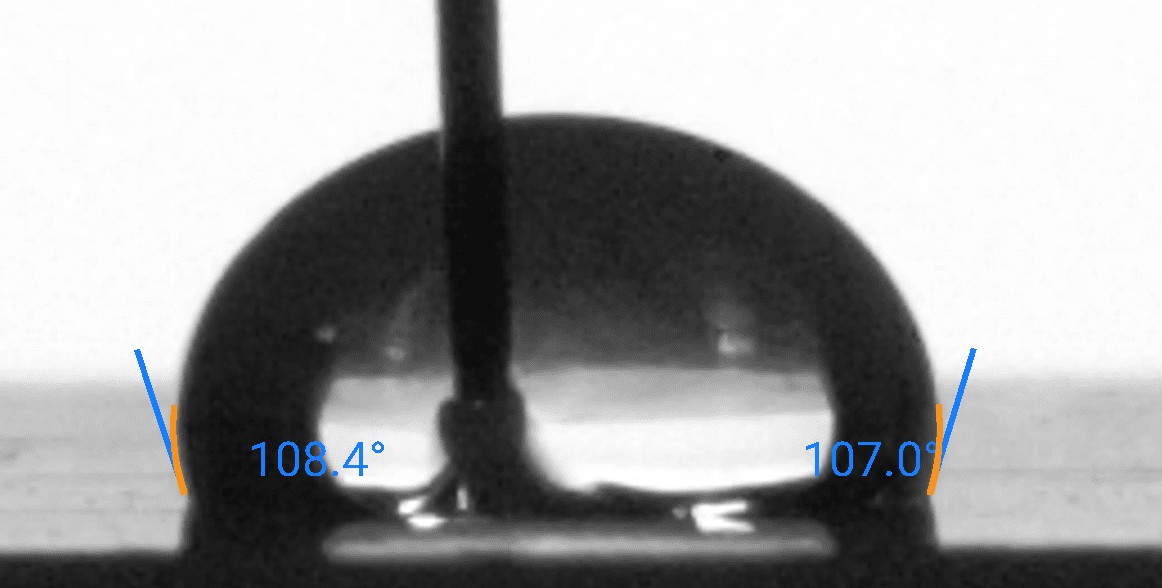
Der Kontaktwinkel quantifiziert die Benetzbarkeit einer Oberfläche, indem er den Winkel zwischen der Oberfläche einer Flüssigkeit und einer festen Oberfläche darstellt.
Dropletlab-Forschung

Sample Image taken from Droplet Lab Tensiometer.

Young – Laplace-Methode

Polynomiale Methode

Dynamischer Kontaktwinkel

Ideally, when we place a drop on a solid surface, a unique angle exists between the liquid and the solid surface. We can calculate the value of this ideal contact angle (the so-called Young’s contact angle) using Young’s equation. In practice, due to surface geometry, roughness, heterogeneity, contamination, and deformation, the contact angle value on a surface is not necessarily a single consistent value but rather falls within a range. The upper and lower limits of this range are known as the advancing and receding contact angles, respectively. The values of advancing and receding contact angles for a solid surface are highly sensitive to many parameters, such as temperature, humidity, homogeneity, and minor contamination of the surface and liquid. For example, the advancing and receding contact angles of a surface can differ at different locations.

Dynamischer Kontaktwinkel versus statischer Kontaktwinkel

Praktische Oberflächen und Beschichtungen weisen von Natur aus eine Kontaktwinkelhysterese auf, die auf eine Reihe von Gleichgewichtswerten hinweist. Wenn wir statische Kontaktwinkel messen, erhalten wir einen einzigen Wert innerhalb dieses Bereichs. Sich ausschließlich auf statische Messungen zu verlassen, wirft Probleme auf, wie z. B. schlechte Wiederholgenauigkeit und unvollständige Oberflächenbewertung in Bezug auf Haftung, Sauberkeit, Rauheit und Homogenität.

In practical applications, we need to understand how easily a liquid spreads (advancing angle) and how easily it is removed (receding angle), such as in painting and cleaning. Measuring advancing and receding angles offers a holistic view of liquid-solid interaction, unlike static measurements, which yield an arbitrary value within the range.

Diese Erkenntnisse sind entscheidend für reale Oberflächen mit Variationen, Rauheit und Dynamik und helfen Branchen wie Kosmetik, Materialwissenschaft und Biotechnologie bei der Gestaltung effektiver Oberflächen und der Optimierung von Prozessen.

Erfahren Sie, wie die Kontaktwinkelmessung mit unserem Tensiometer durchgeführt wird

Für ein vollständigeres Verständnis der Kontaktwinkelmessung lesen Sie unsere Kontaktwinkelmessung: Der endgültige Leitfaden

Open Benchmark Data: Contact Angle & Surface Energy

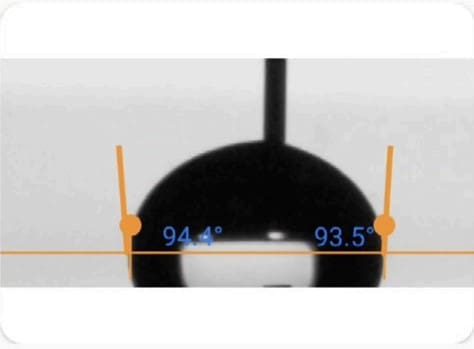
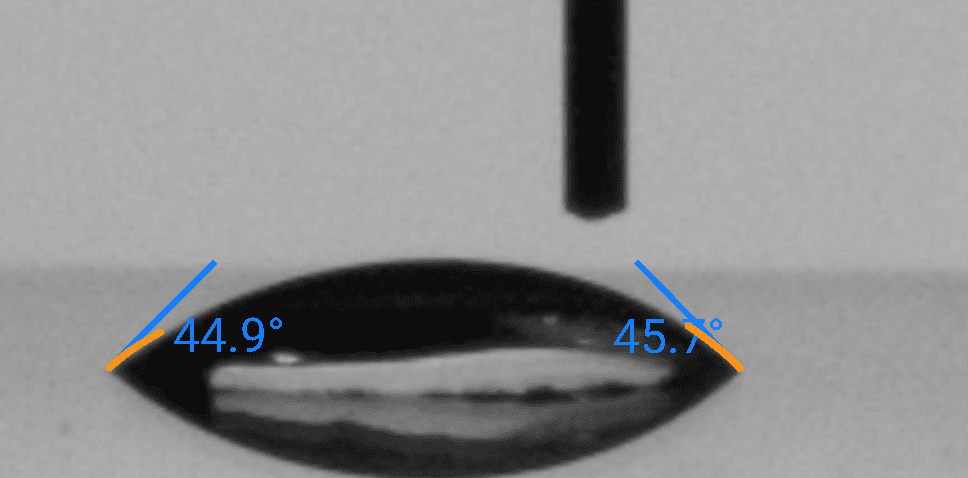
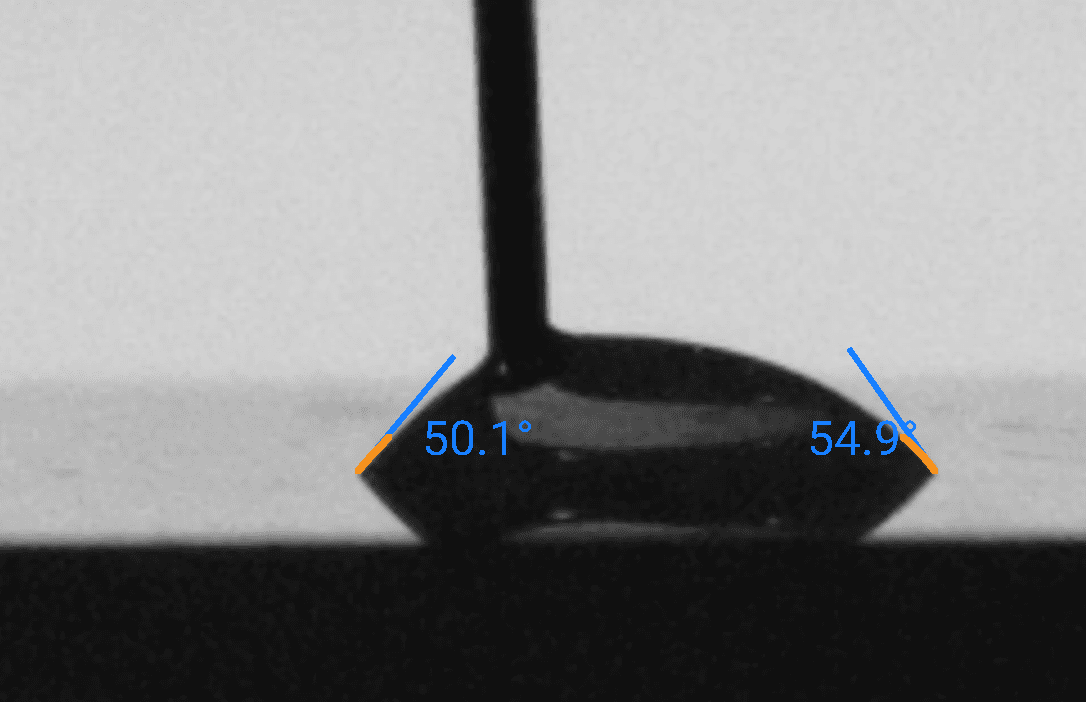
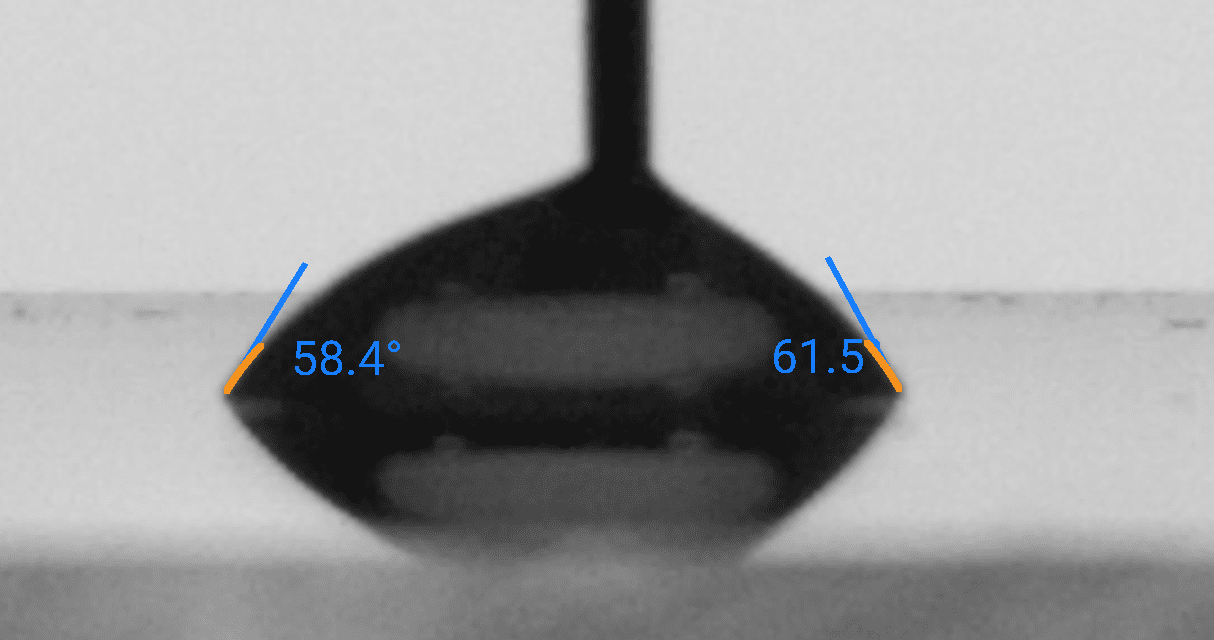
These reference measurements show how deionized water wets four standard substrates measured with the Droplet Lab Dropometer. Use them as visual and numerical benchmarks when you're checking your own sample preparation, treatments, and chemistry.

Full contact angle and surface energy datasets (including additional liquids and statistics) are available on our dataset hub.

Glass - DI Water
Glass - DI Water
Nylon - DI Water
Nylon - DI Water
PMMA - DI Water
PMMA - DI Water
Teflon - DI Water
Teflon - DI Water

The droplet images above are taken from the same benchmark series as our open dataset. For each substrate and probe liquid we report:

● Advancing and receding contact angles (and hysteresis)
● Derived surface energy (SFE) values based on multi-liquid measurements
● Measurement conditions, uncertainties, and sample preparation details

Comparing your own droplet shapes and angles against these references is a fast way to spot contamination, treatment drift, or unexpected changes in wettability.

Kapitel 3: Messung der Oberflächenspannung

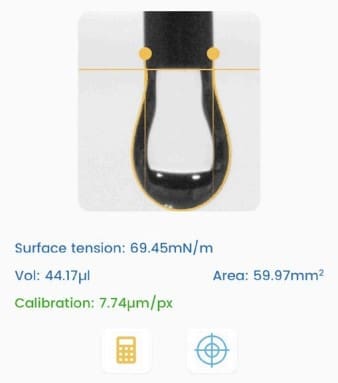
Diese Eigenschaft misst die Kraft, die auf die Oberfläche einer Flüssigkeit wirkt, mit dem Ziel, ihre Oberfläche zu minimieren.

Messung der Oberflächenspannung

Sample Image taken from Droplet Lab Tensiometer

Dynamische Oberflächenspannung

Die dynamische Oberflächenspannung unterscheidet sich von der statischen Oberflächenspannung, die sich auf die Oberflächenenergie pro Flächeneinheit (oder die Kraft, die pro Längeneinheit entlang des Randes einer flüssigen Oberfläche wirkt) bezieht.

Die statische Oberflächenspannung charakterisiert den Gleichgewichtszustand der Grenzfläche von Flüssigkeiten, während die dynamische Oberflächenspannung die Kinetik von Änderungen an der Grenzfläche berücksichtigt. Diese Veränderungen können das Vorhandensein von Tensiden, Additiven oder Schwankungen in Temperatur, Druck und Zusammensetzung an der Grenzfläche beinhalten.

Wann sollte die dynamische Oberflächenspannungsmessung verwendet werden?

Dynamic surface tension is essential for processes that involve rapid changes at the liquid-gas or liquid-liquid interface, such as droplet and bubble formation, coalescence (change in surface area), the behavior of foams, and the drying of paints (change in composition, e.g., evaporation of solvent). It is measured by analyzing the shape of a hanging droplet over time.

Die dynamische Oberflächenspannung gilt für verschiedene Branchen, darunter Kosmetika, Beschichtungen, Pharmazeutika, Farben, Lebensmittel und Getränke sowie industrielle Prozesse, in denen das Verständnis und die Kontrolle des Verhaltens von Flüssigkeitsgrenzflächen für die Produktqualität und Prozesseffizienz unerlässlich ist.

Erfahren Sie, wie die Messung der Oberflächenspannung mit unserem Tensiometer durchgeführt wird

Für ein vollständigeres Verständnis der Oberflächenenergiemessung lesen Sie unsere Oberflächenspannungsmessung: Der endgültige Leitfaden

Kapitel 4: Messung der Oberflächenenergie

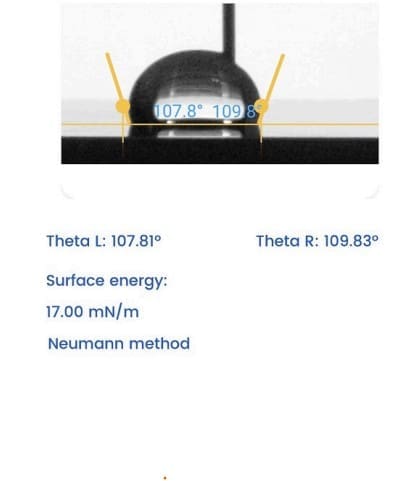
Die Oberflächenenergie bezieht sich auf die Energie, die erforderlich ist, um eine Flächeneinheit einer neuen Oberfläche zu erzeugen.
231

Sample Image taken from Droplet Lab Tensiometer

Erfahren Sie, wie die Messung der Oberflächenenergie mit unserem Tensiometer durchgeführt wird

Für ein umfassenderes Verständnis der Oberflächenenergiemessung lesen Sie unsere Oberflächenenergiemessung: Der ultimative Leitfaden

For benchmark contact angle and surface energy values on glass, nylon, PMMA, and Teflon, see the Open Benchmark Data panel above or visit our Dataset Hub for full CSV downloads.

Kapitel 5: Gleitwinkelmessung

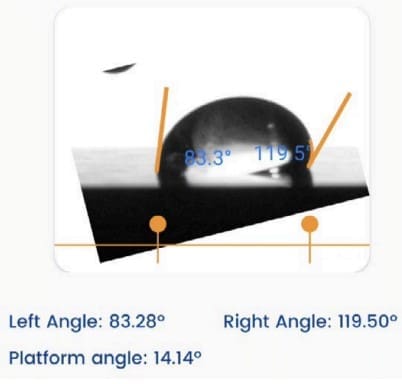
Der Gleitwinkel misst den Winkel, in dem ein flüssiger Film über eine feste Oberfläche gleitet. Es wird häufig verwendet, um die Rutschhemmung einer Oberfläche zu beurteilen.

Gleitwinkel 1

Sample Image taken from Droplet Lab Tensiometer

Erfahren Sie, wie die Gleitwinkelmessung mit unserem Tensiometer durchgeführt wird

Für ein umfassenderes Verständnis der Gleitwinkelmessung lesen Sie unsere Gleitwinkelmessung: Der endgültige Leitfaden

Kapitel 6: Anwendungen in der Praxis

In der Biotechnologiebranche gibt es mehrere Fallstudien, die die Vorteile der Durchführung von Messungen der Oberflächeneigenschaften veranschaulichen.

Buffer-Dependent Wetting and Surface Energy Tuning of Polyserotonin Biointerfaces for Biomedical Coatings

This study evaluates how buffer choice during serotonin polymerization influences the physicochemical properties of polyserotonin nanoparticles (PSeNP) and polyserotonin films, which are bioinspired materials with potential biomedical and coating applications. The authors demonstrate that buffer molecules can become incorporated into the forming polyserotonin matrix, supported by experimental surface/chemical analyses and density functional theory calculations. While nanoparticle elasticity remains similar across buffer systems, polyserotonin films show buffer-dependent differences in nanoscale surface properties, consistent with solvent/buffer effects on surface functional groups. Overall, the work provides guidance for selecting synthesis conditions to rationally tailor polyserotonin material properties toward specific applications.

Role of the Droplet Lab Goniometer

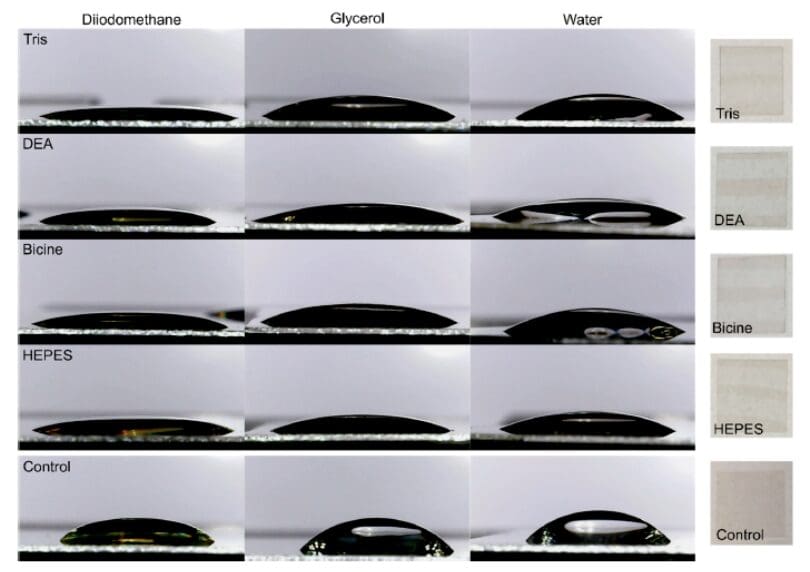
The Droplet Lab goniometer (cited in the paper as “Droplet Smart Tech, Markham, ON, Canada”) was used to measure static contact angles on polyserotonin-coated glass films using 20 µL droplets of milli-Q water, glycerol, and diiodomethane (Materials & Methods, Section 2.2, page 3). Those contact angle measurements were then used to calculate surface energy via the Owens–Wendt–Rabel–Kaelbel (OWRK) model, enabling quantitative comparison of buffer-dependent film wettability and surface energetics (Results/Discussion, Section 3.4, pages 7–8; Supplementary Figure S5 and Table S1 are referenced for the contact angle and surface energy data).

Key Findings

  • Buffer components can incorporate into polyserotonin frameworks during synthesis (evidence supported by chemical/surface characterization and DFT).
  • Nanoparticle size distribution depends on buffer choice (e.g., Tris produced the most uniform size distribution; other buffers yielded broader distributions).
  • Nanoparticle stiffness (apparent Young’s modulus) showed no significant dependence on buffer type when particles of comparable size were analyzed.
  • Polyserotonin films alter surface wetting: the film coating makes glass more hydrophilic, decreasing water contact angle by >15° and increasing surface energy from ~47 to ~61 mJ/m² (Section 3.4, pages 7–8).
  • The increase in surface energy for coated glass is driven more by the dispersive component than the polar component (Section 3.4, pages 7–8).
  • Buffer choice also affects film thickness and nanoscale surface interactions (e.g., Tris produced thinner films; HEPES produced thicker films per the referenced supplemental table).

Why It Matters

In biotechnology workflows such as biointerface coatings, nanoparticle-enabled delivery systems, and surface engineering for reduced fouling or controlled adsorption; small shifts in wettability, surface energy, and surface chemistry can change protein adsorption, cell interactions, and coating performance. This paper shows that buffer selection during synthesis is a practical “knob” to tune film surface properties (quantified via contact angle and surface energy) without materially changing nanoparticle stiffness, helping teams define synthesis specifications and QC targets that align with downstream biological performance.

Method Snapshot

Polyserotonin films on glass were evaluated using static contact angles: 20 µL droplets of water, glycerol, and diiodomethane were manually placed on the films and imaged (page 3, Section 2.2). Surface energy was calculated using the OWRK model, which uses the known surface tension components of the probe liquids (surface tension not measured directly in this study).

Data Note

Contact angle images of diiodomethane, glycerol, and water on PSe films formed on glass coverslips. A panel of alternating strips of PSe films formed on the glass coverslips on the right.

Figure

Citation (APA Format)

Jeon, K., Asuncion, J. A., Corbett, A. L., Yuan, T., Patel, M., Andoy, N. M. O., Kreis, C. T., Voznyy, O., & Sullan, R. M. A. (2022). Buffer components incorporate into the framework of polyserotonin nanoparticles and films during synthesis. Nanomaterials, 12(12), 2027. https://doi.org/10.3390/nano12122027

View Publication →

Der Tanz der Sensoren für gelösten Sauerstoff in der Fermentation

Glykolipid-Biotenside aus Hefe stellen eine nachhaltige Innovation in der chemischen Produktion dar. Verschiedene Branchen, von der Lebensmittel- bis zur Kosmetikindustrie, setzen auf diese Tenside. Entscheidend ist, dass gelöster Sauerstoff eine Schlüsselrolle bei ihrer Synthese spielt. Es versorgt Mikroorganismen mit ausreichend Sauerstoff und schafft die ideale Umgebung für ein gutes Wachstum. Daher müssen Membranen, die den Gehalt an gelöstem Sauerstoff überwachen, das richtige Gleichgewicht erreichen: hydrophob genug, um Zelltrümmer abzustoßen, aber nicht so hydrophob, dass sie Luftblasen einschließen. Die Forscher verwenden Werkzeuge wie das von Droplet Lab entwickelte Tensiometer, um die Oberflächeneigenschaften dieser Membranen und der Fermentationslösung zu beurteilen und so einen nahtlosen und präzisen Produktionsprozess zu gewährleisten.

Der Tanz der Sensoren für gelösten Sauerstoff in der Fermentation

Leben schaffen mit Oberflächenbeschichtungen

Medizinische Implantate, Gerüste und Biosensoren verändern unser Leben und werden zur täglichen Realität. Es ist entscheidend zu verstehen, wie verschiedene Oberflächen von Biomaterialien mit Wasser interagieren und es entweder anziehen (hydrophil) oder abstoßen (hydrophob). Dieses Wissen wirkt sich direkt auf alles aus, von der Zelladhäsion bis zur Geweberegeneration. Durch eine sorgfältige Anpassung der Oberflächenenergie und der Rauheit eines Substrats können wir beispielsweise das Zellwachstum deutlich verbessern. Die Oberflächenspannung spielt bei der Herstellung von Hybridwerkstoffen eine Schlüsselrolle. Wir können 3D-gedruckte Polymere mit zellbeladenen Hydrogelen kombinieren, um vollständig biokompatible 3D-Strukturen aus lebendem Gewebe zu schaffen. Dieser innovative Ansatz nutzt Oberflächenbenetzungskräfte, um flüssige Filme über die Öffnungen eines Netzes zu suspendieren, die dann in eine feste Beschichtung oder ein Hydrogel umgewandelt werden können.

Leben schaffen mit Oberflächenbeschichtungen

Nano Magic: Gezielte Behandlung

It's easy to dismiss nanoparticles as insignificant due to their small size, but looks can be deceiving. Despite their tiny size, they're revolutionizing the biotech industry with their remarkable versatility. Their large surface area to volume ratio, coupled with adjustable surface chemistry, makes them ideal for drug delivery systems. Take glaucoma treatment, for example. Both the medication itself and its delivery method play crucial roles in its effectiveness. By analyzing contact angles, researchers can precisely control how drug-loaded nanoparticles interact with the eye's surface. This leads to optimized formulations that not only improve patient outcomes but also ensure sustained and efficient drug delivery.

Nano Magic: Gezielte Behandlung

Bioprozessreinigung: Wo Präzision auf Wirksamkeit trifft

Moderne Bioprozesse bieten faszinierende Reisen, bei denen Rohstoffe in potenziell lebensrettende Medikamente oder lebenswichtige Enzyme umgewandelt werden. In den Anfangsstadien finden sich jedoch häufig Einschlusskörper oder Kristalle. Diese Bioprozesse erzeugen eine komplexe flüssige Phase, einen Schmelztiegel verschiedener Biopartikel, die von Zelltrümmern und ganzen Zellen bis hin zu partikulären Biokatalysatoren und Nebenprodukten reichen. Es ist keine leichte Aufgabe, diese wertvollen Einheiten von den umgebenden anderen Partikeln zu trennen, da der Kontaktwinkel jedes Biopartikels eine entscheidende Rolle in diesem Reinigungsprozess spielt.
Surface properties take center stage here, as a particle's surface dictates its interactions with its environment. This is where our tools come into play, providing researchers with the detailed insights needed to optimize the purification process. For example, drying and re-dispersing these particles present significant challenges. Without understanding the capillary forces at play – forces directly influenced by surface tension – particles can easily aggregate or films can crack. By providing precise measurements, we empower researchers to avoid these pitfalls and achieve the highest possible product quality.

Bioprozessreinigung: Wo Präzision auf Wirksamkeit trifft

Wir sind Ihre Partner bei der Lösung Ihrer geschäftlichen und technologischen Probleme herausforderungen

Wenn Sie an der Implementierung dieser oder anderer Anwendungen interessiert sind, kontaktieren Sie uns bitte.

Kapitel 7: Normen und Richtlinien

In an industry where precision reigns supreme, how can Biotechnology manufacturers ensure their products withstand scrutiny? The answer lies in standards and guidelines: the compass that guides them through the complex maze of quality and performance.

ASTM D1331 — Surface & Interfacial Tension of Solutions (Du Noüy Ring / Wilhelmy Plate Force Methods)

What it is

ASTM D1331 is a method-defined standard for measuring surface tension and interfacial tension of liquids using force tensiometry, where a Du Noüy ring or Wilhelmy plate is pulled from a liquid or across an interface. Results may be called “ASTM D1331” only when generated using these ring/plate force methods (optical pendant-drop results are not D1331 as-written).

When to use it

Release/spec or customer-required reporting

Use when a customer, contract, or internal specification explicitly requires a value reported as “ASTM D1331” (ring/plate force tensiometry is required).

Reference method for method-bridging

Use as the periodic “truth” method to validate or calibrate faster internal screening methods (e.g., Dropometer pendant-drop) by building correlation bands against D1331 results.

In-scope / Out-of-scope

In scope
  • Surface tension of liquid formulations measured by Du Noüy ring or Wilhelmy plate force tensiometry.
  • Interfacial tension between two liquid phases (e.g., aqueous/organic, aqueous/oil) using ring/plate force tensiometry.
  • Comparative QC/R&D testing when the same geometry, corrections, and temperature control are used consistently.
  • Solutions that may include surfactants/additives (common in biotech formulations), provided handling, cleanliness, and equilibration are controlled and documented.
Out of scope
  • Optical pendant-drop (Young–Laplace) methods (e.g., Dropometer pendant drop) and any other non-force optical techniques.
  • Sessile-drop contact angle or solid-surface wettability/surface energy determinations.
  • Dynamic surface tension methods (e.g., maximum bubble pressure) unless your SOP explicitly defines how they relate (they are not D1331).
  • Labeling non-ring/plate results as “ASTM D1331” (method name is not interchangeable with the property name).

Minimum you must report (checklist)

  • Sample identity (formulation name, lot/batch, concentration of key excipients/surfactants, age/time since mixing).
  • Property measured: surface tension or interfacial tension; for interfacial, identify both phases.
  • Instrument + method geometry: Du Noüy ring or Wilhelmy plate; include ring/plate material and dimensions (as applicable).
  • Temperature and control method (setpoint, measured value, equilibration time).
  • Cleaning/conditioning protocol for ring/plate and sample vessel (and any acceptance check).
  • Replicate plan + statistics (n, mean/median, SD/IQR, outlier rule if used).
  • Correction/processing details used for force data (e.g., any correction factor approach and inputs required).
  • Deviations from ASTM D1331 or your internal SOP (and why).

Note: Dropometer (optical pendant-drop Young–Laplace) can measure the same property (surface/interfacial tension) but it does not comply with ASTM D1331 because D1331 requires ring/plate force tensiometry. Use pendant drop for internal trending/screening and reserve ring/plate for any result that must be labeled “ASTM D1331.”

How to interpret results (guardrails)

  • Treat γ as method-defined: do not compare pendant-drop γ and D1331 γ as interchangeable unless you have a validated bridge dataset.
  • Use correlation bands for QC decisions: build Green/Yellow/Red limits from paired measurements (Dropometer vs D1331) and re-verify periodically.
  • Watch repeatability as a signal: increased scatter often indicates contamination, poor cleaning, bubbles/particles, or unstable interfaces—investigate before releasing decisions.
  • Standardize time + temperature in biotech fluids: surfactant/protein systems can be time-dependent; control equilibration timing and report it consistently.

Jetzt sind Sie an der Reihe

We hope this guide showed you how to apply surface science in the Biotechnology industry.

Nun möchten wir das Wort an Sie übergeben:

Feel free to leave a comment below—we’d love to hear from you.

Hinterlasse eine Antwort

Deine E-Mail-Adresse wird nicht veröffentlicht. Pflichtfelder sind markiert *


Experiment herunterladen