





Inhalt

Chemikalien Industrie
The Practical Guide to Surface Science (2026)

?s=100&d=m
Geschrieben von
No biography added yet.
Weiterlesen
?s=100&d=m
Reviewed by
N/A
No biography added yet.
Weiterlesen
?s=100&d=m
Written By

No biography added yet.

?s=100&d=m
Bewertet von

N/A N/A

No biography added yet.

This is a practical guide to Surface Science for researchers working in the Chemicals Industry.

In diesem brandneuen Leitfaden erfährst du alles über:

  • Entscheidende Prinzipien der Oberflächenforschung
  • The significance of surface science measurements for the Chemicals industry
  • Anwendbare ASTM-Normen und -Richtlinien

Lassen Sie uns gleich eintauchen.

chemical

Executive Summary

What it covers: A practical guide to the four core surface measurements—contact angle (static + advancing/receding), surface tension (static + dynamic), surface energy, and sliding angle—and how to apply each in chemicals R&D, formulation, and QC. It also links measurement choices to real production problems like wetting defects, dispersion stability, and adhesion failures.
Key insights: Advancing/receding (dynamic) contact angles give a more realistic picture of wettability on real, imperfect surfaces than a single static value, and Young–Laplace vs. polynomial fitting is a repeatability vs. flexibility trade-off. Use dynamic surface tension when interfaces evolve quickly (droplet/bubble formation, foams, solvent evaporation/drying), and treat benchmark datasets/images as fast “sanity checks” to catch contamination or treatment drift.
Business value: Better control of surface properties improves nanoparticle dispersibility, coating/substrate adhesion, and emulsion stability—reducing rejects, rework, and troubleshooting time. In sustainability-focused production, surface measurements help optimize catalysts and wetting/interaction behavior to cut waste and energy use while improving consistency.
Standards to follow: Use ASTM D7334 for advancing contact angle practice and the ISO 19403 series for reproducible wettability/SFE, dynamic angles, and roll-off/sliding behavior in R&D and QC. For liquid coatings, follow EN ISO 19403‑3 for pendant-drop surface tension (and cite the exact revision/edition used to keep QC trending comparable).
Bottom line: This is a standards-aligned, shop-floor-to-lab playbook for choosing the right surface measurement at the right time—and interpreting it in a way that improves product reliability, speeds root-cause work, and strengthens formulation decisions. It turns surface science from “nice-to-have data” into an operational tool for tighter QC and better-performing chemical products.

Kapitel 1: Einführung

The surface properties of materials significantly impact the chemical industry, influencing product quality, performance, and consumer satisfaction. Understanding surface tension, contact angle, sliding angle, and surface energy enables the development of chemicals and materials with superior adhesion, dispersibility, and stability.

In addressing the chemical industry’s challenges—such as creating high-performance products, and ensuring product stability and longevity—precision, innovation, and efficiency are essential. Surface science offers critical insights into surface interactions, interfacial phenomena, and material compatibility, providing a foundation for optimizing chemical production methodologies.

We use the following surface properties to understand the behavior of Chemicals products and improve their quality.

Kapitel 2: Kontaktwinkelmessung

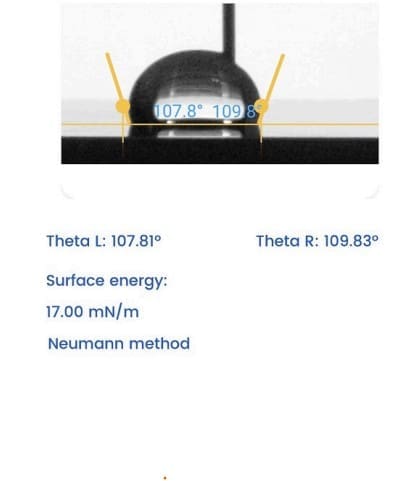
Der Kontaktwinkel quantifiziert die Benetzbarkeit einer Oberfläche, indem er den Winkel zwischen der Oberfläche einer Flüssigkeit und einer festen Oberfläche darstellt.
Dropletlab-Forschung

Sample Image taken from Droplet Lab Tensiometer.

Young – Laplace-Methode

Polynomiale Methode

Dynamischer Kontaktwinkel

Ideally, when we place a drop on a solid surface, a unique angle exists between the liquid and the solid surface. We can calculate the value of this ideal contact angle (the so-called Young’s contact angle) using Young’s equation. In practice, due to surface geometry, roughness, heterogeneity, contamination, and deformation, the contact angle value on a surface is not necessarily a single consistent value but rather falls within a range. The upper and lower limits of this range are known as the advancing and receding contact angles, respectively. The values of advancing and receding contact angles for a solid surface are highly sensitive to many parameters, such as temperature, humidity, homogeneity, and minor contamination of the surface and liquid. For example, the advancing and receding contact angles of a surface can differ at different locations.

Dynamischer Kontaktwinkel versus statischer Kontaktwinkel

Praktische Oberflächen und Beschichtungen weisen von Natur aus eine Kontaktwinkelhysterese auf, die auf eine Reihe von Gleichgewichtswerten hinweist. Wenn wir statische Kontaktwinkel messen, erhalten wir einen einzigen Wert innerhalb dieses Bereichs. Sich ausschließlich auf statische Messungen zu verlassen, wirft Probleme auf, wie z. B. schlechte Wiederholgenauigkeit und unvollständige Oberflächenbewertung in Bezug auf Haftung, Sauberkeit, Rauheit und Homogenität.

In practical applications, we need to understand how easily a liquid spreads (advancing angle) and how easily it is removed (receding angle), such as in painting and cleaning. Measuring advancing and receding angles offers a holistic view of liquid-solid interaction, unlike static measurements, which yield an arbitrary value within the range.

Diese Erkenntnisse sind entscheidend für reale Oberflächen mit Variationen, Rauheit und Dynamik und helfen Branchen wie Kosmetik, Materialwissenschaft und Biotechnologie bei der Gestaltung effektiver Oberflächen und der Optimierung von Prozessen.

Erfahren Sie, wie die Kontaktwinkelmessung mit unserem Tensiometer durchgeführt wird

Für ein vollständigeres Verständnis der Kontaktwinkelmessung lesen Sie unsere Kontaktwinkelmessung: Der endgültige Leitfaden

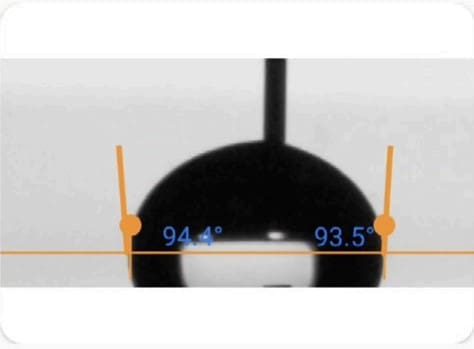
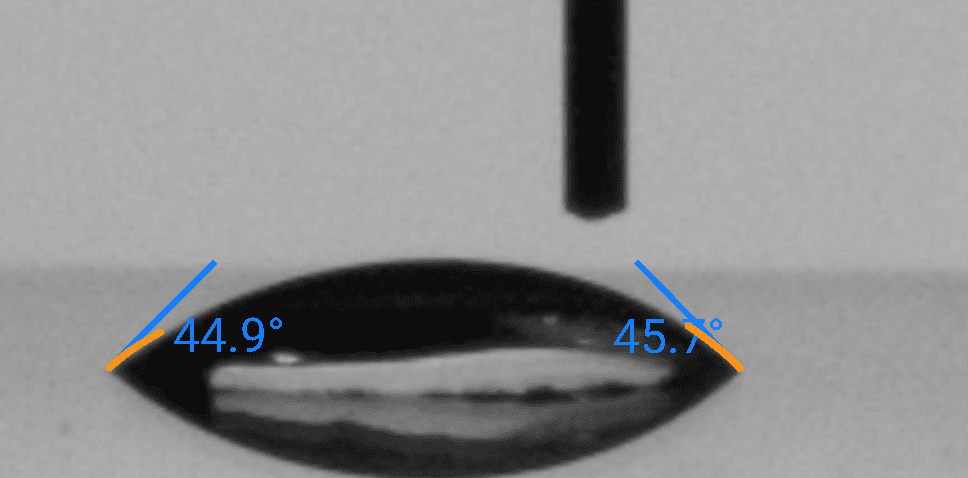
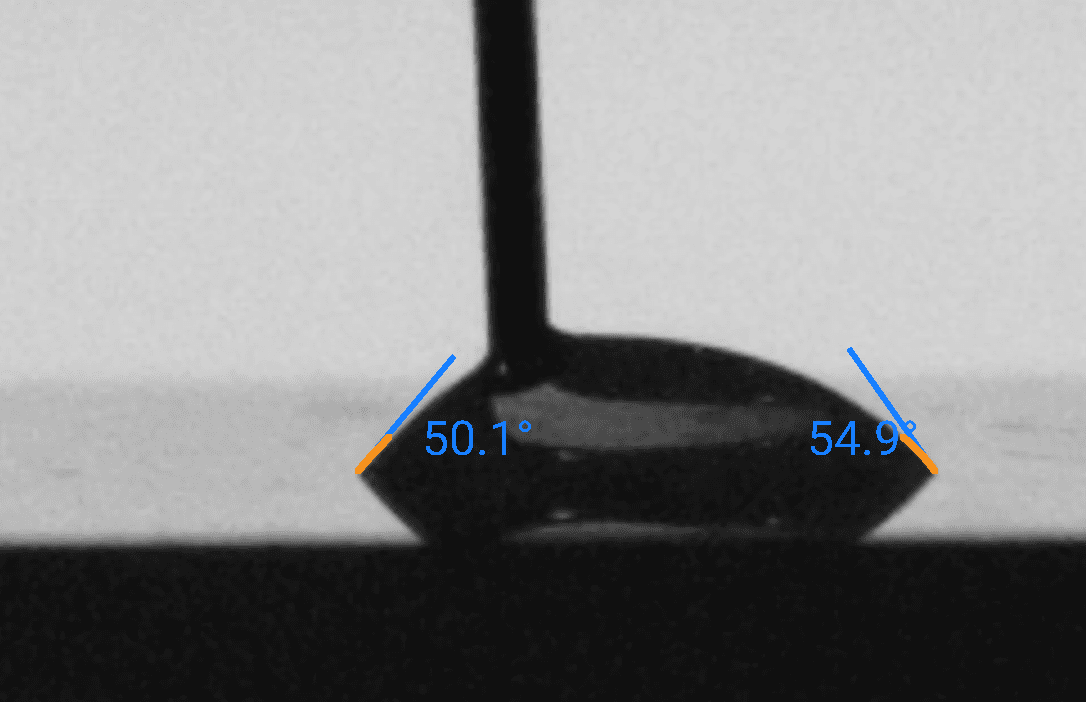
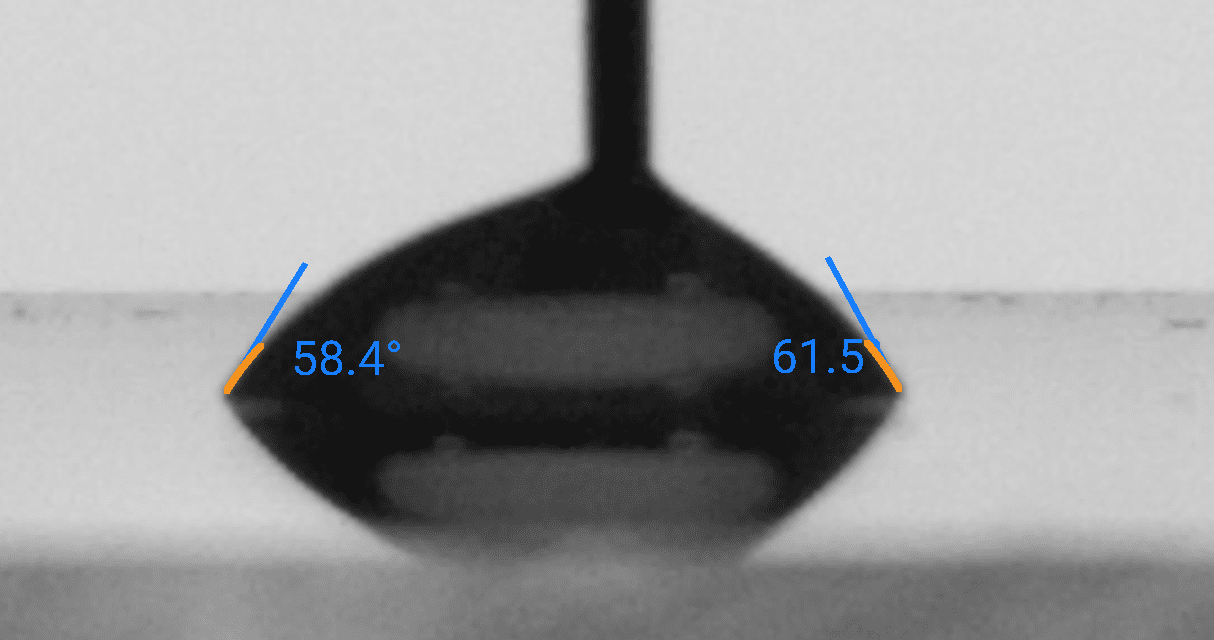
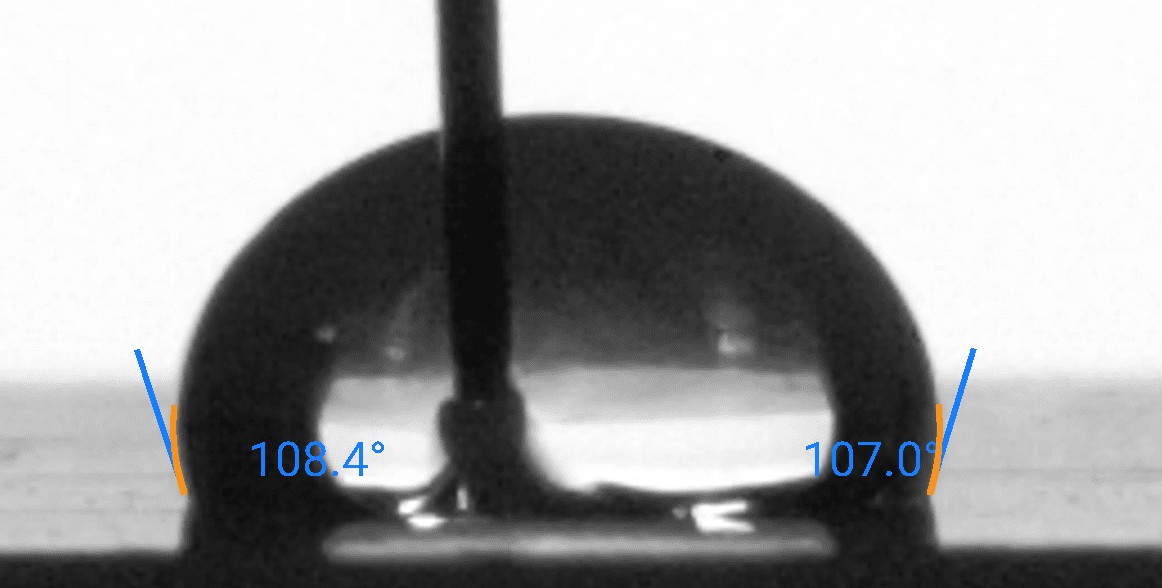
Open Benchmark Data: Contact Angle & Surface Energy

These reference measurements show how deionized water wets four standard substrates measured with the Droplet Lab Dropometer. Use them as visual and numerical benchmarks when you're checking your own sample preparation, treatments, and chemistry.

Full contact angle and surface energy datasets (including additional liquids and statistics) are available on our dataset hub.

Glass - DI Water
Glass - DI Water
Nylon - DI Water
Nylon - DI Water
PMMA - DI Water
PMMA - DI Water
Teflon - DI Water
Teflon - DI Water

The droplet images above are taken from the same benchmark series as our open dataset. For each substrate and probe liquid we report:

● Advancing and receding contact angles (and hysteresis)
● Derived surface energy (SFE) values based on multi-liquid measurements
● Measurement conditions, uncertainties, and sample preparation details

Comparing your own droplet shapes and angles against these references is a fast way to spot contamination, treatment drift, or unexpected changes in wettability.

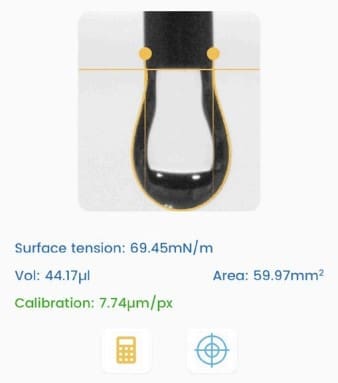
Kapitel 3: Messung der Oberflächenspannung

Diese Eigenschaft misst die Kraft, die auf die Oberfläche einer Flüssigkeit wirkt, mit dem Ziel, ihre Oberfläche zu minimieren.

Messung der Oberflächenspannung

Sample Image taken from Droplet Lab Tensiometer

Dynamische Oberflächenspannung

Die dynamische Oberflächenspannung unterscheidet sich von der statischen Oberflächenspannung, die sich auf die Oberflächenenergie pro Flächeneinheit (oder die Kraft, die pro Längeneinheit entlang des Randes einer flüssigen Oberfläche wirkt) bezieht.

Die statische Oberflächenspannung charakterisiert den Gleichgewichtszustand der Grenzfläche von Flüssigkeiten, während die dynamische Oberflächenspannung die Kinetik von Änderungen an der Grenzfläche berücksichtigt. Diese Veränderungen können das Vorhandensein von Tensiden, Additiven oder Schwankungen in Temperatur, Druck und Zusammensetzung an der Grenzfläche beinhalten.

Wann sollte die dynamische Oberflächenspannungsmessung verwendet werden?

Dynamic surface tension is essential for processes that involve rapid changes at the liquid-gas or liquid-liquid interface, such as droplet and bubble formation, coalescence (change in surface area), the behavior of foams, and the drying of paints (change in composition, e.g., evaporation of solvent). It is measured by analyzing the shape of a hanging droplet over time.

Die dynamische Oberflächenspannung gilt für verschiedene Branchen, darunter Kosmetika, Beschichtungen, Pharmazeutika, Farben, Lebensmittel und Getränke sowie industrielle Prozesse, in denen das Verständnis und die Kontrolle des Verhaltens von Flüssigkeitsgrenzflächen für die Produktqualität und Prozesseffizienz unerlässlich ist.

Erfahren Sie, wie die Messung der Oberflächenspannung mit unserem Tensiometer durchgeführt wird

Für ein vollständigeres Verständnis der Oberflächenenergiemessung lesen Sie unsere Oberflächenspannungsmessung: Der endgültige Leitfaden

Kapitel 4: Messung der Oberflächenenergie

Die Oberflächenenergie bezieht sich auf die Energie, die erforderlich ist, um eine Flächeneinheit einer neuen Oberfläche zu erzeugen.
231

Sample Image taken from Droplet Lab Tensiometer

Erfahren Sie, wie die Messung der Oberflächenenergie mit unserem Tensiometer durchgeführt wird

Für ein umfassenderes Verständnis der Oberflächenenergiemessung lesen Sie unsere Oberflächenenergiemessung: Der ultimative Leitfaden

For benchmark contact angle and surface energy values on glass, nylon, PMMA, and Teflon, see the Open Benchmark Data panel above or visit our Dataset Hub for full CSV downloads.

Kapitel 5: Gleitwinkelmessung

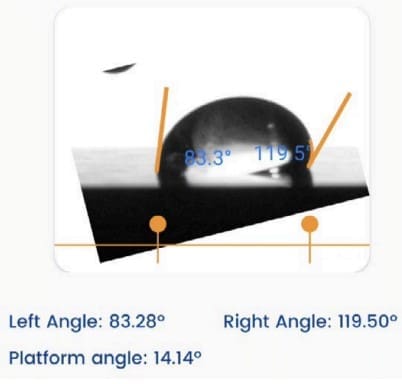
Der Gleitwinkel misst den Winkel, in dem ein flüssiger Film über eine feste Oberfläche gleitet. Es wird häufig verwendet, um die Rutschhemmung einer Oberfläche zu beurteilen.

Gleitwinkel 1

Sample Image taken from Droplet Lab Tensiometer

Erfahren Sie, wie die Gleitwinkelmessung mit unserem Tensiometer durchgeführt wird

Für ein umfassenderes Verständnis der Gleitwinkelmessung lesen Sie unsere Gleitwinkelmessung: Der endgültige Leitfaden

Kapitel 6: Anwendungen in der Praxis

Within the Chemicals industry, several case studies exemplify the advantages of conducting surface property measurements.

Dynamic-covalent fluorosurfactant system for stabilizing fluorinated-oil emulsions by forming an elastic interfacial film

The authors report a newly synthesized fluorosurfactant made by copolymerizing a fluoroacrylate with a boronic-acid-containing acrylamide to stabilize droplets of fluorinated oils. At the fluorinated oil/water interface, the copolymer can dynamically couple with diols or polyols present in the aqueous phase, forming an ultrathin elastic film that stiffens the interface. This interfacial rigidification suppresses droplet recoalescence and enables more robust droplet-based applications.

Role of the Droplet Lab Goniometer

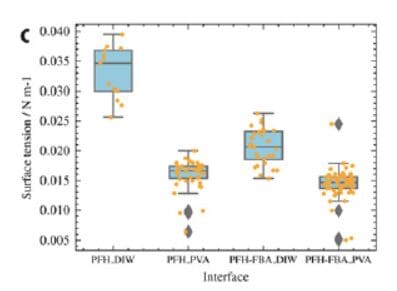
The Droplet Lab tensiometer was used in pendant-drop mode to quantify interfacial tension between perfluorohexane (PFH) and aqueous phases with/without additives. This measurement verified how the new fluorophilic boronic acid (FBA) copolymer and poly(vinyl) alcohol (PVA) each influence interfacial tension and supported the key conclusion that lasting emulsion stability requires the combined FBA–PVA interfacial assembly, not just tension reduction alone (methods: pendant-drop tensiometry; results summarized and visualized in Fig. 2b–c).

Key Findings

  • Interfacial-tension reduction is measurable but not sufficient by itself:
    • Adding FBA to PFH reduces PFH–water interfacial tension to ~20 mN/m (from ~30 mN/m without additives).
    • Adding PVA to water reduces it to ~17 mN/m.
    • The combined FBA-in-PFH + PVA-in-water yields a similar interfacial tension, but stable resistance to coalescence occurs only when both are present.
  • Mechanistic stabilization via an elastic interfacial film: dynamic boronic ester bonding between FBA (oil phase) and PVA (water phase) forms a solid-like elastic film, evidenced by transient wrinkling during droplet retraction (Fig. 2a).
  • Elasticity jump vs commercial control surfactant: interfacial rheology shows the FBA–PVA interface has a ~2-orders-of-magnitude higher complex shear modulus than interfaces stabilized with a commercial fluorosurfactant control (008-FluoroSurfactant) or PVA alone.

Enables complex, thermally reconfigurable emulsions: stable water-in-oil-in-water double emulsions with a hexane:PFH mixed oil shell can undergo temperature-triggered phase separation (around an UCST near 23 °C), reconfiguring into more complex morphologies (triple-emulsion structures) upon cooling.

Why It Matters

For chemical formulators working with fluorinated oils (often challenging to stabilize), this study shows that engineering interfacial mechanics (creating an elastic film via dynamic covalent coupling) can be more decisive than lowering interfacial tension alone. Practically, this supports surfactant system selection and spec-setting: pairing a fluorophilic surfactant with a complementary aqueous-phase polymer (diol/polyol functionality) can deliver robust anti-coalescence performance, enabling more reliable emulsions for microreactors, encapsulation, and responsive materials.

Method Snapshot

  • Sample/interface: PFH–water interfaces with/without FBA in PFH and/or PVA in water.
  • Droplet method: Pendant-drop tensiometry (Droplet Lab tensiometer; OpenDrop analysis).
  • Temperature: not explicitly stated for tensiometry (typical use suggests ambient conditions; only reportable as “not specified”).
  • Angle type: N/A (no contact-angle measurements reported).

Surface/interfacial tension outcomes: PFH–water ~30 mN/m (baseline), reduced to ~20 mN/m (with FBA) and ~17 mN/m (with PVA).

Data Note

Figure 2c contains the surface/interfacial tension measurements (boxplots) for PFH–water interfaces across four conditions (PFH/DIW, PFH/PVA–water, PFH+FBA/DIW, PFH+FBA/PVA–water), generated using the Droplet Lab tensiometer.

Figure

Citation (APA Format)

Wu, Z., Deveney, B. T., Werner, J. G., Aime, S., & Weitz, D. A. (2025). Fluorophilic boronic acid copolymer surfactant for stabilization of complex emulsion droplets with fluorinated oil. Lab on a Chip, 25, 2315–2319. https://doi.org/10.1039/d5lc00309a

View Publication →

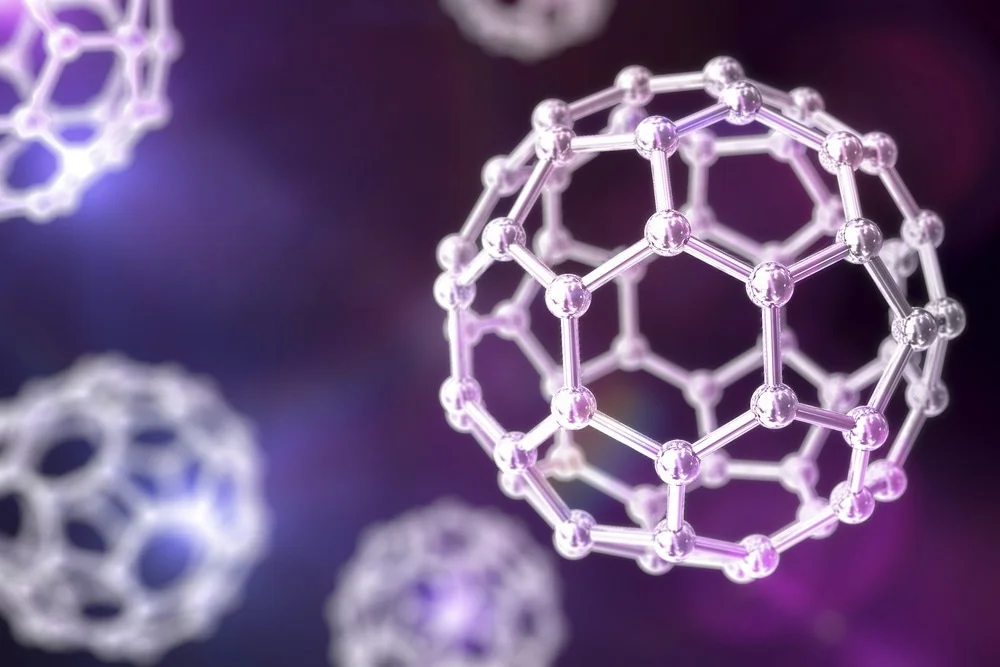
Nanoparticle Dispersibility

In the dynamic and ever-evolving chemical industry, achieving a uniform dispersion of nanoparticles is a challenging task that often determines the effectiveness of a formulation. Imagine a scenario where nanoparticles, commonly used to enhance the performance or appearance of a product, tend to aggregate, leading to non-uniform distributions within the formulation. This aggregation not only reduces the product's efficacy but also poses challenges in the manufacturing process.

By precisely manipulating surface properties such as wettability and surface energy, nanoparticles can achieve a homogeneous dispersion throughout the formulation. This uniform dispersion is crucial for ensuring consistent product quality and performance. The benefits of this precise control go beyond achieving uniformity. Improved nanoparticle dispersibility enhances product stability, shelf life, and overall effectiveness, providing a significant competitive advantage in the market.

Nanoparticle Dispersibility

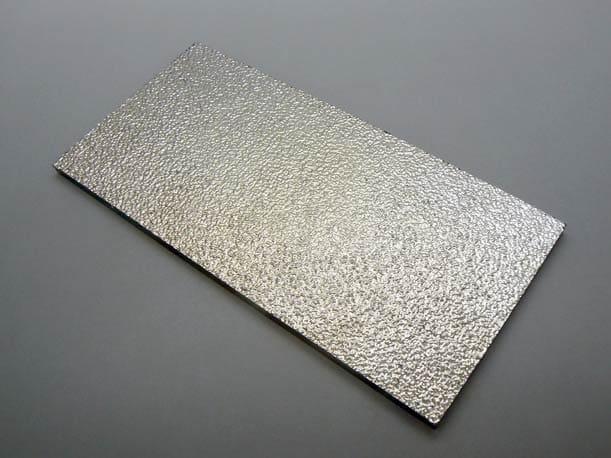
Adhesion Enhancement

In the field of coatings and adhesives, adhesion is critically important as it can significantly impact a product's effectiveness. Consider a situation where the bonding between a coating and its underlying substrate is suboptimal, leading to issues such as peeling, delamination, or reduced longevity. By accurately measuring contact angles and understanding the interactions at the interface between the coating and substrate, you can make informed decisions on modifying surface properties.

Enhanced adhesion is achieved by strategically adjusting the surface properties of coatings to increase compatibility with substrates. This not only improves the product's performance but also extends its lifespan, enhancing the durability and efficacy of products across various industries, including automotive, construction, and others that heavily rely on coatings and adhesives.

Adhesion Enhancement

Nachhaltige chemische Produktion

Ein Chemieunternehmen steht vor der Herausforderung, angesichts wachsender Umweltbedenken, strenger Vorschriften und sich ändernder Kundenpräferenzen hin zu umweltfreundlichen Produkten auf nachhaltige Methoden umzusteigen. Um diese Herausforderung zu meistern, nutzt das Unternehmen die Oberflächenwissenschaft als transformatives Werkzeug.

Die Messung des Kontaktwinkels und der Oberflächenspannung spielt dabei eine entscheidende Rolle, indem sie genaue Einblicke in die Oberflächeneigenschaften von Materialien liefert. Diese Messungen helfen dem Unternehmen, die Benetzungseigenschaften und Wechselwirkungen von Rohstoffen zu bewerten und zu optimieren, was zur Entwicklung effizienterer Katalysatoren führt. Durch das Verständnis und die Manipulation dieser Oberflächeneigenschaften können Forscher die Effizienz des Katalysators verbessern, Abfall reduzieren und den Energieverbrauch senken, was den Prinzipien der nachhaltigen Produktion entspricht.

Dadurch reduziert das Unternehmen seine Umweltbelastung erheblich, übertrifft die gesetzlichen Anforderungen und positioniert sich als führend in der umweltverträglichen Herstellung von Chemikalien. Dieser Wandel kommt nicht nur der Umwelt zugute, sondern führt auch zu Kosteneinsparungen, Marktexpansion und einem gestärkten Markenimage, da die Verbraucher zunehmend Produkte bevorzugen, die Nachhaltigkeitsstandards einhalten.

Nachhaltige chemische Produktion

Wir sind Ihre Partner bei der Lösung Ihrer geschäftlichen und technologischen Probleme herausforderungen

Wenn Sie an der Implementierung dieser oder anderer Anwendungen interessiert sind, kontaktieren Sie uns bitte.

Kapitel 7: Normen und Richtlinien

In an industry where precision reigns supreme, how can Chemicals manufacturers ensure their products withstand scrutiny? The answer lies in standards and guidelines: the compass that guides them through the complex maze of quality and performance.

EN ISO 19403-3 (Part 3) — Paints and varnishes — Determination of surface tension using the pendant drop method

What it is

An optical method for determining the surface tension (γ) of paints, varnishes, and related liquid coating materials by fitting the pendant-drop profile using Young–Laplace shape analysis. Applicability can be restricted for liquids with non-Newtonian flow behaviour, so results must be interpreted within those limits.

When to use it

Incoming QC / batch-release trending

Incoming QC / batch-release trending
Use it to detect batch-to-batch γ drift in resins, solvent blends, additive packages, and finished formulations before application risk shows up on the line.

Troubleshooting wetting and leveling defects

Troubleshooting wetting and leveling defects
Use it when defects (e.g., craters/fisheyes, poor edge coverage, orange peel, intercoat wetting changes) suggest a wettability shift, additive drift, or contamination.

In-scope / Out-of-scope

In scope
  • Liquid coating materials (e.g., resins, solvents, additives, surfactant packages, and paint/varnish formulations) where pendant-drop profiling is feasible.
  • Surface tension of liquids (γ) determined from pendant-drop shape using Young–Laplace fitting.
  • Controlled-condition measurement suitable for repeatable QC trending (temperature defined; density input required for calculations).
  • Replicate-based reporting with fit/shape validity checks (e.g., axisymmetry and fit success).
Out of scope
  • Contact angle / solid-surface wettability measurements (use contact-angle standards instead).
  • Interfacial tension and polar/dispersive component determination (addressed in other parts/methods; only claim if explicitly supported and validated).
  • Alternative surface-tension methods (e.g., ring/plate/bubble-pressure approaches) not based on pendant-drop profile fitting.
  • Full rheology characterization (the method notes non-Newtonian limitations but does not replace rheology testing when flow behaviour drives instability).

Minimum you must report (checklist)

  • Standard revision used (explicitly cite the year/edition used by your quality system) and any deviations from your SOP.
  • Sample identity and history (material type, lot/batch, dilution if any, conditioning/aging time, filtration/degassing if used).
  • Test temperature (setpoint and how it was controlled/verified).
  • Liquid density value at test temperature and the source/method used to obtain it (required input for Young–Laplace analysis).
  • Instrument + pendant-drop setup (instrument model, needle/capillary type/ID, optical calibration/scale approach, and any key acquisition settings that affect shape).
  • Replicates and statistics (number of drops; report γ plus median/mean and spread such as SD or IQR).
  • Fit model and validity criteria (Young–Laplace fitting stated explicitly; axisymmetry requirement; fit-quality pass/fail rule and how failed fits were handled).
  • Result reporting basis (γ in mN/m; time point or stabilization rule after drop formation; any observed time-dependence or instability).

Note: ISO listings show a 2017 edition and a newer 2024 edition—use and cite the exact revision required by your QMS so trending remains comparable. Instruments (e.g., Dropometer) can execute pendant-drop imaging and Young–Laplace fitting with QC gating, but they do not replace the standard or your lab’s controlled protocol.

How to interpret results (guardrails)

  • Treat γ as a trend vs a retained control/baseline, not a universal pass/fail: define Green/Yellow/Red limits by correlating γ shifts to downstream outcomes (leveling, defect counts, spray appearance) for each material family.
  • Use replicate scatter as a diagnostic: unusually high spread or unstable drop profiles often indicate contamination, sample heterogeneity, or handling/cleaning issues—investigate before adjusting formulation.
  • Fit quality is a hard gate: if the drop is not axisymmetric or the Young–Laplace fit fails your acceptance criteria, the result is not valid—re-clean, re-sample, and re-run.
  • Be cautious with non-Newtonian/time-dependent liquids: if the profile evolves with time or repeatability is poor, interpret γ within the method’s limitations and confirm with complementary rheology and/or application tests.

Jetzt sind Sie an der Reihe

We hope this guide showed you how to apply surface science in the Chemicals industry.

Nun möchten wir das Wort an Sie übergeben:

Feel free to leave a comment below—we’d love to hear from you.

Häufig gestellte Fragen

Do we need a computer or mains power on the floor?

No—measurements run on your company phone; the app works offline.

Do we need a computer or mains power on the floor?

No—measurements run on your company phone; the app works offline. No—measurements run on your company phone; the app works offline. No—measurements run on your company phone; the app works offline.

Do we need a computer or mains power on the floor?

No—measurements run on your company phone; the app works offline. No—measurements run on your company phone; the app works offline. No—measurements run on your company phone; the app works offline.

Hinterlasse eine Antwort

Deine E-Mail-Adresse wird nicht veröffentlicht. Pflichtfelder sind markiert *


Experiment herunterladen