





Inhalt

Pharmazeutisch Industrie
The Practical Guide to Surface Science (2026)

?s=100&d=m
Geschrieben von
No biography added yet.
Weiterlesen
?s=100&d=m
Reviewed by
N/A
No biography added yet.
Weiterlesen
?s=100&d=m
Written By

No biography added yet.

?s=100&d=m
Bewertet von

N/A N/A

No biography added yet.

This is a practical guide to Surface Science for researchers working in the Pharmaceutical Industry.

In diesem brandneuen Leitfaden erfährst du alles über:

  • Entscheidende Prinzipien der Oberflächenforschung
  • The significance of surface science measurements for the Pharmaceutical industry
  • Anwendbare ASTM-Normen und -Richtlinien

Lassen Sie uns gleich eintauchen.

Pharmaceutical Products

Executive Summary

What it covers: A practical, pharma-focused guide to applying surface science—contact angle (static and dynamic), surface/interfacial tension (including dynamic), surface energy, and sliding angle—to understand and control powders, liquids, coatings, and interfaces. It also includes benchmark reference data, real-world pharma case studies, and a reporting framework for repeatable measurements.
Key insights: Real pharmaceutical surfaces rarely have a single “true” contact angle; advancing/receding angles and hysteresis often tell you more than a one-off static value, especially on rough, heterogeneous, or porous substrates. Young–Laplace fitting tends to be more consistent for axisymmetric drops, while polynomial fitting is more flexible for non-axisymmetric drops; dynamic surface tension is the right tool when interfaces evolve quickly (e.g., during droplet/bubble formation, foams, and drying).
Business value: Turns wetting and interfacial behavior into measurable, trendable attributes that support faster formulation down-selection, smoother tech transfer, and more defensible investigations when dissolution, coating quality, or process performance drifts. In practice, these measurements can link physicochemical metrics to outcomes like vesicle yield, oral dissolution/bioavailability, cleanability/cross-contamination risk, patch bonding consistency, and inhalable aerosol performance.
Standards to follow: Align wetting characterization with USP ⟨1243⟩, Wetting Properties of Pharmaceutical Systems (Proposed General Chapter; PF 49(5)), emphasizing fixed-timestamp contact angle reporting, controlled temperature (and RH where relevant), and clear traceability (instrument/software/SOP/operator). Follow the chapter’s guardrails: use product-family-calibrated targets (not universal limits), report replicates + stats and explicit reject/re-run rules, and treat data as GMP/audit-ready only when captured under your site’s validated systems and procedures.
Bottom line: This is a standards-minded playbook for choosing the right surface measurement, running it in a controlled way, and interpreting it with the right guardrails, so wetting and interfacial effects stop being “mystery variables” and become actionable controls for formulation, manufacturing, and QC trending. It helps pharma teams move from subjective observations to comparable numbers that support better decisions and more robust products.

Kapitel 1: Einführung

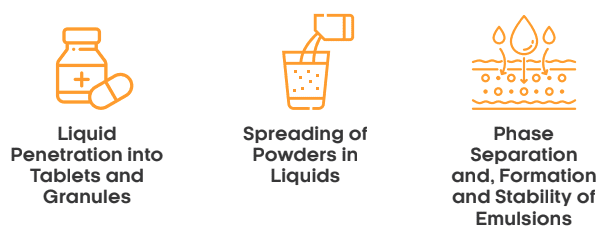
The pharmaceutical industry divides into major segments, including generic drugs, over-the-counter (OTC) medicines, bulk drugs, vaccines, contract research and manufacturing (CRO and CMO), biosimilars, and biologics. Characterizing pharmaceutical powders involves understanding surface properties, which play an important role in processes like liquid penetration into tablets and granules, the spreading of powders in liquids, phase separation, and the formation and stability of emulsions. Additionally, understanding processes such as adsorption, surface tension, and friction at phase interfaces is essential to achieving optimal conditions in pharmaceutics.


Pharmazeutisch

We use the following surface properties to understand the behavior of Pharmaceutical products and improve their quality.

Kapitel 2: Kontaktwinkelmessung

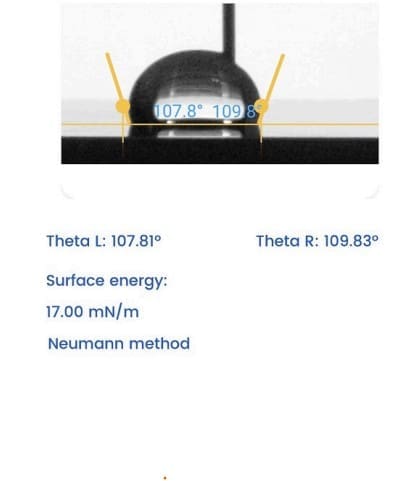
Der Kontaktwinkel quantifiziert die Benetzbarkeit einer Oberfläche, indem er den Winkel zwischen der Oberfläche einer Flüssigkeit und einer festen Oberfläche darstellt.
Dropletlab-Forschung

Sample Image taken from Droplet Lab Tensiometer.

Young – Laplace-Methode

Polynomiale Methode

Dynamischer Kontaktwinkel

Ideally, when we place a drop on a solid surface, a unique angle exists between the liquid and the solid surface. We can calculate the value of this ideal contact angle (the so-called Young’s contact angle) using Young’s equation. In practice, due to surface geometry, roughness, heterogeneity, contamination, and deformation, the contact angle value on a surface is not necessarily a single consistent value but rather falls within a range. The upper and lower limits of this range are known as the advancing and receding contact angles, respectively. The values of advancing and receding contact angles for a solid surface are highly sensitive to many parameters, such as temperature, humidity, homogeneity, and minor contamination of the surface and liquid. For example, the advancing and receding contact angles of a surface can differ at different locations.

Dynamischer Kontaktwinkel versus statischer Kontaktwinkel

Praktische Oberflächen und Beschichtungen weisen von Natur aus eine Kontaktwinkelhysterese auf, die auf eine Reihe von Gleichgewichtswerten hinweist. Wenn wir statische Kontaktwinkel messen, erhalten wir einen einzigen Wert innerhalb dieses Bereichs. Sich ausschließlich auf statische Messungen zu verlassen, wirft Probleme auf, wie z. B. schlechte Wiederholgenauigkeit und unvollständige Oberflächenbewertung in Bezug auf Haftung, Sauberkeit, Rauheit und Homogenität.

In practical applications, we need to understand how easily a liquid spreads (advancing angle) and how easily it is removed (receding angle), such as in painting and cleaning. Measuring advancing and receding angles offers a holistic view of liquid-solid interaction, unlike static measurements, which yield an arbitrary value within the range.

Diese Erkenntnisse sind entscheidend für reale Oberflächen mit Variationen, Rauheit und Dynamik und helfen Branchen wie Kosmetik, Materialwissenschaft und Biotechnologie bei der Gestaltung effektiver Oberflächen und der Optimierung von Prozessen.

Erfahren Sie, wie die Kontaktwinkelmessung mit unserem Tensiometer durchgeführt wird

Für ein vollständigeres Verständnis der Kontaktwinkelmessung lesen Sie unsere Kontaktwinkelmessung: Der endgültige Leitfaden

Open Benchmark Data: Contact Angle & Surface Energy

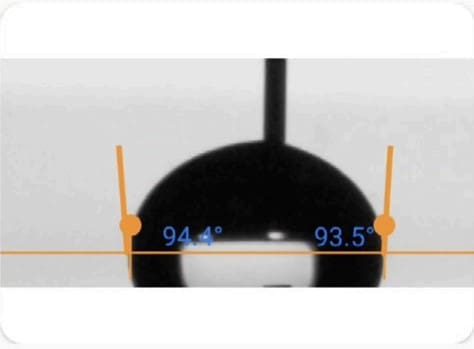
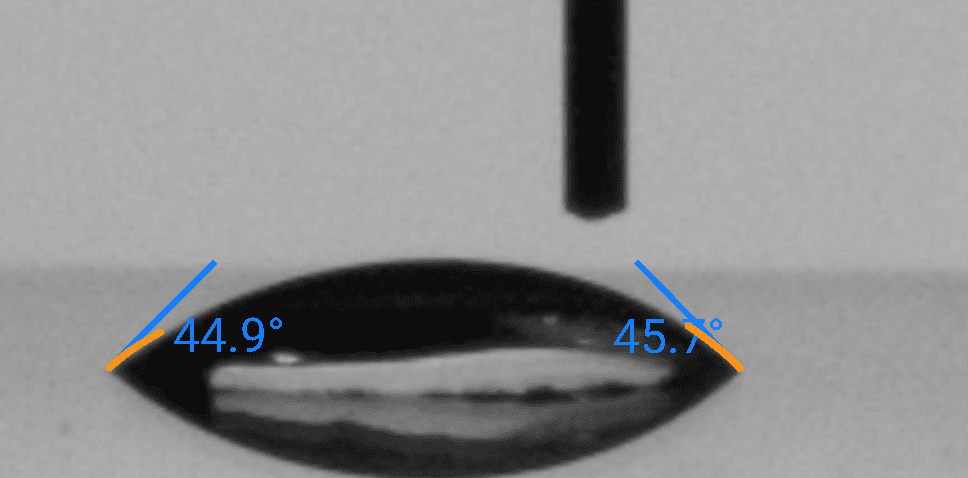
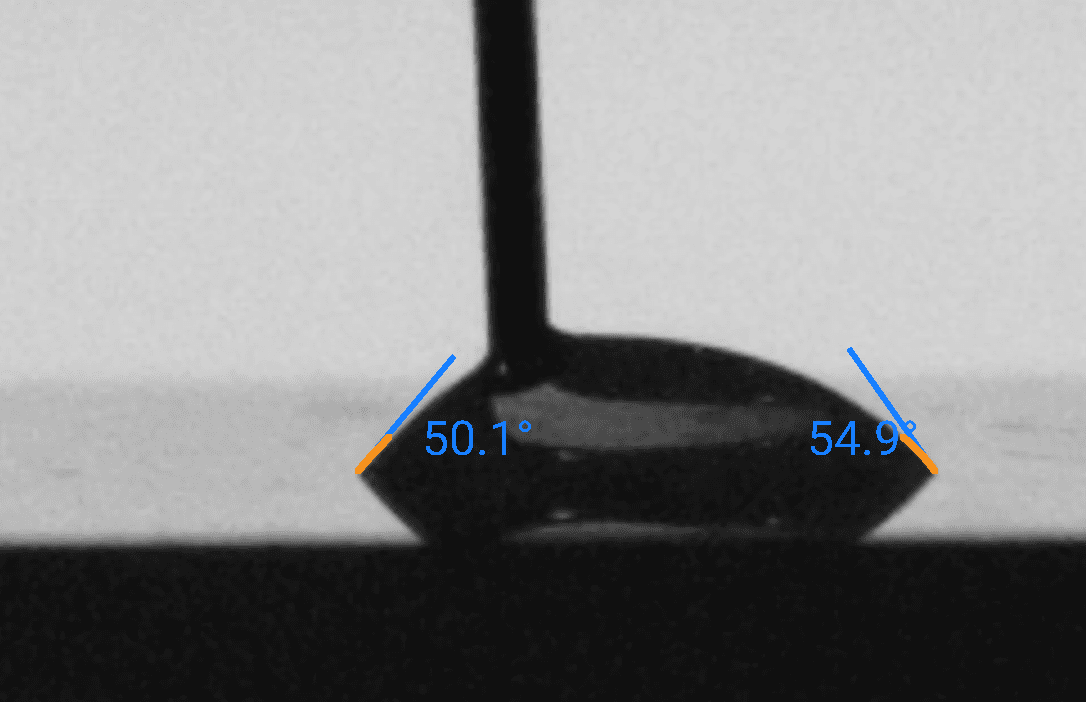
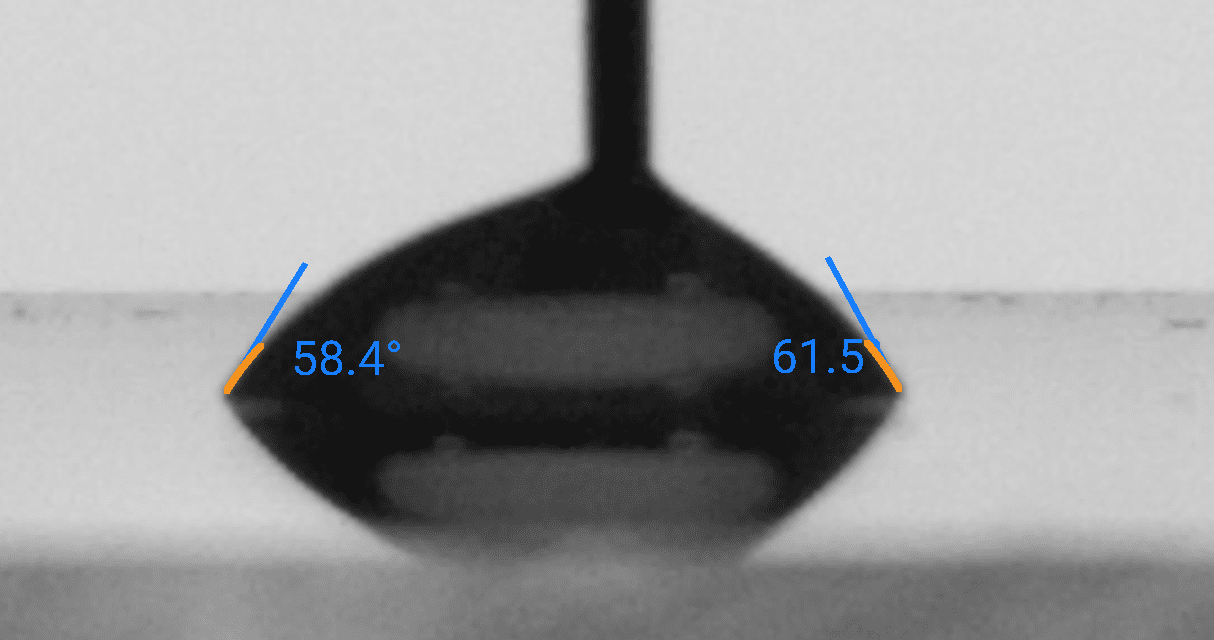
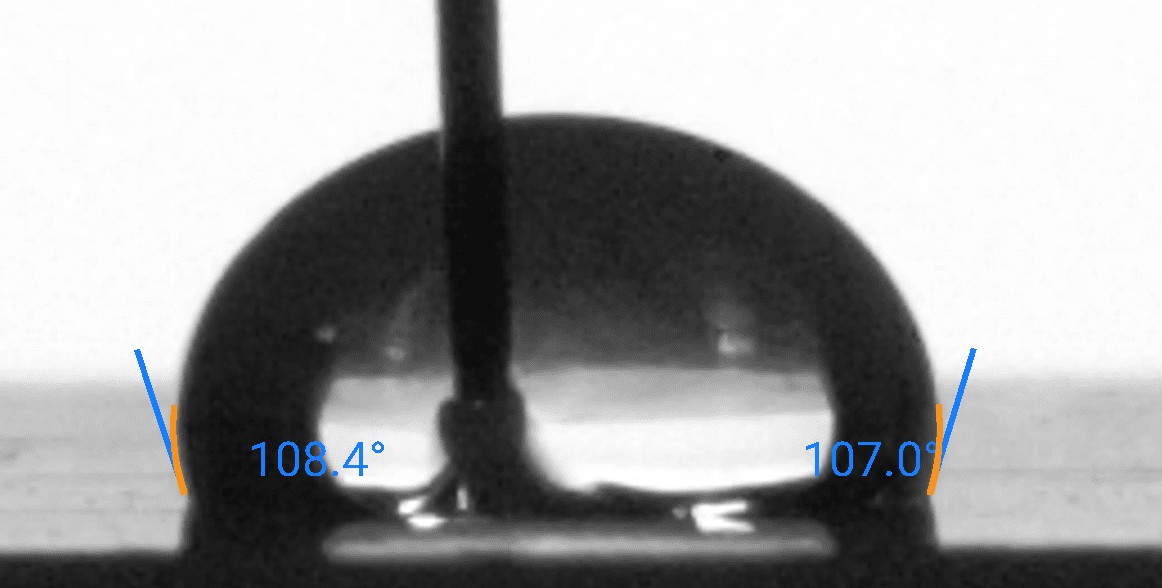
These reference measurements show how deionized water wets four standard substrates measured with the Droplet Lab Dropometer. Use them as visual and numerical benchmarks when you're checking your own sample preparation, treatments, and chemistry.

Full contact angle and surface energy datasets (including additional liquids and statistics) are available on our dataset hub.

Glass - DI Water
Glass - DI Water
Nylon - DI Water
Nylon - DI Water
PMMA - DI Water
PMMA - DI Water
Teflon - DI Water
Teflon - DI Water

The droplet images above are taken from the same benchmark series as our open dataset. For each substrate and probe liquid we report:

● Advancing and receding contact angles (and hysteresis)
● Derived surface energy (SFE) values based on multi-liquid measurements
● Measurement conditions, uncertainties, and sample preparation details

Comparing your own droplet shapes and angles against these references is a fast way to spot contamination, treatment drift, or unexpected changes in wettability.

Kapitel 3: Messung der Oberflächenspannung

Diese Eigenschaft misst die Kraft, die auf die Oberfläche einer Flüssigkeit wirkt, mit dem Ziel, ihre Oberfläche zu minimieren.

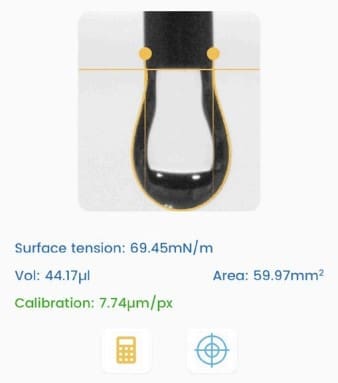
Messung der Oberflächenspannung

Sample Image taken from Droplet Lab Tensiometer

Dynamische Oberflächenspannung

Die dynamische Oberflächenspannung unterscheidet sich von der statischen Oberflächenspannung, die sich auf die Oberflächenenergie pro Flächeneinheit (oder die Kraft, die pro Längeneinheit entlang des Randes einer flüssigen Oberfläche wirkt) bezieht.

Die statische Oberflächenspannung charakterisiert den Gleichgewichtszustand der Grenzfläche von Flüssigkeiten, während die dynamische Oberflächenspannung die Kinetik von Änderungen an der Grenzfläche berücksichtigt. Diese Veränderungen können das Vorhandensein von Tensiden, Additiven oder Schwankungen in Temperatur, Druck und Zusammensetzung an der Grenzfläche beinhalten.

Wann sollte die dynamische Oberflächenspannungsmessung verwendet werden?

Dynamic surface tension is essential for processes that involve rapid changes at the liquid-gas or liquid-liquid interface, such as droplet and bubble formation, coalescence (change in surface area), the behavior of foams, and the drying of paints (change in composition, e.g., evaporation of solvent). It is measured by analyzing the shape of a hanging droplet over time.

Die dynamische Oberflächenspannung gilt für verschiedene Branchen, darunter Kosmetika, Beschichtungen, Pharmazeutika, Farben, Lebensmittel und Getränke sowie industrielle Prozesse, in denen das Verständnis und die Kontrolle des Verhaltens von Flüssigkeitsgrenzflächen für die Produktqualität und Prozesseffizienz unerlässlich ist.

Erfahren Sie, wie die Messung der Oberflächenspannung mit unserem Tensiometer durchgeführt wird

Für ein vollständigeres Verständnis der Oberflächenenergiemessung lesen Sie unsere Oberflächenspannungsmessung: Der endgültige Leitfaden

Kapitel 4: Messung der Oberflächenenergie

Die Oberflächenenergie bezieht sich auf die Energie, die erforderlich ist, um eine Flächeneinheit einer neuen Oberfläche zu erzeugen.
231

Sample Image taken from Droplet Lab Tensiometer

Erfahren Sie, wie die Messung der Oberflächenenergie mit unserem Tensiometer durchgeführt wird

Für ein umfassenderes Verständnis der Oberflächenenergiemessung lesen Sie unsere Oberflächenenergiemessung: Der ultimative Leitfaden

For benchmark contact angle and surface energy values on glass, nylon, PMMA, and Teflon, see the Open Benchmark Data panel above or visit our Dataset Hub for full CSV downloads.

Kapitel 5: Gleitwinkelmessung

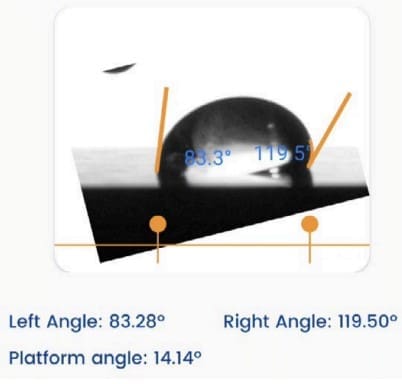
Der Gleitwinkel misst den Winkel, in dem ein flüssiger Film über eine feste Oberfläche gleitet. Es wird häufig verwendet, um die Rutschhemmung einer Oberfläche zu beurteilen.

Gleitwinkel 1

Sample Image taken from Droplet Lab Tensiometer

Erfahren Sie, wie die Gleitwinkelmessung mit unserem Tensiometer durchgeführt wird

Für ein umfassenderes Verständnis der Gleitwinkelmessung lesen Sie unsere Gleitwinkelmessung: Der endgültige Leitfaden

Kapitel 6: Anwendungen in der Praxis

Within the Pharmaceutical industry, several case studies exemplify the advantages of conducting surface property measurements.

Pendant-Drop Interfacial Tension as a Formulation Screen for Scalable Lipid Vesicle Drug-Delivery Systems

The paper addresses a common pharmaceutical delivery challenge: therapeutic cargos vary widely, and delivery systems often require tuning to achieve robust performance. The authors present nanoscale lipid vesicles engineered with asymmetric leaflet composition and demonstrate that these vesicles can support delivery of nucleic-acid and protein payload classes in cellular models. A key formulation insight is established by linking interfacial properties of lipid-in-oil systems to vesicle formation outcomes, positioning interfacial tension as a measurable handle relevant to formulation selection and manufacturing robustness.

Role of the Droplet Lab Goniometer

Droplet Lab is used for pendant-drop tensiometry to quantify mineral oil / aqueous PBS interfacial tension for different lipid-containing oil formulations. These values are then interpreted against vesicle formation yield trends, making the Droplet Lab measurement a formulation-screening metric rather than a purely descriptive material property.

What this enables for pharma teams:

  • Objective comparison of lipid formulation “interfacial activity” (how strongly a lipid reduces oil/water interfacial tension)

A quantitative bridge from physicochemical measurement → process outcome (yield), supporting earlier-stage down-selection and comparability thinking.


Key Findings

  • Interfacial tension differs strongly across lipid chemistries in the oil/buffer system (Fig. 3c), demonstrating meaningful separation between candidates by a single quantitative metric.
  • The study reports a correlation between lower interfacial tension and higher vesicle yield, implying interfacial tension can act as an early indicator of formation efficiency.
  • Reported interfacial-tension values span a broad range (e.g., ~61.5 ± 3.5 mN/m for one lipid condition vs markedly lower values for others), providing a practical “screening window” for formulation differentiation.
  • Yield is assessed via fluorescence-linked quantification and is shown to vary substantially by lipid selection, reinforcing the need for formulation screening metrics beyond composition alone.

Why It Matters

In pharmaceutical development, delivery platforms succeed or fail not only on biological performance but on manufacturability, reproducibility, and change control. This paper highlights interfacial tension (measured by pendant drop) as a pragmatic, fast, and quantitative formulation attribute that correlates with formation yield—making it useful for formulation down-selection, comparability assessments, and QC-oriented specifications tied to interface-driven process behavior rather than trial-and-error alone.

Method Snapshot

Measurement mode: pendant-drop tensiometry (Droplet Lab) at an oil–aqueous buffer interface, with interfacial tension obtained by Young–Laplace shape fitting. Temperature is not explicitly stated in the pendant-drop description.

Data Note

Figure 3c: shows the interfacial tension results for water/mineral-oil systems with different lipids (caption notes Mean ± SD, n=3), providing the paper’s core Droplet Lab measurement dataset used to support the yield correlation.

Figure

Citation (APA Format)

Yang, C., Menge, J., Zhvania, N., Yu, M., Yang, H., Chen, D., Zheng, Z., Weitz, D. A., & Jahnke, K. (2025). Engineering asymmetric nanoscale vesicles for mRNA and protein delivery to cells. Advanced Functional Materials, 35, 2505738. https://doi.org/10.1002/adfm.202505738

View Publication →

Developing a New Oral Drug Formulation

Consider a scenario where a pharmaceutical company develops a new oral drug formulation. The drug's success depends on its ability to dissolve quickly and be absorbed by the body. By measuring the wetting angle of the drug solution on various excipient surfaces, such as the tablet matrix and coating materials, the company can identify which materials promote optimal wetting and dissolution. A lower contact angle indicates better wetting and faster dissolution, leading to improved bioavailability and therapeutic efficacy.

Developing a New Oral Drug Formulation

Preventing Contamination in Manufacturing

In pharmaceutical manufacturing, ensuring the cleanliness of equipment surfaces is crucial to preventing contamination and maintaining product quality. By measuring the sliding angle of liquids used in manufacturing, the company can identify surfaces that are less likely to allow liquids to adhere. This helps design equipment surfaces that are easy to clean and resistant to liquid adhesion, reducing the risk of cross-contamination and ensuring the production of safe and consistent pharmaceutical products.

Preventing Contamination in Manufacturing

Compatibility in Drug Delivery Systems

Consider a pharmaceutical company developing a transdermal patch for efficient drug delivery. The patch consists of a drug reservoir and an adhesive layer, both essential for optimal drug release and secure skin adhesion. However, the company discovered a discrepancy in the surface energies of these two materials. This insight prompted further investigation into potential causes, such as poor drug adhesion or inconsistent drug delivery. The company meticulously measured the surface energy of both the drug reservoir and the adhesive material, ensuring that these components have matching surface energies for proper bonding and consistent drug release.

Compatibility in Drug Delivery Systems

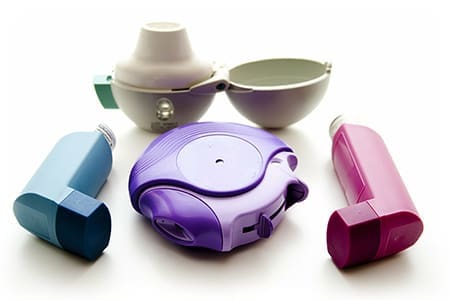
Optimierung inhalierbarer Medikamente

Stellen Sie sich ein Pharmaunternehmen vor, das inhalierbare Medikamente gegen Atemwegserkrankungen entwickelt. Die Wirksamkeit dieser Medikamente hängt von der Produktion von Aerosoltröpfchen in einer präzisen Größe ab, um die Lunge effektiv zu erreichen. Durch die Messung der Oberflächenspannung der im Aerosol verwendeten flüssigen Formulierung kann das Unternehmen die Sprüheigenschaften optimieren, um die gewünschte Tröpfchengröße und Gleichmäßigkeit zu erreichen. Dieser Prozess stellt sicher, dass das Medikament direkt an die Zielstelle in der Lunge abgegeben wird, wodurch seine therapeutische Wirkung maximiert wird.

Optimierung inhalierbarer Medikamente

Wir sind Ihre Partner bei der Lösung Ihrer geschäftlichen und technologischen Probleme herausforderungen

Wenn Sie an der Implementierung dieser oder anderer Anwendungen interessiert sind, kontaktieren Sie uns bitte.

Kapitel 7: Normen und Richtlinien

In an industry where precision reigns supreme, how can Pharmaceutical manufacturers ensure their products withstand scrutiny? The answer lies in standards and guidelines: the compass that guides them through the complex maze of quality and performance.

USP ⟨1243⟩ — Wetting Properties of Pharmaceutical Systems (Proposed General Chapter; PF 49(5))

What it is

A proposed USP general chapter that provides a standardized framework for characterizing wetting-related properties of pharmaceutical systems—most commonly through contact angle–based wettability assessment (solids) and surface/interfacial tension measurement techniques (liquids), along with discussion of influencing factors and related concepts (e.g., surface free energy).

When to use it

Formulation development / optimization

Compare excipient or surfactant options using contact angle and/or γ–log C behavior.

Tech transfer

Replace “looks OK” assessments with numeric, operator-comparable wetting metrics (defined timestamp for θ; defined temperature for γ).

Manufacturing / investigations

When you see batch-to-batch drift in disintegration/dissolution or coating appearance/uniformity and suspect wetting-related causes.

QC trending

Establish baseline and monitor drift in solid-side wettability and liquid-side spreading capability over time.

In-scope / Out-of-scope

In scope
  • Solids Wettability characterization via contact angle (with explicit definition of when the angle is read). Optional use of advancing/receding angles only when repeatable on the substrate.
  • Liquids Surface tension and (when relevant) interfacial tension measurement techniques and factors influencing results.
  • Method context Recognizing/controlling factors that influence measurements (surface heterogeneity, porosity/absorption, temperature, etc.).
Out of scope
  • Universal numeric limits (e.g., “θ must be < X° for all tablets”) — wetting targets must be product-/family-calibrated against performance outcomes.
  • Replacing compendial performance tests Wetting data supports understanding and control; it does not replace dissolution/disintegration or coating quality requirements.
  • Forcing unstable metrics If receding angle/hysteresis is not repeatable on rough/porous surfaces, don’t treat it as mandatory evidence.
  • Data-system compliance by default Instrument outputs are only “GMP records” when integrated under your site’s validated controls and procedures.

Minimum you must report (checklist)

  • Sample + context: sample ID (lot/product family), sample type (tablet/compact/coating vs solution/media), and any conditioning/handling (e.g., equilibration) plus the measurement map (faces/regions).
  • Test conditions: temperature (and RH if relevant) at time of test.
  • Traceability: instrument + software version, analysis model/fit method, and operator/SOP identifier.
  • Replicates + stats: n for each metric and the statistic you standardize on (e.g., median + IQR or mean + SD).
  • Solids (contact angle): probe liquid + droplet volume, θ @ fixed timestamp (and any secondary timepoint), spot-to-spot variability (IQR/SD), optional Δθ(t1→t2), and optional θₐ/θᵣ/hysteresis only if repeatable.
  • Liquids (surface/interfacial tension): method geometry (e.g., pendant drop), temperature setpoint, density inputs (and source), γ/IFT result (n + stats), pendant-drop fit/QC acceptance criteria; if reporting CMC, include concentration-series design and breakpoint/estimation method.
  • Data integrity: explicit reject/re-run rules (e.g., failed fit QC, unstable baseline/edge, absorption collapse before timestamp) and system suitability controls (reference tablet + reference liquid with run frequency and acceptance/trending limits).

Dropometer supports wetting characterization aligned with USP ⟨1243⟩ by producing standardized, timestamped θ (solids) and γ/IFT (liquids) with settings captured per run. Whether those records are GMP/audit-ready depends on your site’s validated systems, SOPs, and controls.

How to interpret results (guardrails)

  • Never compare solid θ without matching timestamp + conditioning; porous/absorbing surfaces can change rapidly, so fixed-time θ (and/or Δθ) is the defensible basis.
  • Use median θ @ t plus variability (IQR/SD) to separate “surface wettability shift” from “surface heterogeneity shift,” then confirm significance against your product-family correlation to outcomes.
  • Treat θₐ/θᵣ/hysteresis as optional diagnostics only when the substrate yields stable, repeatable values, don’t force it on rough/absorbing tablets.
  • Interpret γ/IFT primarily as a controlled trend metric (same temperature, same formulation window), and only trust changes when pendant-drop fit QC and inputs (temperature/density) are under control.

Jetzt sind Sie an der Reihe

We hope this guide showed you how to apply surface science in the Pharmaceutical industry.

Nun möchten wir das Wort an Sie übergeben:

Feel free to leave a comment below—we’d love to hear from you.

Hinterlasse eine Antwort

Deine E-Mail-Adresse wird nicht veröffentlicht. Pflichtfelder sind markiert *


Experiment herunterladen