This is a practical guide to Surface Science for researchers working in the Transportation Industry.
In diesem brandneuen Leitfaden erfährst du alles über:
Lassen Sie uns gleich eintauchen.
The transportation industry boasts a diverse range of service providers, encompassing air, road, rail, and sea transport. It extends beyond just movement, also including warehousing, handling, stevedoring, and value-added services like packaging, labeling, and assembly. Optimizing surface characteristics according to the specific needs of each service plays a crucial role in all these areas, ultimately enhancing overall efficiency.
We use the following surface properties to understand the behavior of Transportation products and improve their quality.
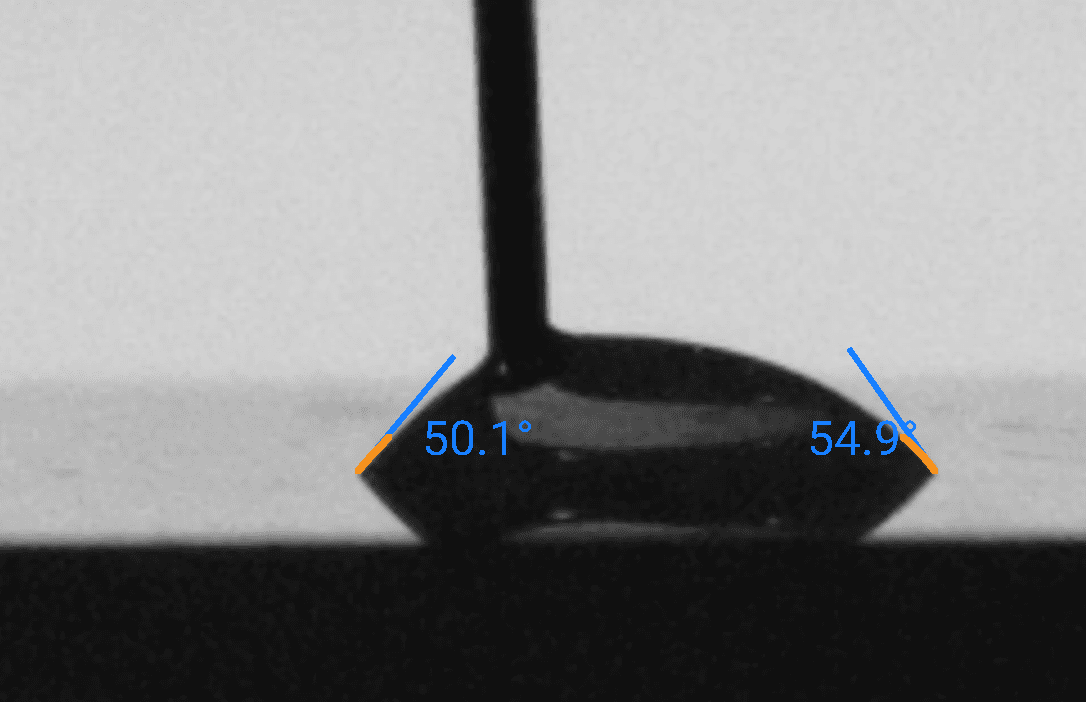
Sample Image taken from Droplet Lab Tensiometer.
Young – Laplace-Methode
Polynomiale Methode
Ideally, when we place a drop on a solid surface, a unique angle exists between the liquid and the solid surface. We can calculate the value of this ideal contact angle (the so-called Young’s contact angle) using Young’s equation. In practice, due to surface geometry, roughness, heterogeneity, contamination, and deformation, the contact angle value on a surface is not necessarily a single consistent value but rather falls within a range. The upper and lower limits of this range are known as the advancing and receding contact angles, respectively. The values of advancing and receding contact angles for a solid surface are highly sensitive to many parameters, such as temperature, humidity, homogeneity, and minor contamination of the surface and liquid. For example, the advancing and receding contact angles of a surface can differ at different locations.
Praktische Oberflächen und Beschichtungen weisen von Natur aus eine Kontaktwinkelhysterese auf, die auf eine Reihe von Gleichgewichtswerten hinweist. Wenn wir statische Kontaktwinkel messen, erhalten wir einen einzigen Wert innerhalb dieses Bereichs. Sich ausschließlich auf statische Messungen zu verlassen, wirft Probleme auf, wie z. B. schlechte Wiederholgenauigkeit und unvollständige Oberflächenbewertung in Bezug auf Haftung, Sauberkeit, Rauheit und Homogenität.
In practical applications, we need to understand how easily a liquid spreads (advancing angle) and how easily it is removed (receding angle), such as in painting and cleaning. Measuring advancing and receding angles offers a holistic view of liquid-solid interaction, unlike static measurements, which yield an arbitrary value within the range.
Diese Erkenntnisse sind entscheidend für reale Oberflächen mit Variationen, Rauheit und Dynamik und helfen Branchen wie Kosmetik, Materialwissenschaft und Biotechnologie bei der Gestaltung effektiver Oberflächen und der Optimierung von Prozessen.
Erfahren Sie, wie die Kontaktwinkelmessung mit unserem Tensiometer durchgeführt wird
Für ein vollständigeres Verständnis der Kontaktwinkelmessung lesen Sie unsere Kontaktwinkelmessung: Der endgültige Leitfaden
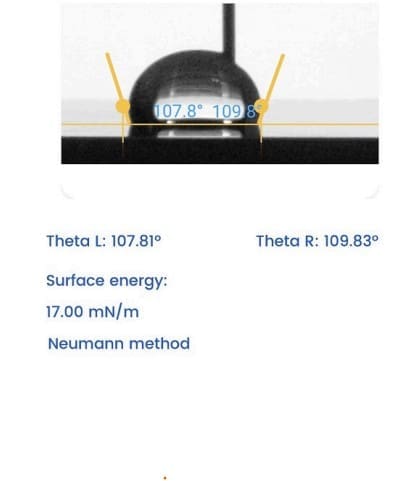
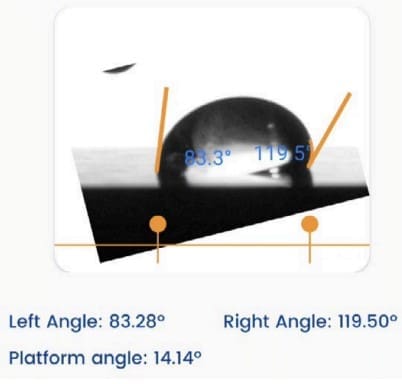
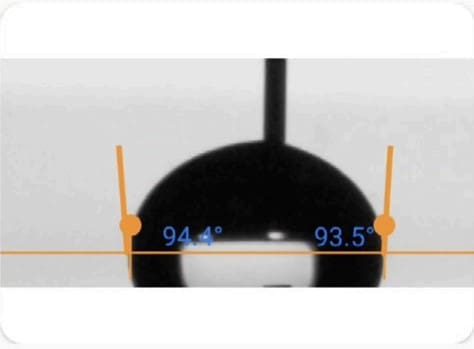
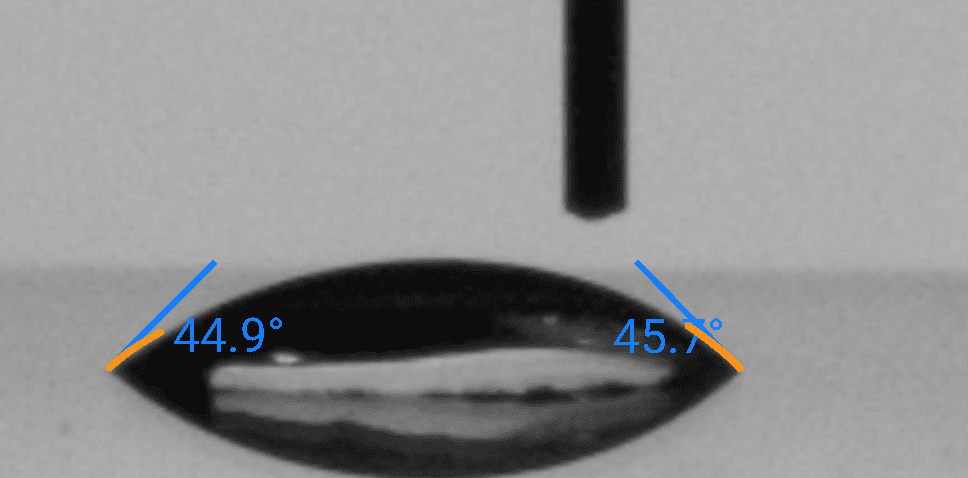
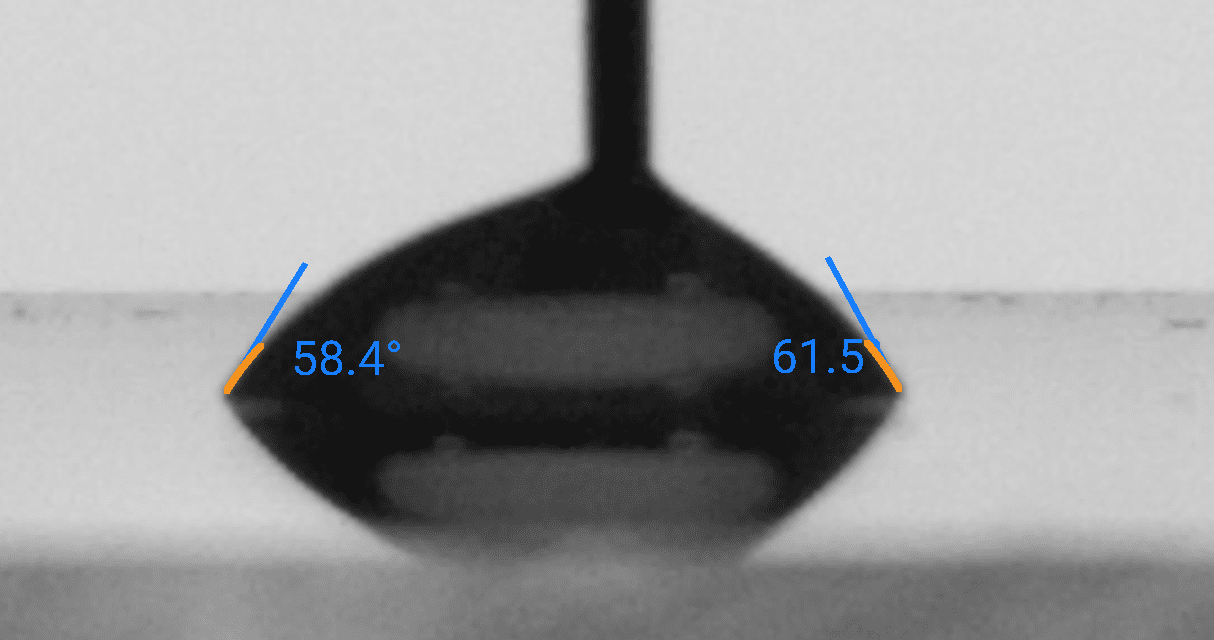
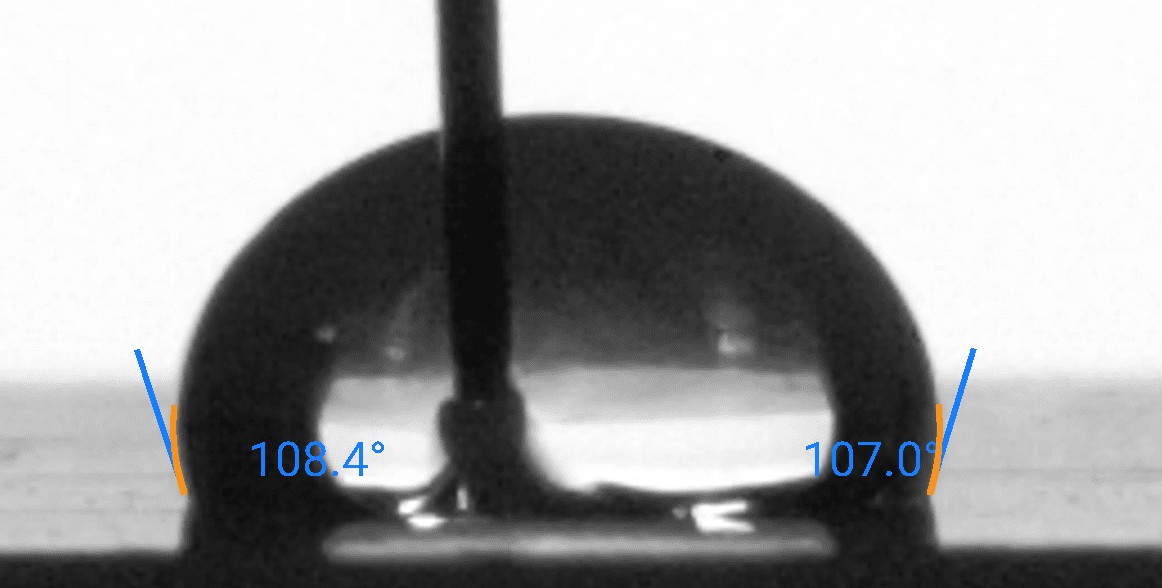
These reference measurements show how deionized water wets four standard substrates measured with the Droplet Lab Dropometer. Use them as visual and numerical benchmarks when you're checking your own sample preparation, treatments, and chemistry.
Full contact angle and surface energy datasets (including additional liquids and statistics) are available on our dataset hub.
The droplet images above are taken from the same benchmark series as our open dataset. For each substrate and probe liquid we report:
● Advancing and receding contact angles (and hysteresis)
● Derived surface energy (SFE) values based on multi-liquid measurements
● Measurement conditions, uncertainties, and sample preparation details
Comparing your own droplet shapes and angles against these references is a fast way to spot contamination, treatment drift, or unexpected changes in wettability.
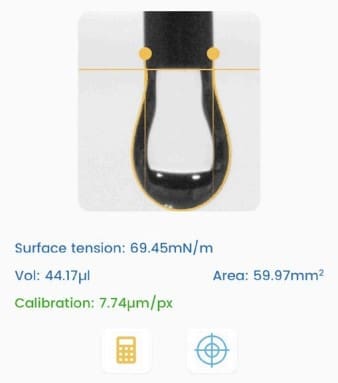
Measurements were performed with the Droplet Lab Dropometer under controlled laboratory conditions. Treat these values as sanity checks and starting points for your own process targets, not as product specifications.
Diese Eigenschaft misst die Kraft, die auf die Oberfläche einer Flüssigkeit wirkt, mit dem Ziel, ihre Oberfläche zu minimieren.
Sample Image taken from Droplet Lab Tensiometer
Dynamische Oberflächenspannung
Die dynamische Oberflächenspannung unterscheidet sich von der statischen Oberflächenspannung, die sich auf die Oberflächenenergie pro Flächeneinheit (oder die Kraft, die pro Längeneinheit entlang des Randes einer flüssigen Oberfläche wirkt) bezieht.
Die statische Oberflächenspannung charakterisiert den Gleichgewichtszustand der Grenzfläche von Flüssigkeiten, während die dynamische Oberflächenspannung die Kinetik von Änderungen an der Grenzfläche berücksichtigt. Diese Veränderungen können das Vorhandensein von Tensiden, Additiven oder Schwankungen in Temperatur, Druck und Zusammensetzung an der Grenzfläche beinhalten.
Wann sollte die dynamische Oberflächenspannungsmessung verwendet werden?
Dynamic surface tension is essential for processes that involve rapid changes at the liquid-gas or liquid-liquid interface, such as droplet and bubble formation, coalescence (change in surface area), the behavior of foams, and the drying of paints (change in composition, e.g., evaporation of solvent). It is measured by analyzing the shape of a hanging droplet over time.
Die dynamische Oberflächenspannung gilt für verschiedene Branchen, darunter Kosmetika, Beschichtungen, Pharmazeutika, Farben, Lebensmittel und Getränke sowie industrielle Prozesse, in denen das Verständnis und die Kontrolle des Verhaltens von Flüssigkeitsgrenzflächen für die Produktqualität und Prozesseffizienz unerlässlich ist.
Erfahren Sie, wie die Messung der Oberflächenspannung mit unserem Tensiometer durchgeführt wird
Für ein vollständigeres Verständnis der Oberflächenenergiemessung lesen Sie unsere Oberflächenspannungsmessung: Der endgültige Leitfaden
Sample Image taken from Droplet Lab Tensiometer
Erfahren Sie, wie die Messung der Oberflächenenergie mit unserem Tensiometer durchgeführt wird
Für ein umfassenderes Verständnis der Oberflächenenergiemessung lesen Sie unsere Oberflächenenergiemessung: Der ultimative Leitfaden
For benchmark contact angle and surface energy values on glass, nylon, PMMA, and Teflon, see the Open Benchmark Data panel above or visit our Dataset Hub for full CSV downloads.
Der Gleitwinkel misst den Winkel, in dem ein flüssiger Film über eine feste Oberfläche gleitet. Es wird häufig verwendet, um die Rutschhemmung einer Oberfläche zu beurteilen.
Sample Image taken from Droplet Lab Tensiometer
Erfahren Sie, wie die Gleitwinkelmessung mit unserem Tensiometer durchgeführt wird
Für ein umfassenderes Verständnis der Gleitwinkelmessung lesen Sie unsere Gleitwinkelmessung: Der endgültige Leitfaden
Within the Transportation industry, several case studies exemplify the advantages of conducting surface property measurements.
To combat the dangerous threat of ice buildup on aircraft wings, coatings are being developed with a dual purpose: anti-icing and de-icing. These coatings must effectively repel water droplets, prevent ice formation from both vapor and liquid states, and most importantly, significantly reduce ice adhesion once it forms. Measuring the contact angle and sliding angle becomes crucial in evaluating the effectiveness of superhydrophobic coatings for de-icing. By designing ice-phobic coatings with a low sliding angle, we can prevent ice from sticking and facilitate its easy removal, ultimately saving time and resources during deicing procedures.

Despite their excellent mechanical and thermal properties, titanium alloys used in aerospace and automotive transportation suffer from low adhesion and corrosion. To address this challenge, we can create low-wetting surfaces on the alloy substrate. Anodization, for example, can be used on Ti6Al4V alloy to achieve a remarkable water contact angle of 158° and a sliding angle of 5.3°, creating a highly anti-adhesive surface. Alternatively, a combination of sandblasting and a hydrothermal method can be employed to prepare micro–nanoscale hierarchical structures on Ti6Al4V alloys. This method further improves the water contact angle to 161° and the sliding angle to a mere 3°, significantly enhancing the anti-adhesive properties.

Wenn Sie an der Implementierung dieser oder anderer Anwendungen interessiert sind, kontaktieren Sie uns bitte.
In an industry where precision reigns supreme, how can Transportation manufacturers ensure their products withstand scrutiny? The answer lies in standards and guidelines: the compass that guides them through the complex maze of quality and performance.
ISO 19403-6 specifies an optical sessile-drop method to measure dynamic advancing (θₐ) and dynamic receding (θᵣ) contact angles by increasing and decreasing droplet volume. It’s used to quantify wetting/dewetting behavior and contact-angle hysteresis (Δθ = θₐ − θᵣ) to help diagnose surface heterogeneity, contamination, or pretreatment drift on coated panels and substrates.
Use dynamic θₐ/θᵣ (not just static angle) when you need early indication that surfaces will wet and resist dewetting before applying transportation coatings, adhesives, or sealants.
Use θₐ/θᵣ/Δθ trends and variability to separate likely chemistry/contamination drift from texture/heterogeneity/pinning effects when defects (e.g., fisheyes/craters, adhesion loss) start rising.
Dynamic contact angles are method-dependent, so your SOP must lock needle geometry, dosing rate, dwell, leveling, and fit/QC rules to keep trends comparable. If you see “ISO 19403-6:2023” internally, it commonly refers to a draft/DIS stage; the published ISO edition is 2024.
We hope this guide showed you how to apply surface science in the Transportation industry.
Nun möchten wir das Wort an Sie übergeben:
Feel free to leave a comment below—we’d love to hear from you.